
A coupon code looks harmless until it is tied to a customer account, a private promotion, or a high-value redemption. Then someone pastes it into a crowded channel, a link preview calls the merchant, and a supposedly limited offer starts circulating outside its intended audience.
Coupon codes and secure messaging intersect more often than teams expect. Customer support agents send replacement discounts. Marketing teams distribute embargoed promotions. Friends share referral links containing identifiers. Remote employees coordinate campaign launches across devices they do not fully control.
Teams think the problem is choosing an encrypted app. The real problem is controlling the full path from code creation to redemption, including endpoints, previews, retention, forwarding, and operational ownership. That changes the conversation from “Is this chat encrypted?” to “What information are we placing in chat, who can use it, and what happens after delivery?”
This guest contribution draws on the deal-sharing experience of the team at c0upons.com, adapted here for readers who care about practical communication privacy.
Table of contents
- Why coupon codes become a secure messaging problem
- Build a threat model before choosing a channel
- Choose the right channel for each coupon
- Design a secure coupon code workflow
- Protecting coupon codes in secure messaging
- What works and what fails
- Operational controls for teams
- Common failure modes and recovery
- Implementation blueprint for 2026
- Where qrypt.chat fits
Why coupon codes become a secure messaging problem
A discount can act like a bearer credential
Many public promotional codes are not sensitive. If a retailer prints AUTUMN10 on its homepage, encrypting that string adds little value. Anyone who sees it is supposed to use it.
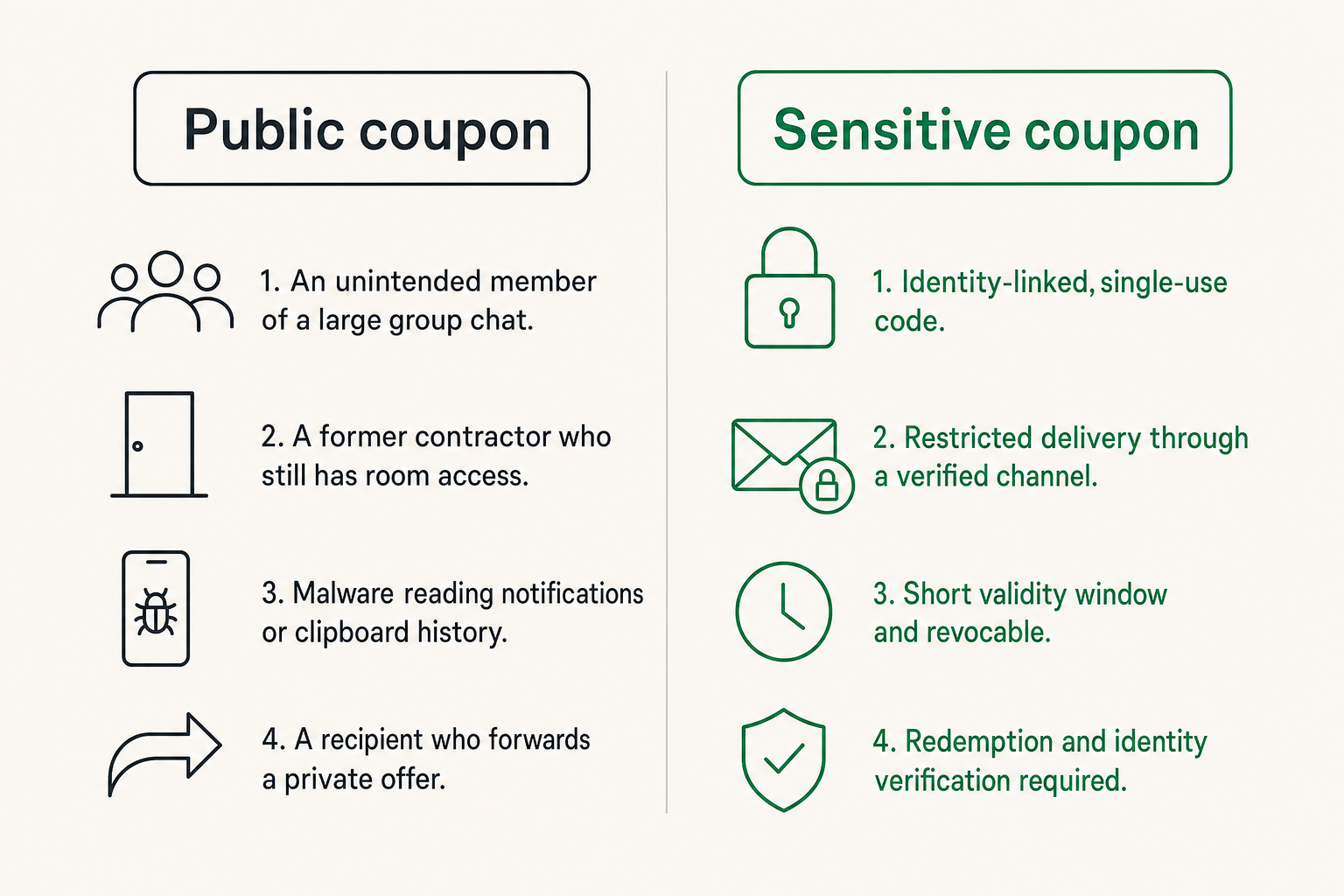
Other codes behave differently. A single-use customer recovery code, employee discount, partner allocation, private presale offer, or account-specific referral can transfer value to whoever possesses it. In practical terms, it behaves like a low-assurance bearer credential. The system may not verify that the redeemer is the intended recipient.
That does not make every coupon equivalent to a password. It does mean the handling decision should depend on impact rather than appearance. Ask what happens if the code is copied, indexed, forwarded, or redeemed first by someone else.
Practical rule: If possession is enough to claim the benefit, handle the coupon as a temporary credential rather than ordinary chat text.
The message contains more than the code
The mistake teams make is focusing on the alphanumeric token while ignoring its context. A coupon message might include:
- The recipient’s name, email address, or account number.
- A campaign name that has not been announced.
- A referral URL containing affiliate or customer identifiers.
- Eligibility rules that reveal employment, membership, or purchase history.
- Screenshots exposing order details, open browser tabs, or internal dashboards.
- A redemption deadline and merchant name that make phishing easier.
Even when message content is protected in transit, notification previews may display it on a lock screen. Screenshots may enter cloud photo backups. Clipboard managers may retain it. Browser previews may contact the destination before the user deliberately opens the link.
The secure object is therefore not just the code. It is the code, context, delivery channel, recipient device, and redemption path.
Build a threat model before choosing a channel
Identify the asset and likely abuse
A useful way to think about it is to classify the coupon along two axes: economic value and identity sensitivity. A public 10% code has low confidentiality requirements. A one-time reimbursement code associated with a complaint may reveal a customer relationship and carry direct value.
Consider realistic actors rather than abstract attackers:
- An unintended member of a large group chat.
- A former contractor who still has room access.
- Malware reading notifications or clipboard history.
- A recipient who forwards a private offer.
- An automated preview service requesting a unique URL.
- Someone with temporary access to an unlocked device.
Then identify the failure you care about: unauthorized redemption, campaign leakage, identity exposure, fraudulent resale, or loss of customer trust. Different failures require different controls.
Separate content privacy from metadata privacy
End-to-end encryption can protect message content between participating endpoints. It does not automatically erase every surrounding signal. Depending on the product and configuration, account identifiers, timestamps, group membership, IP-derived information, device notifications, or local message databases may remain relevant.
This distinction matters when a code is linked to a sensitive activity. The text of a pharmacy promotion may be encrypted while the conversation relationship still reveals useful context. A workplace channel name such as acquisition-launch can expose campaign intent even if individual messages are protected.
The practical question is not whether a product uses the word “encrypted.” Ask which data is encrypted, where keys exist, what the service can observe, how devices store content, and how deletion behaves across participants.
Decide what does not belong in chat
Some data should remain in the merchant or support system. Do not place full payment details, account recovery answers, identity documents, or password-reset credentials beside a coupon merely because the conversation is encrypted.
Chat should carry the minimum information required to complete the handoff. For a support case, that may be a single-use code, merchant domain, expiry time, and a non-sensitive case reference. The support platform can retain the full customer record under its existing access controls.
Practical rule: Encryption is not permission to combine data that should remain in separate systems.
Choose the right channel for each coupon
Match protection to coupon value
Not every promotion requires the same workflow. Overprotecting public codes creates friction and encourages workarounds. Underprotecting targeted codes creates preventable leakage.
| Coupon type | Typical risk | Appropriate delivery | Additional control |
|---|---|---|---|
| Public campaign code | Low | Public page or ordinary announcement | Confirm terms and expiry |
| Subscriber promotion | Moderate | Direct message or controlled mailing | Avoid exposing subscriber identity |
| Single-use support code | Moderate to high | Verified private conversation | Short expiry and case reference |
| Employee or partner code | High | Restricted encrypted room | Recipient scope and revocation |
| High-value private offer | High | Verified one-to-one channel | Single use, monitoring, rapid disablement |
This table is a starting point, not a universal rating. A low-percentage discount can still be sensitive if it reveals a person’s membership in a private organization. Conversely, a high public discount may require integrity and availability controls but little confidentiality.
Evaluate the entire messaging boundary
When reviewing a secure messaging channel, include:
- How participants verify one another.
- Whether groups expose complete and current membership.
- What happens when a member leaves.
- Whether messages sync to new devices.
- How notification previews are controlled.
- Whether link previews can be disabled.
- How long local copies remain.
- Whether forwarding, exporting, bots, or integrations widen access.
- How account and device recovery work.
What breaks in practice is usually at the edge. A team selects strong encryption, then connects a logging bot that copies messages elsewhere. A private group remains accessible to a vendor after the contract ends. An agent pastes codes into personal notes so they can switch devices.
The channel decision must account for those operational paths, not just the cryptographic protocol.
Design a secure coupon code workflow
Use a controlled delivery sequence
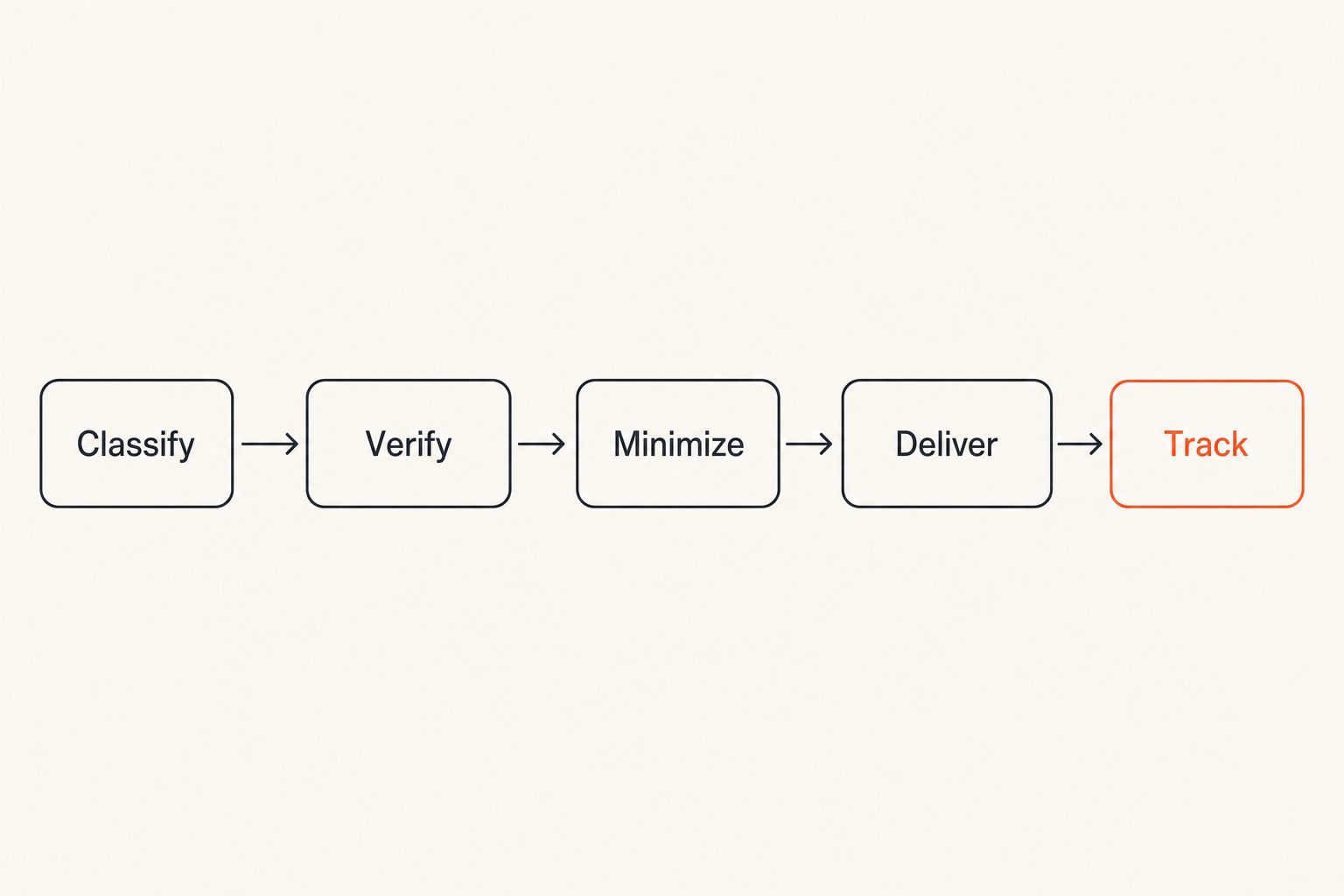
A reliable workflow can be implemented without making every code transfer a ceremony:
- Classify the coupon. Determine whether it is public, targeted, single-use, identity-linked, or high value.
- Verify the destination. Confirm the person or team and inspect group membership before sending.
- Minimize the payload. Include only the code, official merchant domain, expiry, and necessary conditions.
- Deliver through the appropriate channel. Use a private, encrypted conversation for restricted codes.
- Confirm receipt without repeating the secret. The recipient can acknowledge using a case or campaign reference.
- Monitor redemption state. Mark single-use codes as issued, redeemed, expired, or revoked in the system of record.
- Remove unnecessary copies. Apply retention policy to chats, tickets, exports, screenshots, and temporary notes.
This sequence treats messaging as transport. The coupon platform or merchant system remains authoritative for validity and redemption.
Send context without oversharing
A concise restricted-code message might look like this:
Reference: CASE-1842
Code: [single-use code]
Use at: merchant.example
Expires: 2026-10-07 18:00 UTC
Conditions: one redemption; eligible items only
The message does not need the customer’s address, purchase history, complete ticket transcript, or reason for compensation. If the recipient already knows the merchant, even the domain may be unnecessary.
Avoid sending a screenshot when text will do. Screenshots frequently expose extra interface content, carry metadata, resist structured redaction, and end up in photo backups. If a visual is necessary, crop it deliberately and inspect every visible area before sending.
Handle acknowledgements carefully
Teams often duplicate sensitive data during confirmation. One person sends a code, and the recipient replies by quoting the entire message. A manager then forwards both messages into an operations room. One secret has become several retained copies.
Use a non-sensitive reference for acknowledgement: “Received CASE-1842.” For high-value campaigns, confirmation should establish delivery, not repeat the token. Redemption status should come from the merchant system rather than a chat reply whenever possible.
Practical rule: Acknowledgement should confirm the handoff, not create another copy of the coupon.
Protecting coupon codes in secure messaging
Prefer scoped and short-lived codes
A secure messaging channel cannot compensate for an unrestricted promotion. Code design remains the strongest control. When the commerce platform supports it, use:
- Single-use or low-redemption limits.
- Short, explicit validity windows.
- Product, region, account, or minimum-order constraints.
- Maximum discount values rather than unlimited percentages.
- Server-side redemption checks.
- A revocation mechanism available to operations staff.
- Non-sequential, sufficiently unpredictable values for private codes.
Do not encode obvious customer data in the token. A code such as SMITH-1988-50 leaks information and may be guessable. The code should be an opaque reference whose rules are enforced server-side.
Rate limits also matter. Attackers should not be able to test large numbers of candidate codes rapidly. Redemption endpoints should detect repeated invalid attempts without blocking legitimate customers after one typo.
Treat links as data-bearing objects
Referral and checkout links often contain more information than their visible label suggests. Query parameters may identify a customer, partner, campaign, cart, or session. URL shorteners can hide those parameters while adding another operator to the request path.
Before sending a link, inspect the complete destination. Remove optional analytics parameters where doing so does not break attribution or validation. Do not remove signed parameters blindly; changing them may invalidate the link or alter security properties.
Link previews deserve special attention. A preview service may request a URL to generate a title and image. If opening the URL consumes a one-time invitation, logs an event, or exposes a unique identifier, the preview itself can change system state. For sensitive links, disable previews or send the merchant domain and coupon separately.
Reduce endpoint exposure
Message confidentiality ends at a readable endpoint. Practical endpoint controls include a screen lock, current operating system, encrypted device storage, minimal notification content, controlled backups, and removal of old sessions.
For remote teams, define whether codes may be handled on personal devices. If they may, specify minimum requirements instead of assuming “bring your own device” transfers risk to the user. If they may not, enforce that decision through account access and managed devices rather than policy alone.
Clipboard history, accessibility services, browser extensions, and third-party keyboards can also observe copied text. High-value codes should not remain in clipboard managers indefinitely. Where possible, let users open a protected redemption flow rather than repeatedly copying a token between applications.
What works and what fails
Controls that work together
No single control solves the problem. Effective handling combines limited coupon authority with a private delivery path and clear operations.
| Approach | What works | What fails |
|---|---|---|
| Encryption | Protects content across the supported message path | Does not secure a compromised recipient device |
| Expiring messages | Reduces routine retention | Cannot retract screenshots or prior exports |
| Single-use codes | Limits repeated redemption | The wrong person can still redeem first |
| Account-bound offers | Narrows eligible users | Can increase identity linkage and support work |
| Restricted groups | Limits intended recipients | Stale membership quietly widens access |
| Audit records | Supports investigation and reconciliation | Excessive logs can recreate sensitive content |
The most resilient combination is usually an opaque, constrained code sent to a verified recipient through a private channel, with redemption state maintained outside chat.
Security theater that fails in production
The mistake teams make is adding visible friction without reducing authority or exposure. Examples include splitting a code across two messages in the same conversation, replacing one character with “the usual symbol,” or deleting a message immediately while leaving it in notifications and backups.
Sending half the code by email and half through chat provides limited protection if both accounts are open on the same compromised device. Password-protecting a document and sending the password beside it has the same weakness. These measures may obstruct accidental viewing, but they should not be treated as strong separation.
Another failure is using disappearing messages as an access-control system. Expiration can reduce retained copies; it cannot stop a recipient from recording information while authorized to view it. Use it as a retention control, not a promise that the message never existed.
Operational controls for teams
Assign ownership and access
Someone must own the coupon lifecycle. In a small organization, that may be one operations lead. In a larger environment, marketing can define campaign rules while support issues customer-specific codes and finance reconciles liabilities.
Ownership should answer:
- Who can create restricted codes?
- Who may send them?
- Who can increase value or expiry?
- Who can revoke a leaked batch?
- Who reviews group membership?
- Who investigates suspicious redemption?
Use role-based access instead of shared administrator credentials. Remove access when responsibilities change. Private campaign rooms should have an owner and a closure date; otherwise, they tend to become permanent archives of old offers and participant lists.
Build a minimal audit trail
Operations need enough evidence to reconcile issuance and redemption without copying every chat message into another database. A minimal record can include:
{
  "coupon_reference": "CPN-74291",
  "campaign": "partner-fall-2026",
  "issued_at": "2026-09-30T14:20:00Z",
  "expires_at": "2026-10-07T18:00:00Z",
  "delivery_class": "verified-private-chat",
  "status": "issued"
}
The record does not need the conversation transcript or full recipient profile. If recipient binding is required, store the appropriate internal account reference under the commerce system’s controls.
Logging message content “just in case” undermines deletion and expands breach impact. Log state transitions—created, issued, redeemed, expired, revoked—not every human discussion around them.
Prepare a revocation path
A response plan should exist before a code leaks. Operators need a fast way to disable one coupon or a batch, identify legitimate redemptions, issue replacements, and communicate with affected recipients.
Revocation should not depend on the employee who created the campaign being online. Document an escalation route and give on-call staff narrowly scoped authority. For a leaked public campaign, changing the code may create more customer harm than leaving it active, so response should reflect actual impact.
The secure message is useful for coordinating response, but the action must occur in the system that validates coupons.
Common failure modes and recovery
The code reaches the wrong room
A sender may choose a similarly named channel, reply inside the wrong thread, or overlook a guest member. First, assume the content was accessible even if nobody acknowledges reading it. Delete the message where supported, but do not confuse deletion with guaranteed recall.
Then revoke or constrain the coupon, inspect redemption events, issue a replacement if needed, and record the incident using a non-sensitive reference. Review why selection was ambiguous. Distinct room names, smaller groups, and recipient confirmation usually help more than telling users to “be careful.”
A device or account is compromised
If an account is suspected of compromise, terminate active sessions, rotate account recovery credentials, review linked devices, and remove the account from restricted rooms. Codes visible during the exposure window should be evaluated for revocation.
Do not rotate every public promotion automatically. Prioritize single-use, high-value, private, and identity-linked codes. Check whether the attacker could access message history or only new notifications; this determines the exposure window.
Recovery should also address the initial path. If the problem was an unlocked device, session rotation alone is incomplete. If it was social engineering against account recovery, stronger device controls alone will not fix it.
Redemption data no longer reconciles
A code can be legitimately shared yet still cause operational confusion. Support may issue two replacements, a preview bot may trigger a tracked link, or a delayed webhook may leave a coupon marked unused after checkout.
Keep state changes idempotent. Processing the same redemption event twice should not create two liabilities or two replacement codes. Store provider event identifiers, validate event authenticity, and reconcile ambiguous states against the commerce platform.
When chat and the system of record disagree, the system of record should win after verification. Editing messages to reflect status creates fragile, manual state management.
Implementation blueprint for 2026
Define a simple coupon classification
Start with three classes that users can remember:
- Public: intended for broad distribution; no personal or confidential context.
- Restricted: limited to a community, partner, subscriber group, or internal campaign.
- Sensitive: single-use, high-value, identity-linked, compensatory, or unreleased.
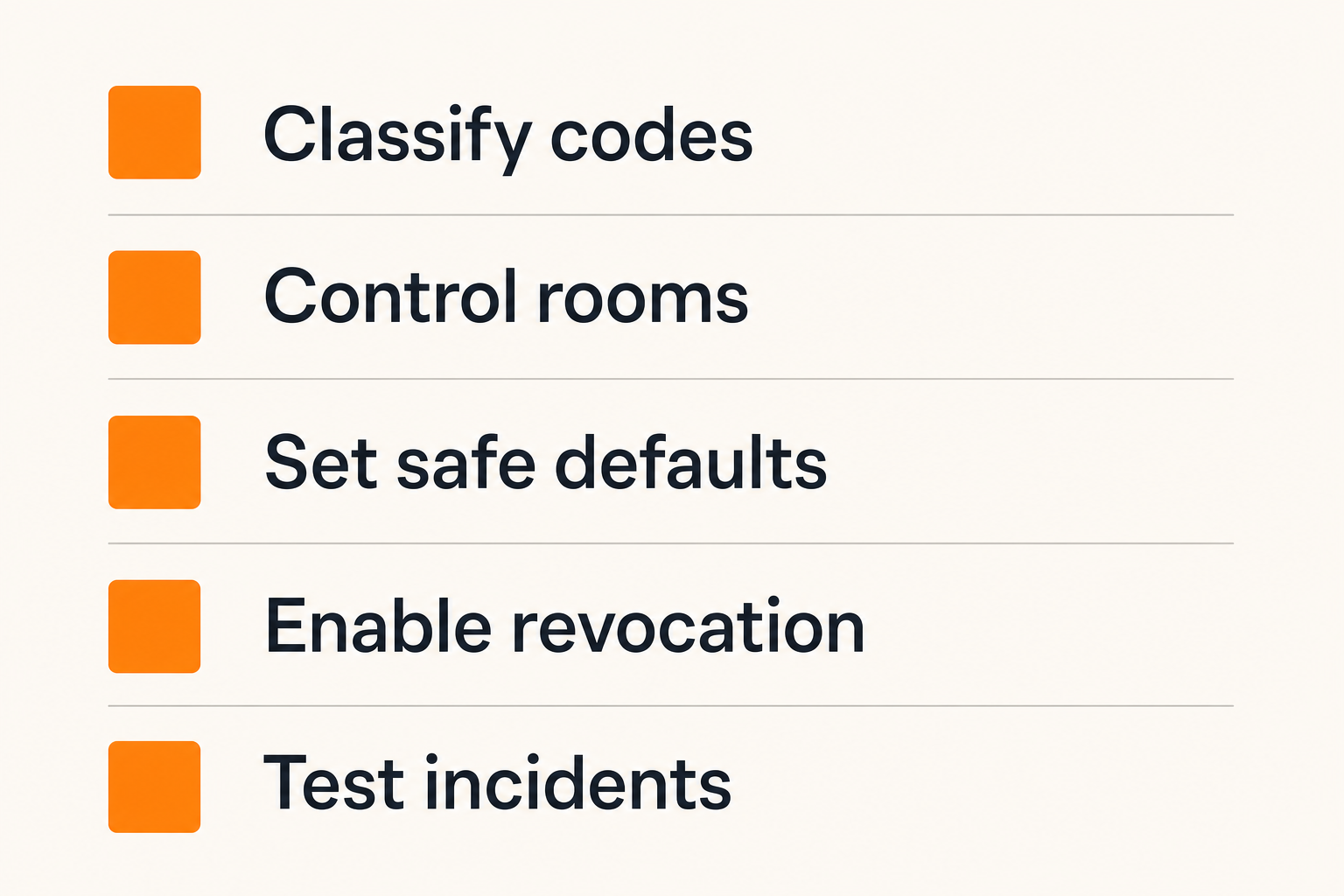
Map each class to an allowed channel, retention period, preview setting, and approval level. Avoid a ten-tier taxonomy that staff will ignore. Edge cases can be escalated to the more protective class.
A useful policy statement is: public codes may use public channels; restricted codes require controlled groups; sensitive codes require a verified direct conversation and a revocable, short-lived token.
Turn policy into defaults
Documentation is not enough. Configure the workflow so the safe path is easier:
- Create clearly named rooms with visible membership.
- Disable unnecessary bots and exports in restricted spaces.
- Set conservative notification previews on managed devices.
- Make private, single-use codes the default in the coupon tool.
- Provide a message template that omits customer details.
- Give support staff a one-click revocation route.
- Review access and open campaigns on a fixed schedule.
Where automation exists, pass references rather than raw coupon content. For example, a support tool can create a constrained code and return it only to the assigned agent, while the audit stream records the coupon reference and status.
Practical rule: If secure handling depends on every sender remembering seven optional steps, the workflow is not secure enough.
Test the workflow with realistic cases
Run a tabletop exercise before a major campaign. Test a message sent to the wrong room, a former contractor retaining access, a code redeemed before the customer receives it, and a lost staff device.
Measure practical outcomes: How quickly can the team identify affected coupons? Can someone revoke them outside business hours? Does the recipient receive a valid replacement without exposing more personal data? Can finance distinguish legitimate redemption from duplicate event processing?
Also test ordinary usability. If agents need several minutes to issue a modest recovery coupon, they will build shortcuts. Good security constrains authority and exposure while keeping the common path efficient.
Where qrypt.chat fits
Use private messaging as one control layer
A privacy-focused messaging service can provide the protected communication layer for restricted coupon delivery, campaign coordination, and incident response. It should sit inside the workflow rather than become the coupon database.
Use qrypt.chat for conversations that should not be exposed through ordinary group messaging, especially when remote participants need a clear private channel. Keep coupon generation, eligibility, redemption, and revocation in the merchant or promotion platform. This separation limits the number of systems that need full customer and transaction context.
That architecture also makes migration and investigation easier. Messaging handles human coordination. The commerce system enforces value. An operational record connects them using a non-sensitive reference.
Questions to ask before rollout
Before using any encrypted chat for coupon operations, verify:
- How recipients establish and recover accounts.
- How active devices and room members are reviewed.
- Which metadata the service and participants can observe.
- Whether previews, exports, and integrations can be controlled.
- How deletion and retention behave across endpoints.
- What support staff should do when identity is uncertain.
- Which coupon classes are allowed in group versus direct chat.
The goal is not to claim that chat makes coupon sharing risk-free. The goal is to reduce unnecessary exposure while preserving an operationally usable handoff.
Coupon codes and secure messaging work well together when the code is constrained, the recipient is verified, the payload is minimal, and redemption remains authoritative outside the conversation. Encryption protects an important part of that path, but workflow design determines whether the protection survives real use.
Try qrypt.chat
Private communication for people and teams that want a clearer boundary around sensitive conversations. Try qrypt.chat.