
A coupon code looks harmless. Then someone shares it with a tracked link, a screenshot showing their account email, or a message explaining what they plan to buy and where it will be delivered.
That is the real issue behind coupon codes secure messaging. The code itself may be public, but the surrounding metadata can reveal identity, relationships, shopping behavior, location, employer activity, or access to a private membership program.
Teams think the problem is choosing an encrypted chat app. The real problem is building a sharing workflow that separates the reusable code from sensitive context, verifies the destination, limits retention, and gives recipients enough information to use the deal safely.
This guest contribution draws on the deal-sharing experience of the team at c0upons.com, with the workflow adapted for privacy-conscious users, security professionals, and remote teams.
Table of contents
- Why coupon sharing is a privacy workflow
- Threat modeling coupon codes secure messaging
- What secure messaging protects and does not protect
- Classify the coupon before sending
- A coupon codes secure messaging workflow
- Link hygiene and scam resistance
- Group chats remote teams and communities
- Common failure modes
- Implementation controls for administrators
- Choosing the right tool and operating model
Why coupon sharing is a privacy workflow
The coupon is rarely the sensitive part
A public code such as SAVE15 has little confidentiality value. Thousands of shoppers may already know it. Encrypting that string is not harmful, but it does not address the larger exposure.
The accompanying message may reveal that a person is buying medical supplies, travel tickets, security hardware, legal services, or equipment for a confidential project. A screenshot can expose a name, loyalty balance, partial payment details, address, open browser tabs, or order history. An account-specific URL may contain identifiers even when the visible code looks generic.
The mistake teams make is assigning one sensitivity level to the entire message. In practice, the code, merchant, URL, sender identity, purchase reason, and redemption result can each carry different risk.
Metadata changes the risk
Secure messaging reduces who can read message content, but communication still produces metadata. Depending on the system and its configuration, that may include sender and recipient identifiers, timestamps, device information, group membership, message size, notification previews, and retained backups.
One isolated coupon is usually unremarkable. A long history can show purchasing patterns, business relationships, travel schedules, health concerns, or recurring operational needs. The risk comes from aggregation as much as from any single message.
A useful way to think about it is that every deal has two layers: the redemption data and the behavioral context. Minimize both independently.
Privacy and authenticity are separate
Encryption can help ensure that outsiders do not read a message in transit. It does not prove that the underlying coupon is valid, that the merchant page is genuine, or that the sender's device is uncompromised.
This distinction matters because a phishing link delivered through an encrypted channel is still a phishing link. In fact, recipients may trust it more because it arrived in a private group.
Practical rule: Treat message privacy, sender identity, link authenticity, and coupon validity as four separate checks.
That changes the conversation. Instead of asking whether coupons should be encrypted, ask which parts need confidentiality, how recipients verify them, and what should happen after the offer expires.
Threat modeling coupon codes secure messaging
Identify the asset
Start by identifying what would cause harm if exposed or misused. The asset might be a single-use discount, a private employee benefit, an affiliate identity, the contents of a planned order, or access to a restricted storefront.
For a public promotional code, availability is often more important than secrecy: recipients need an accurate code before it expires. For an account-bound offer, confidentiality and access control matter more. For a purchase involving sensitive goods, the merchant name and shopping context may require protection even if the discount is public.
Do not label everything confidential by default. Overclassification adds friction and encourages users to ignore policy.
Identify the likely observer
Threat models should reflect plausible observers rather than imaginary omnipotent attackers. Consider:
- A public-channel member who should not receive a private offer
- A former employee who remains in a group
- A person looking over an unlocked device
- A compromised endpoint or browser session
- A messaging provider or backup service retaining metadata
- A scammer impersonating a trusted colleague
- A merchant or tracking network correlating referral parameters
The practical question is not whether exposure is theoretically possible. It is whether the workflow places information in front of parties who do not need it.
Match controls to consequences
A public grocery discount does not need the same controls as a one-time code for an executive travel account. Use consequence-based tiers:
| Offer type | Main risk | Suitable sharing control | Typical retention |
|---|---|---|---|
| Public reusable code | Inaccuracy or phishing | Verified source and normal encrypted chat | Until expiry |
| Limited group offer | Unauthorized redistribution | Restricted group and no forwarding | Short-lived |
| Personal referral | Identity and relationship disclosure | Direct message with context minimized | Delete after use |
| Account-bound code | Account correlation or misuse | Verified recipient and separate confirmation | Delete promptly |
| Login or payment code | Account takeover | Never treat as a coupon | Do not share |
Practical rule: Increase controls when misuse affects an account, identity, entitlement, or sensitive purchase—not merely because a message contains a discount.
What secure messaging protects and does not protect
Encryption protects transport and content
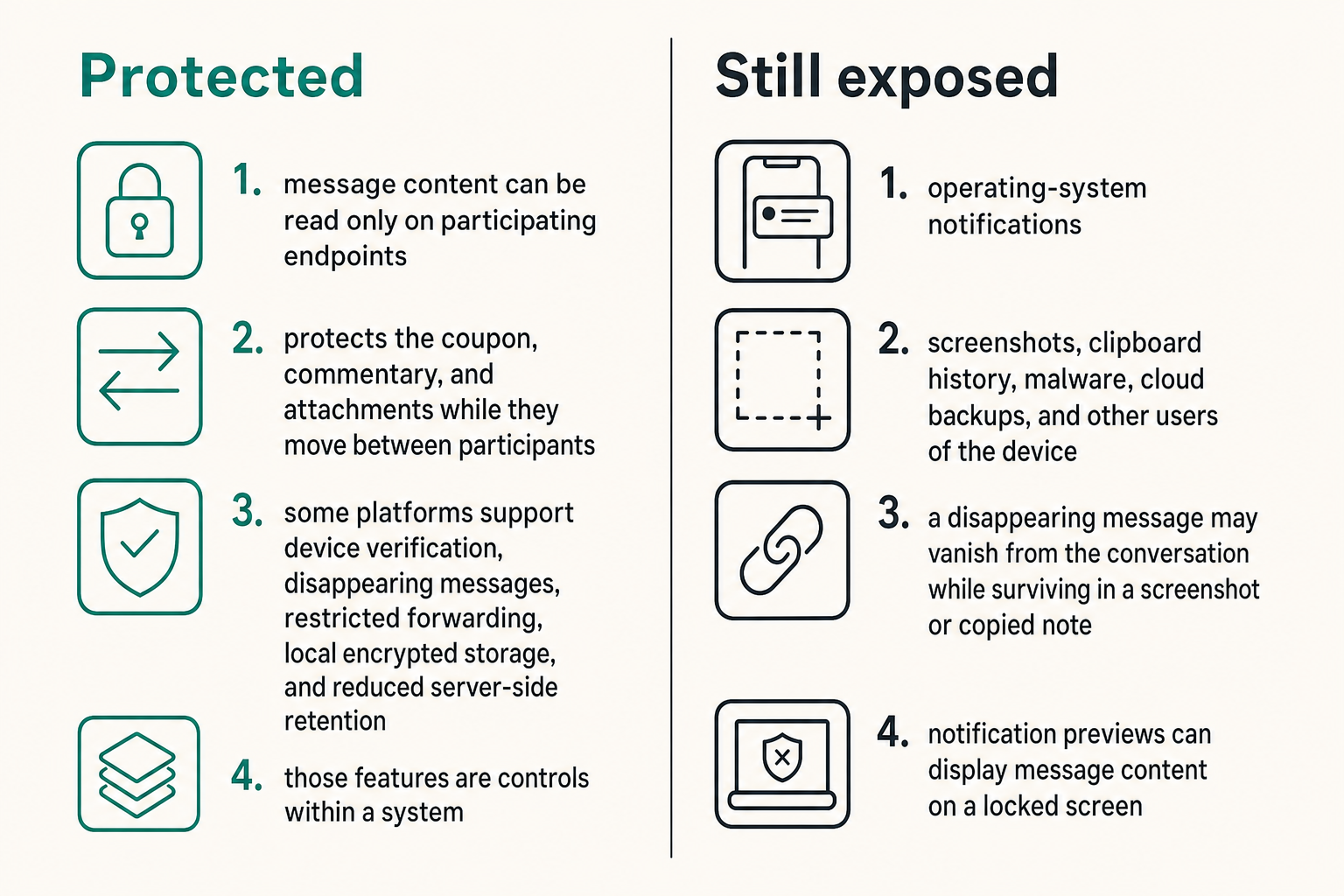
End-to-end encryption is designed so message content can be read only on participating endpoints, assuming the implementation and devices are trustworthy. This is materially better than posting offers in public forums, unprotected email threads, or searchable workplace channels.
It can protect the coupon, commentary, and attachments while they move between participants. Some platforms also support device verification, disappearing messages, restricted forwarding, local encrypted storage, and reduced server-side retention.
Those features are useful, but they are controls within a system. They do not replace a sharing policy or recipient judgment.
Endpoints remain inside the trust boundary
Once a message is decrypted on a phone or laptop, operating-system notifications, screenshots, clipboard history, malware, cloud backups, and other users of the device can expose it. A disappearing message may vanish from the conversation while surviving in a screenshot or copied note.
Notification previews are an easy example. A message can be encrypted during transport but displayed in full on a locked screen. For sensitive offers, disable previews or write the initial notification so it reveals nothing beyond a request to open the chat.
What breaks in practice is not usually the cryptographic primitive. It is the endpoint, backup, membership, or human workflow around it.
A private message can still contain a malicious link
Secure channels provide confidentiality, not automatic content safety. A compromised contact can distribute a convincing fake checkout page to an entire group. Link previews may also disclose the URL to a preview service or cause the device to contact a destination before the user deliberately opens it.
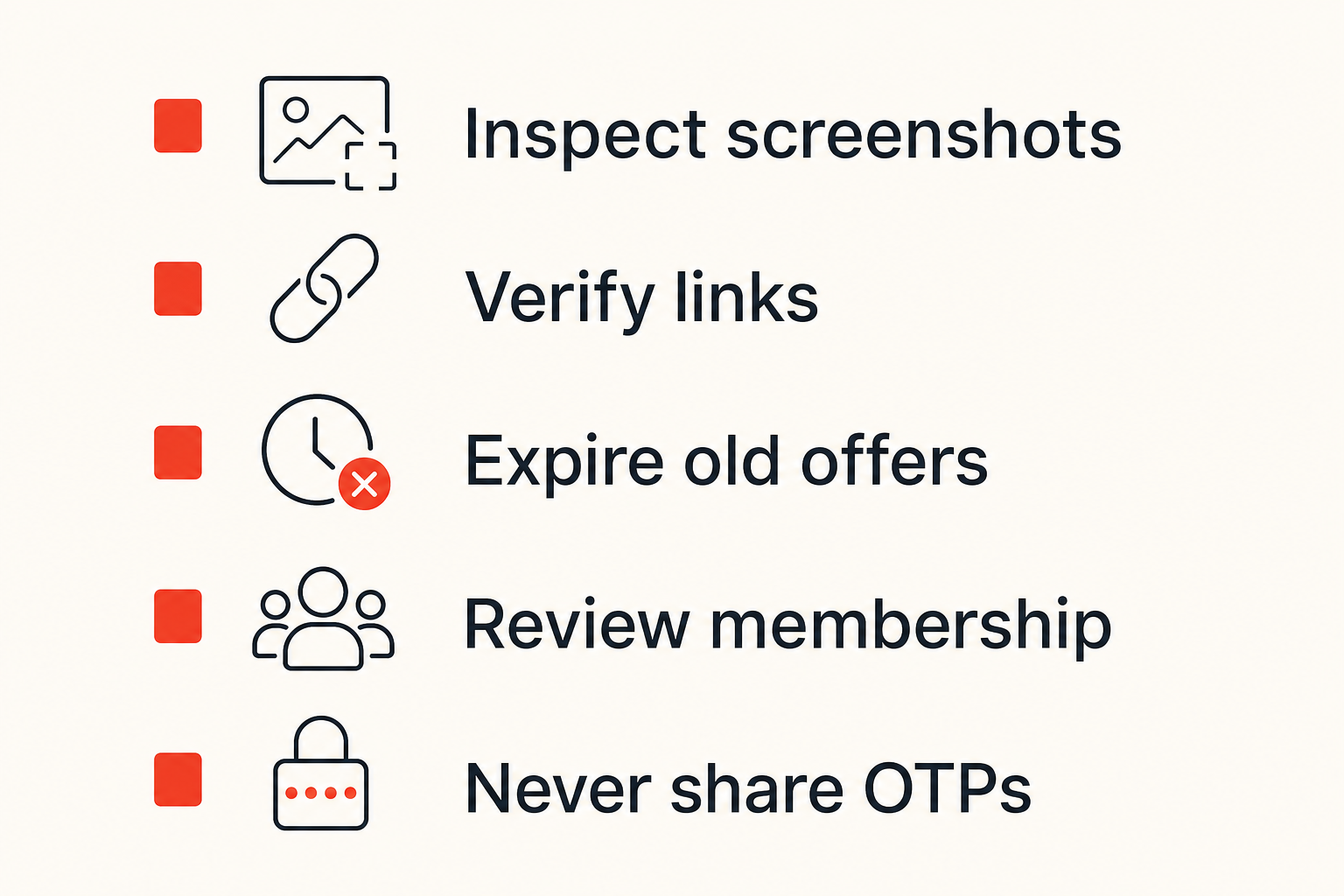
Users should verify unusual domains independently, especially when a message asks them to sign in, enter payment details, install an extension, or act immediately. If possible, navigate to the merchant through a known bookmark or manually entered domain and apply the code at checkout.
The secure option is often to send the code and merchant name without sending a clickable link at all.
Classify the coupon before sending
Public reusable codes
Public reusable codes have the simplest workflow. Share the merchant, exact code, known restrictions, source confidence, and expiry if available. Avoid adding unnecessary personal context.
A useful compact message is:
Merchant: Example Store | Code: SAVE15 | Terms: selected items | Expires: 2026-10-03 | Verified: checkout test
Even here, accuracy matters. Coupon terms change, regional restrictions differ, and a valid code may not apply to every product. Say what was actually verified rather than claiming universal validity.
Personal referral and account-bound offers
Referral links can expose more than a discount code. They may identify the referrer, connect two customer accounts, trigger rewards, or create a durable record with the merchant. Employee, student, membership, and loyalty offers may also prohibit redistribution.
Before sharing, ask whether the recipient needs the full link or only a code. Explain when the sender benefits. Use a direct conversation rather than a large group if the link can identify either party.
Consent matters here. A recipient should know when opening or redeeming an offer establishes a relationship between accounts.
Single-use codes and credentials
Single-use coupons deserve tighter delivery because interception or premature redemption destroys their value. Confirm the recipient through an established channel, send only what is needed, and remove the message after successful redemption where practical.
Never confuse a coupon with a login, password-reset, multifactor authentication, payment authorization, gift-card claim, or account recovery code. Scammers deliberately describe authentication codes as promotions, refunds, or verification discounts.
Practical rule: If a code can authorize access, payment, password recovery, or identity verification, it is a credential—not a coupon—and should not be shared.
A coupon codes secure messaging workflow
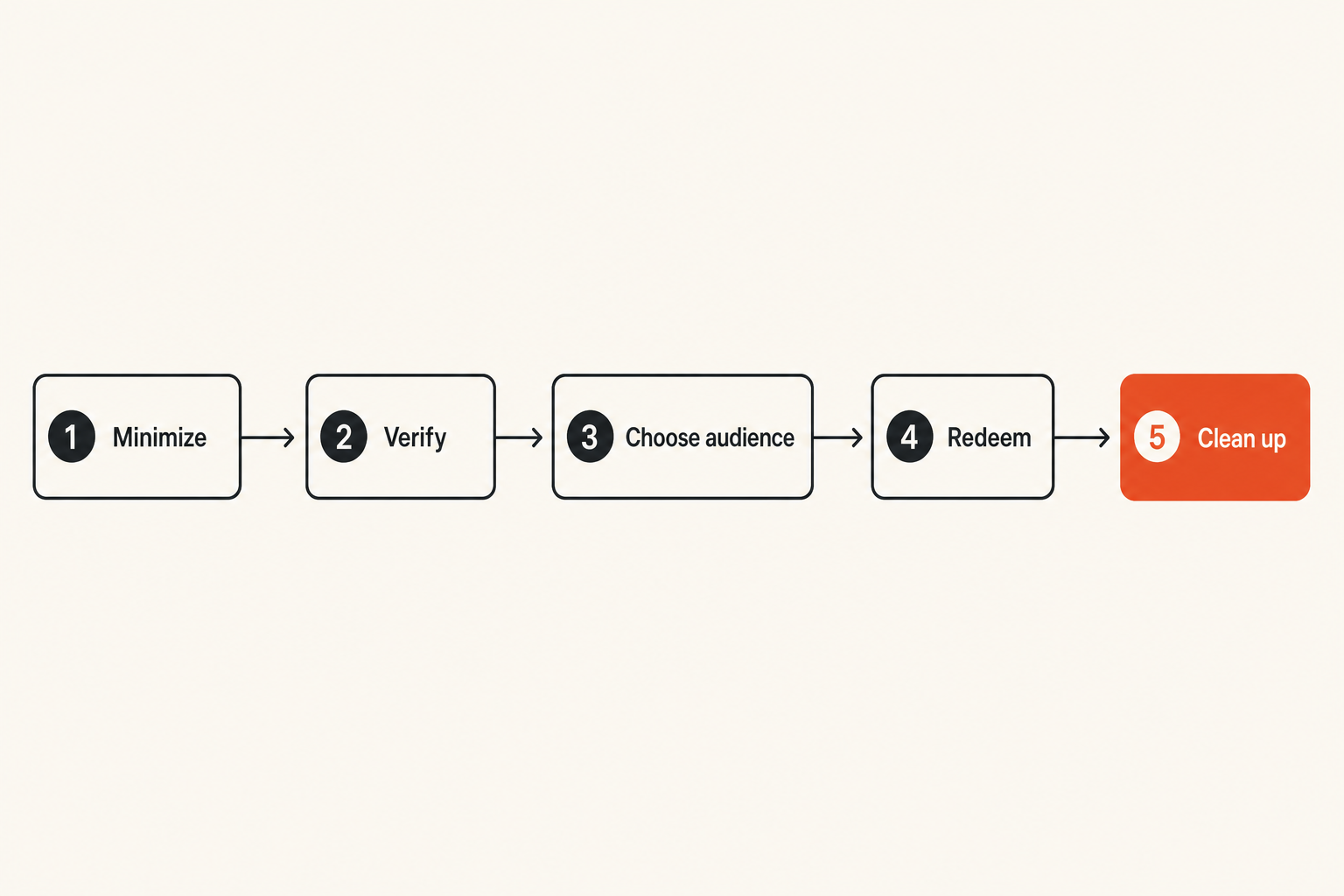
Step 1 minimize the payload
Before sending, strip the message down to the information required for redemption. Do not forward an entire email if the recipient needs only a code and expiry date. Do not send a checkout screenshot when plain text will work.
Inspect links for referral identifiers, email addresses, session tokens, cart identifiers, and tracking parameters. Be careful when removing parameters because some offers require a signed redemption token. If you do not understand a parameter, prefer directing the recipient to the merchant's known site rather than improvising a modified URL.
Step 2 verify the merchant path
Verify the spelling and registrable domain, not just the page logo or display text. Confirm that the page uses HTTPS, but remember that HTTPS only authenticates the domain connection; malicious domains can also obtain certificates.
Check the offer through a trusted merchant entry point. If the code can be tested without completing a purchase, add it at checkout and report the result accurately. Record region, product exclusions, minimum spend, and verification time when those details matter.
Avoid claiming that a coupon is safe merely because it worked. A fraudulent store can accept a discount too.
Step 3 choose audience and retention
Use the smallest audience that needs the offer. A one-to-one chat fits an account-bound or personal referral code. A private group may fit a team benefit. A public channel fits only an intentionally public promotion with no sensitive context.
Then set retention based on the offer's useful life. Expired coupon messages create search clutter and preserve behavioral history without providing ongoing value. Disappearing messages can help, but only if participants understand that deletion is not guaranteed across screenshots, exports, or compromised devices.
Step 4 confirm redemption without oversharing
A recipient usually needs to report only one of four states: worked, failed, expired, or already used. They do not need to share a receipt, address, payment method, account balance, or full order contents.
A practical implementation sequence is:
- Sender classifies the offer and removes unnecessary context.
- Sender verifies the merchant path and states what was tested.
- Sender selects a recipient or restricted group.
- Recipient navigates independently where possible and applies the code.
- Recipient returns a minimal status response.
- Sender edits, expires, or deletes the offer according to policy.
This closes the loop without turning the chat into a purchase ledger.
Link hygiene and scam resistance
Prefer merchant navigation over opaque links
Shortened URLs, QR codes, redirect chains, and button-only links hide the final destination. They are convenient for marketers and useful for tracking, but they make recipient verification harder.
For a well-known merchant, share the official merchant name and code, then let recipients use their existing app, bookmark, or manually entered address. If a unique link is necessary, expose the destination domain in the message and explain why the link is personalized.
QR codes deserve the same skepticism as shortened URLs. A QR image is simply an encoded destination, not evidence that the destination is trustworthy.
Separate the code from the claim
Messages often combine several claims: the merchant is legitimate, the offer is active, the discount is a certain amount, and the link is safe. Verify them separately.
Use status language such as:
Verified at checkout at 14:20 UTCReported by sender; not independently testedWorked for new accounts in the UKLink is personalized and may identify the referrerExpiry stated by merchant; timezone not specified
This avoids false certainty. It also lets recipients make a decision when some details remain unknown.
Treat urgency as a signal
Coupons naturally expire, so urgency is not automatically malicious. The problem is urgency combined with a request for credentials, payment outside the normal checkout, software installation, or movement to an unfamiliar domain.
Slow down when a message says the offer will disappear in minutes and demands immediate login. Verify the sender through an existing conversation or another trusted method. Do not rely on the profile name alone; accounts can be hijacked and display names copied.
A real discount that expires during verification is less costly than a compromised account.
Group chats remote teams and communities
Use purpose-built channels
Remote teams sometimes mix discounts with procurement, expense approvals, customer data, and casual conversation. That makes retention and access control difficult. Create a clearly scoped channel for public or team-authorized offers, and keep personal purchases elsewhere.
Define acceptable categories. For example, the channel may allow public software discounts and approved employee benefits but prohibit account credentials, customer-specific pricing, gift cards, and screenshots of internal procurement systems.
Purpose limits reduce ambiguity. They also make moderation possible without requiring administrators to interpret every purchase discussion.
Control membership and forwarding
Group encryption does not solve stale membership. Former employees, contractors, guests, and forgotten secondary devices may retain access unless the platform and administrator remove them.
Review membership before posting restricted benefits. Use groups that provide clear participant lists and membership-change notices. For higher-risk offers, verify recipients directly rather than assuming the group roster is current.
Forwarding restrictions can reduce accidental redistribution, but they are not digital rights management. Anyone who can see a message can usually photograph or manually copy it. Policy and trust remain part of the system.
Assign cleanup ownership
Without ownership, expired offers remain pinned, invalid links keep circulating, and nobody corrects changed terms. Assign the original sender or a channel moderator to mark status and remove stale content.
A lightweight status vocabulary works well:
ACTIVEfor recently verified offersUNVERIFIEDwhen the source appears plausible but has not been testedEXPIREDwhen the deadline has passedDEPLETEDfor a used or exhausted codeSUSPICIOUSwhen the link or request requires investigation
The goal is not bureaucracy. It is preventing yesterday's message from becoming tomorrow's phishing opportunity.
Common failure modes
Posting screenshots without inspection
Screenshots are fast and dangerous. Mobile status bars can expose location indicators, carrier details, notification content, and time patterns. Browser screenshots can show bookmarks, account avatars, email addresses, other tabs, order numbers, loyalty balances, and autofill suggestions.
Cropping helps but can leave embedded metadata depending on the file and editing process. Plain text is usually better for a coupon code. If an image is necessary, capture the smallest region, redact carefully, export a clean copy, and inspect the final image before sending.
What fails is assuming that recipients will look only at the highlighted discount.
Confusing encryption with verification
A familiar encrypted conversation can create excessive trust. Users click because the message appears to come from a colleague, even when the colleague's device or account has been compromised.
Verification should increase with unusual behavior. A known contact who suddenly sends a luxury-goods promotion, requests a login, or asks the recipient to pay through cryptocurrency is not made trustworthy by encryption. Confirm through established context and inspect the merchant independently.
Encryption protects a message from certain observers. It does not make every sender claim true.
Keeping expired offers forever
Long retention seems useful because users can search old deals. In practice, it mixes active and invalid offers, increases behavioral history, and lets stale malicious links continue circulating.
Retention should align with operational value. Delete or clearly expire time-limited messages. If the community needs a reusable knowledge base, store only normalized fields such as merchant, code, terms, verification date, and status. Exclude personal discussion and account artifacts.
Searchability is not free. It creates a database that needs access control, cleanup, and incident response.
Turning a deal channel into an account recovery channel
The most dangerous failure occurs when users begin forwarding one-time passwords, payment confirmations, password-reset links, or gift-card credentials because they resemble coupon codes.
Administrators should state a bright-line rule: authentication and recovery material never belongs in the channel. Messages requesting those items should be treated as potential compromise signals, not merely deleted as off-topic.
If such a code is posted, assume exposure. Revoke or rotate it where possible, review account sessions, and contact the affected user through a trusted path.
Implementation controls for administrators
Set a simple message schema
Structured messages improve verification without requiring a complex bot or database. A practical template is:
Merchant:
Code or offer:
Public, group, or personal:
Destination domain:
Restrictions:
Expiry and timezone:
Verification status and time:
Sender benefit or referral disclosure:
Not every field must be completed for every public coupon. The schema exists to surface uncertainty and prevent a naked link from being treated as sufficient context.
For sensitive groups, prohibit attachment-only posts. Require enough visible text for recipients to assess the offer without opening an unknown file.
Design for retries edits and deletion
Messaging workflows have state. A sender may post twice after a network retry, edit a destination, or delete a warning while an older forwarded copy remains. Administrators should decide which action represents the authoritative state.
Where bots or integrations are used, give each offer a stable identifier and make submissions idempotent. A repeated request with the same identifier should update or return the existing offer rather than create duplicates. Log status transitions without collecting purchase details.
Deletion should propagate where the platform supports it, but the operating assumption must be that a recipient may have copied the content already.
Measure operational quality without reading content
Privacy-conscious teams can improve the workflow without inspecting private purchases. Measure process signals such as the percentage of offers with an expiry, number of stale active posts, time to flag a suspicious link, membership-review cadence, and duplicate-post rate.
Avoid analytics that reconstruct who bought what. The purpose is to evaluate channel hygiene, not build a shadow purchase profile.
Practical rule: Collect metrics about workflow health, not the private behavior the workflow is meant to protect.
If detailed content inspection is required for moderation, state that boundary clearly. Users cannot make informed choices when a channel is presented as private but silently analyzed like a marketing feed.
Choosing the right tool and operating model
Evaluate the full communication lifecycle
Do not evaluate secure messaging only by the encryption label. Review account creation, identity exposure, contact discovery, device linking, group administration, key verification, notification behavior, attachment storage, backups, message deletion, exports, abuse reporting, and recovery.
A platform can use strong encryption while exposing phone numbers to participants or retaining unencrypted device backups. Another may minimize identity data but lack the group controls a remote team needs. The right choice depends on the threat model and operating context.
The UI is not the whole system. Trust boundaries, endpoint behavior, membership, retention, and recovery determine what happens in production.
Use the lightest control that fits
Not every coupon requires a locked-down disappearing conversation. Excessive friction pushes users toward side channels and screenshots. Match the control to the offer:
- Public code: normal encrypted conversation plus source verification
- Personal referral: direct message plus disclosure
- Restricted benefit: controlled group plus membership review
- Single-use entitlement: verified recipient plus short retention
- Authentication or recovery code: never share
What works is a small number of rules that users can apply quickly. What fails is a policy so complex that every discount requires a security review.
A final operating checklist
Before sending a coupon, ask:
- Is this actually a coupon rather than a credential?
- Does the message reveal identity, purchase intent, or account data?
- Can I send plain text instead of a screenshot?
- Can the recipient navigate to the merchant independently?
- Is the destination domain visible and verified?
- Does the recipient need to know that I benefit from the referral?
- Is this the smallest appropriate audience?
- When should the message expire or be removed?
- Can the recipient report success without sharing a receipt?
Coupon codes secure messaging works when privacy and verification are treated as a workflow, not as a feature checkbox. Protect the context, distrust opaque links, minimize retention, and keep credentials out of deal conversations entirely.
Try qrypt.chat
Use private encrypted messaging designed for people and teams that want more control over sensitive conversations. Try qrypt.chat.