
A coupon code looks harmless until it is tied to an employee benefit, private customer offer, high-value purchase, referral account, or single-use checkout session. Then a copied message, malicious link preview, or exposed chat history can create financial and privacy problems.
Coupon codes secure messaging workflows are often treated as a simple question: which chat app should someone use to send a discount? That framing is too narrow. Teams think the problem is encrypting a string such as SAVE20. The real problem is controlling the complete workflow around that string: source verification, link handling, access, metadata, redemption, expiration, and recovery.
This matters in 2026 because promotions increasingly arrive through account-specific links, loyalty portals, creator referrals, workplace channels, and automated shopping assistants. The code may be public while the surrounding information is not.
The practical question is not whether a coupon deserves military-grade secrecy. It is whether your communication workflow exposes more identity, purchase intent, account data, or organizational context than the discount is worth.
Table of contents
- Why coupon codes secure messaging is a workflow problem
- Build a threat model before choosing a channel
- Choose the right channel for the offer
- Use a repeatable coupon-sharing workflow
- Designing coupon codes secure messaging as a state machine
- Protect metadata as well as message content
- Make private deal sharing operable for teams
- Understand what breaks in practice
- Evaluate a secure messaging platform
- Put the architecture into practice
Why coupon codes secure messaging is a workflow problem
The coupon may be a capability
Most generic coupon codes are not secrets. If a retailer publishes AUTUMN15 on its homepage, encrypting that text does not add meaningful protection. But not every promotion is generic.
A code can function as a bearer capability: whoever possesses it can claim the benefit. This is common with single-use vouchers, store credits, event access, beta invitations, customer recovery offers, and employee-only discounts. Some links also contain tokens that automatically associate a browser session with an account or promotion.
That changes the conversation. The security requirement depends on what possession of the message allows someone to do.
A useful classification is:
- Public code: reusable and already published by the merchant.
- Restricted code: intended for a group such as employees, members, or subscribers.
- Single-use code: redeemable once by the first person who submits it.
- Account-bound offer: available only after authentication.
- Tokenized link: a URL that carries entitlement, attribution, or session data.
- Stored-value voucher: a code representing money rather than a percentage discount.
The team at c0upons.com works with the practical distinction between widely available promotions and offers whose eligibility, timing, or redemption terms need closer verification. That distinction should drive the messaging workflow too.
Practical rule: Classify the offer before choosing how to send it. A public promotion and a single-use voucher should not follow the same process.
The surrounding context creates the risk
Even when the code is public, its context may reveal sensitive information. A conversation can disclose that someone is buying medication, security equipment, travel, legal services, political material, or products linked to a private life event.
For a business, the same message might expose vendor selection, travel dates, office locations, purchasing authority, budget timing, or an unreleased campaign. A code posted in a remote-team channel can also reveal which employees qualify for a benefit.
The mistake teams make is protecting the coupon text while attaching an order screenshot containing a full name, address, loyalty number, and partial payment details. The low-sensitivity field receives attention while the high-sensitivity context remains visible.
Before sending, ask four questions:
- Does the offer identify a person or account?
- Can possession transfer value?
- Does the merchant link reveal tracking or session data?
- Would the purchase category itself be sensitive?
Those questions produce a more useful security decision than asking whether coupon codes are confidential in the abstract.
Build a threat model before choosing a channel
Identify what an attacker actually wants
Threat modeling does not need to become a cryptography exercise. Start with realistic misuse.
For a public discount, the main risk may be phishing: an attacker replaces the legitimate merchant URL with a lookalike checkout page. For a single-use voucher, interception and premature redemption matter more. For an employee offer, unauthorized forwarding may expose eligibility rules or trigger program abuse.
Potential adversaries include:
- A stranger who gains access to an unlocked device.
- A former team member who remains in a persistent group.
- Malware reading notifications or clipboard contents.
- A malicious recipient who forwards a restricted offer.
- A phishing operator who substitutes a destination link.
- A service provider with access to message metadata or backups.
Avoid dramatic threat models that ignore ordinary failure. In production, the most likely leak is often a screenshot, wrong recipient, stale group membership, or copied link—not someone breaking modern encryption.
Define the trust boundaries
Map where the offer exists from discovery to redemption. A typical path includes the source website, sender browser, messaging service, recipient device, clipboard, merchant checkout, and perhaps a team expense system.
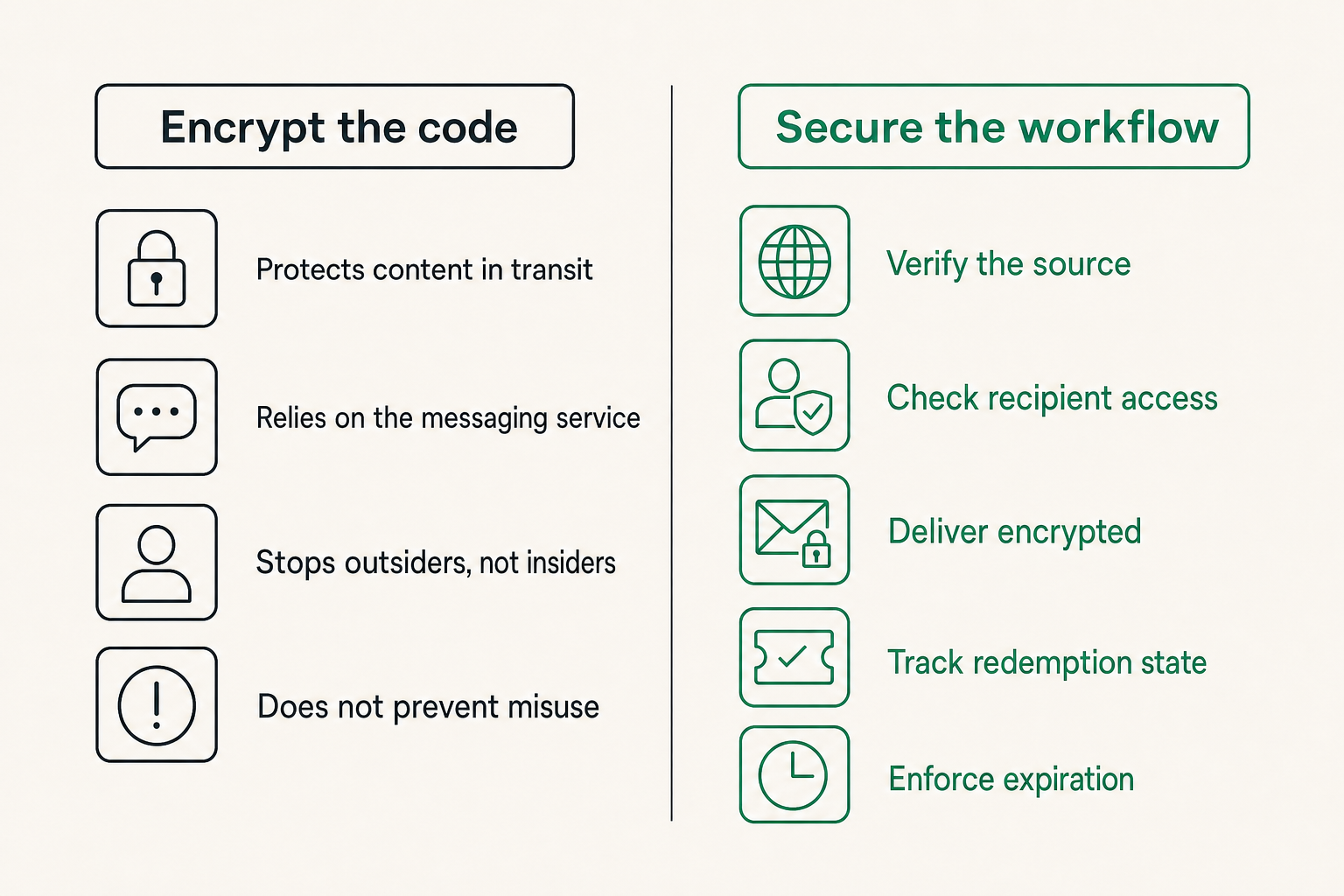
Encryption may protect transport between messaging clients, but it does not automatically protect:
- A compromised endpoint.
- Plaintext notification previews.
- Cloud device backups.
- Browser history after a link opens.
- Clipboard managers.
- Analytics embedded in the merchant page.
- Screenshots stored in a photo library.
- A recipient authorized to read but not redistribute the offer.
Practical rule: End-to-end encryption protects a communication path. It does not make every endpoint, browser, backup, or recipient trustworthy.
Document the boundaries proportionally. A household sharing a public grocery discount may only need to verify the domain and avoid oversharing. A security team distributing limited conference vouchers should define recipients, expiration, ownership, and incident handling.
Choose the right channel for the offer
Secure chat versus email and public posts
The right channel depends on the offer's transferability and context. Secure messaging is valuable when the sender needs a private, direct conversation with controlled membership. It is not a substitute for a merchant's entitlement system.
| Channel | What works | What fails |
|---|---|---|
| Public post | Broad distribution of reusable public codes | No recipient control; scammers can replace or repost links |
| Standard email | Familiar delivery and searchable records | Forwarding, long retention, compromised inboxes, ambiguous sender identity |
| Encrypted chat | Private content in transit, fast verification, smaller recipient scope | Endpoint compromise, screenshots, stale groups, metadata exposure |
| Password manager secure note | Controlled sharing of valuable codes | Poor discussion workflow; access can outlive the promotion |
| Merchant account portal | Strong fit for account-bound eligibility | Users may still receive phishing links pretending to lead there |
What works is matching the channel to the capability. What fails is declaring one channel universally secure without considering retention and recipient behavior.
For high-value or account-bound offers, it can be safer to tell the recipient how to navigate to the merchant's official app or domain rather than sending a clickable deep link. The code can then be communicated separately if needed.
Treat links and previews as separate risks
Coupon messages commonly combine a code with a URL. That makes authenticity as important as confidentiality. An encrypted phishing link is still a phishing link.
Link previews can create an additional request before the recipient chooses to open the site. Depending on the messaging architecture, preview generation may contact the destination, expose an IP address, disclose that a unique link exists, or consume a single-use URL. A preview service can also retain page metadata.
A safer message names the merchant, shows the expected domain in plain text, explains the offer, and separates any account-specific instructions. Recipients should be encouraged to open the merchant independently when the offer is sensitive.
Do not use a URL shortener for private promotions unless there is a strong operational reason. Short links conceal the destination, complicate verification, and add another redirect and logging layer.
Practical rule: Protect the destination, not only the code. Confidential delivery cannot compensate for an unverifiable checkout link.
Use a repeatable coupon-sharing workflow
Verify the source before forwarding
A forwarded deal inherits all the uncertainty of its source. Before sharing, verify the promotion against the merchant's official site, application, or authenticated customer portal. Check the domain character by character, especially when a message creates urgency.
Read the terms that affect the recipient: expiration, region, minimum spend, eligible products, account requirements, recurring subscription conditions, and whether the offer can be combined with another promotion. A code that is genuine but misrepresented still creates support work and lost trust.
If the offer arrived through an email, do not treat the sender name as proof. Navigate independently to the merchant account when possible. Avoid forwarding the original marketing email if a concise text message can convey the verified terms with less tracking and less personal data.
Share redeem and expire deliberately
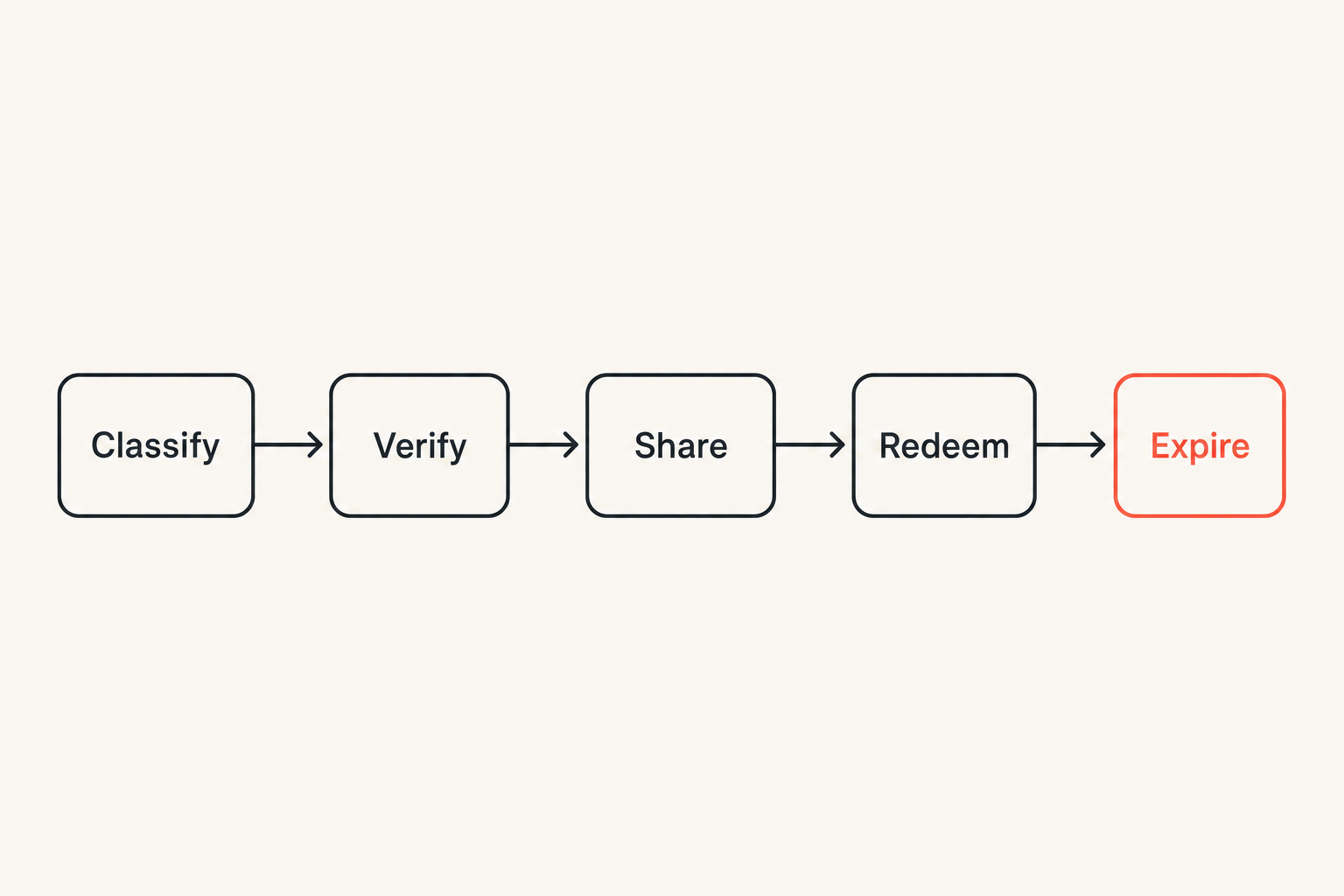
Use the following sequence for restricted, single-use, or sensitive offers:
- Classify the offer. Decide whether it is public, restricted, single-use, account-bound, tokenized, or stored value.
- Verify the source. Confirm the merchant domain and material terms through an independent route.
- Select recipients. Use a direct conversation or a group whose current membership is known.
- Minimize the message. Send the code, merchant identity, essential terms, expiration, and safe redemption instructions—nothing more.
- Verify identity when necessary. For stored value or valuable one-time codes, confirm the recipient through an established channel.
- Redeem without unnecessary copying. Avoid moving the code through shared documents, ticket systems, or multiple clipboards.
- Acknowledge state. Mark the offer as redeemed, invalid, or still available without publishing purchase details.
- Remove stale material. Delete or expire sensitive messages where supported, while recognizing that deletion cannot recall screenshots.
This workflow is intentionally boring. That is a strength. Repeatable controls outperform improvised warnings such as “do not share” when no one knows who owns the code or whether it has already been used.
For a public deal, several steps can be lighter. Verification and destination safety still matter, but recipient authentication and deletion usually do not.
Designing coupon codes secure messaging as a state machine
Send the minimum useful message
A good coupon message gives the recipient enough information to act safely without becoming a data dump. Use a consistent template:
Merchant: Example Store
Offer: 15 percent off eligible items
Code: AUTUMN15
Expires: 2026-10-31 at 23:59 merchant time
Destination: type the official domain or use the merchant app
Limits: one use per account; exclusions apply
Status: available
For a single-use code, add an owner or intended recipient. For a public promotion, omit unnecessary identity fields. Never attach a full checkout screenshot when a cropped description or typed terms will do.
Do not send passwords, payment card data, recovery codes, or account credentials alongside a coupon. Combining those elements turns a low-risk promotion into an account takeover package.
The practical question is what the recipient needs at each step. Before redemption, they need authenticity and terms. After redemption, the group may only need to know that the code is no longer available.
Track state without building surveillance
Coupon sharing has state even if the chat interface presents it as a stream of messages. A useful minimal state model is:
received -> verified -> available -> claimed -> redeemed
                     \-> rejected
                     \-> expired
State avoids duplicate work. It also prevents several people from trying a one-time code while assuming someone else has reserved it.
For small groups, a reply such as claimed by Alex until 14:00 UTC may be enough. For operational teams, use a minimal identifier rather than recording a detailed shopping history. Retain the merchant, offer identifier, owner, status, and expiry only as long as the process requires.
Idempotency matters when bots or integrations post promotions. A retried webhook should not create five apparently distinct codes. Assign a stable offer ID, deduplicate repeated events, and make state transitions conditional. A redeemed offer should not return to available because an older event arrived late.
Automation should not ingest every private conversation. Keep the bot's scope narrow, restrict which rooms it can access, and avoid logging message bodies by default.
Protect metadata as well as message content
Encryption does not erase every trace
Message content and message metadata are different layers. Depending on the service, metadata can include account identifiers, contact relationships, timestamps, device information, IP addresses, group membership, and message size.
That metadata may reveal that a finance lead contacted a travel coordinator immediately before a confidential trip, even if the coupon text remains encrypted. For ordinary shopping this may be inconsequential. For journalists, executives, activists, security teams, and people dealing with sensitive purchases, it may not be.
A useful way to think about it is exposure budgeting. Do not reveal identity, timing, destination, purchase category, and account linkage when the workflow only requires a code and an expiration date.
Private deal sharing should also avoid unnecessary tracking parameters. Remove marketing query parameters when doing so does not break entitlement or attribution the recipient intentionally wants. Do not modify signed or tokenized URLs blindly; changing them may invalidate the offer.
Plan for screenshots exports and notifications
What breaks in practice is often outside the encrypted conversation view. Notification banners can show a code on a locked screen. Desktop clients can place content in operating-system search indexes. Screenshots can sync to a shared photo account. Chat exports can create long-lived plaintext archives.
For sensitive offers:
- Disable message previews on locked devices.
- Review linked desktop and browser sessions.
- Avoid screenshots containing account or order data.
- Limit chat exports and protect any required archive.
- Clear the clipboard after redeeming stored-value codes.
- Use disappearing messages as retention reduction, not as a guarantee.
- Remove former members from groups promptly.
Disappearing messages help reduce passive accumulation. They cannot prevent a recipient from copying content, photographing a screen, or recording a code elsewhere. Be precise about that boundary rather than presenting ephemerality as digital rights management.
Practical rule: If a recipient can read a coupon, that recipient can usually copy it. Use messaging controls to reduce accidental exposure, not to promise impossible revocation.
Make private deal sharing operable for teams
Assign ownership and access
Remote teams often share conference discounts, software credits, travel offers, and employee benefits in chat. Without ownership, the channel becomes a mixture of expired codes, unclear eligibility, and accidental disclosure.
Assign an owner for restricted programs. The owner should verify terms, approve the recipient group, remove expired offers, and handle misuse. Access should follow current roles rather than historical membership in a general-purpose channel.
Separate broad deal discovery from restricted distribution. A public savings channel can contain reusable promotions. Employee-only benefits, vendor credits, and single-use vouchers belong in smaller spaces with explicit membership.
Avoid posting a restricted code in a channel merely because it is convenient. Channel names such as #purchasing do not enforce authorization. Review actual participants, guests, bots, bridges, and archived integrations.
Handle support and reconciliation
A secure workflow still needs to answer ordinary operational questions:
- Was the code valid when it was shared?
- Who was authorized to claim it?
- Was it redeemed, expired, or rejected?
- Did a bot repost it?
- Does the merchant require the original account holder?
- Who contacts support if the discount fails?
Keep enough state to resolve those questions without retaining the recipient's full order. For example, record an internal offer ID, source, verification time, intended scope, expiration, and final status. Do not collect basket contents or payment details unless a separate business process genuinely requires them.
Reconciliation is especially important for stored-value vouchers. Treat them more like cash equivalents than marketing copy. Use direct delivery, recipient confirmation, and a clear record of transfer. If the value is material, do not rely on an ambiguous group message.
Understand what breaks in practice
Common failure patterns
The mistake teams make is buying a secure messaging product and assuming the workflow is now secure. Tooling can protect specific boundaries, but poor decisions remain poor decisions inside an encrypted channel.
Common failures include:
- Wrong recipient: autocomplete selects a similar contact name.
- Stale membership: a contractor or former employee remains in the group.
- Link substitution: a copied message points to a lookalike merchant.
- Preview leakage: a unique URL is fetched before the user opens it.
- Overloaded screenshot: the coupon image includes identity and payment data.
- Duplicate automation: webhook retries repost a single-use offer.
- No status control: multiple recipients assume a code is available.
- False deletion confidence: the sender deletes a message after it was copied.
- Excessive logging: a helpful bot stores plaintext message bodies indefinitely.
- Urgency bypass: an expiring promotion causes users to skip verification.
The pattern is consistent: teams optimize delivery speed and neglect state, authenticity, and endpoint behavior.
Recover without creating more exposure
When a sensitive code is sent incorrectly, first determine whether it can be revoked or replaced. Contact the merchant through an official route for stored value, account-bound promotions, or single-use vouchers. Do not continue forwarding the exposed code while asking whether it works.
Next, remove the message where supported and notify unintended recipients clearly. Avoid repeating the code in the incident message. If a suspicious link was opened, treat the event as potential phishing: close the session, verify the domain, review account activity, and change credentials through the official application if credentials were entered.
For team incidents, record the cause rather than only the outcome. Was membership stale? Did a bot have excessive access? Did the template encourage screenshots? Adjust that control before the next promotion.
Do not demand screenshots as proof of deletion. They do not prove that other copies are gone and may create yet another copy. Recovery should focus on revocation, account protection, and reducing future exposure.
Evaluate a secure messaging platform
Check the security model
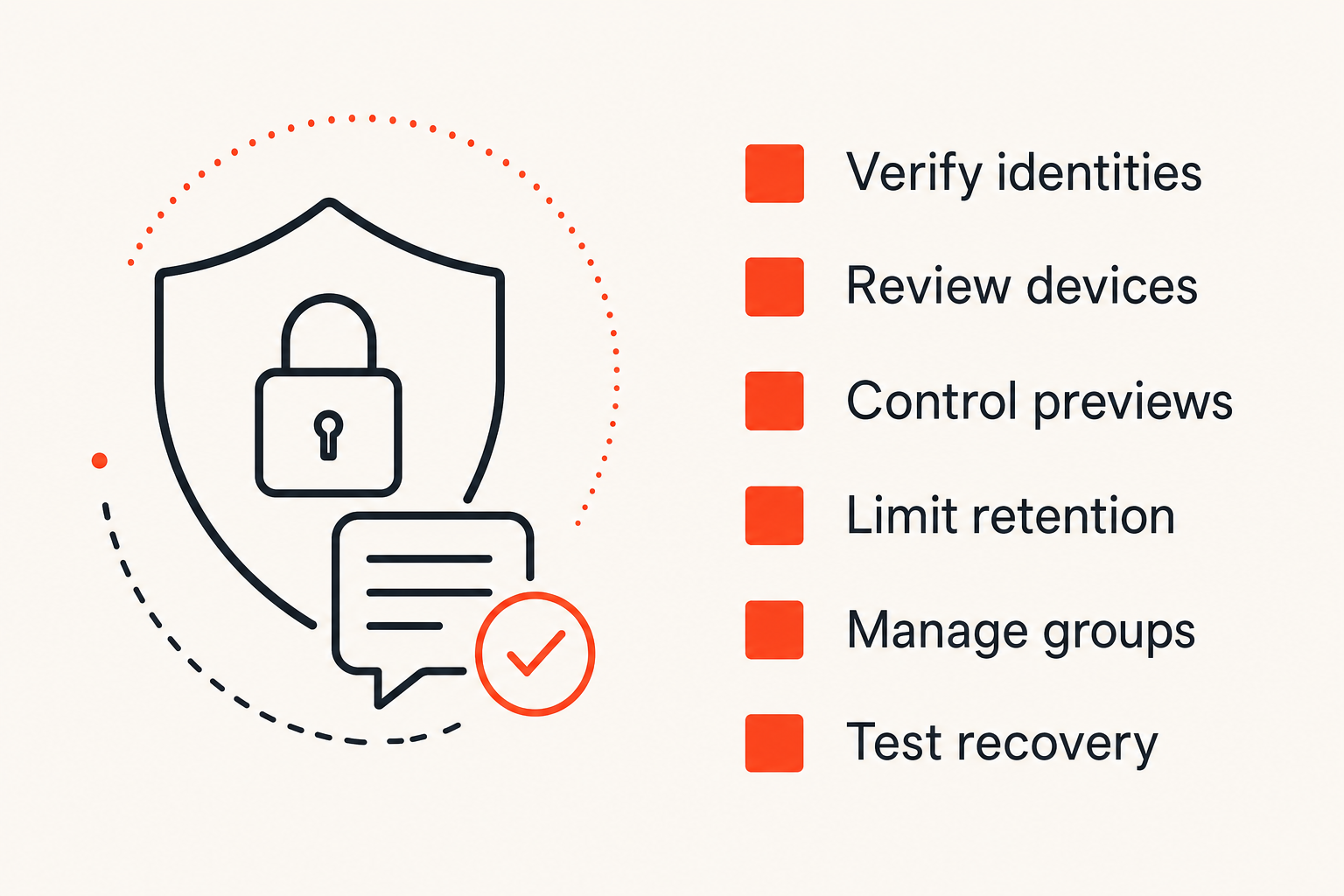
A platform assessment should begin with specific questions, not a generic “encrypted” label. Determine whether messages are end-to-end encrypted, how keys are established, which devices receive content, and what the provider can access.
Check how the product handles:
- Identity and device verification.
- New-device enrollment.
- Group membership changes.
- Key rotation after participants leave.
- Message retention and deletion.
- Backups and account recovery.
- Link previews and remote content.
- Abuse reporting without exposing unrelated conversations.
Security documentation should distinguish encryption in transit from end-to-end encryption. If the service can read message content to power server-side features, understand that boundary and decide whether it fits the offer's sensitivity.
Do not judge a platform only by its cryptographic vocabulary. A sound design can still be undermined by confusing identity indicators, permissive defaults, or recovery flows that expose message history.
Check the operational controls
Usability is part of the security model. People need to recognize the correct recipient, understand who is in a room, and notice when a new device or member appears. If those actions are difficult, policy will drift.
Evaluate whether users can:
- See and verify participants before sending.
- Control notification previews.
- Identify linked devices and revoke sessions.
- Disable or limit link previews.
- Set appropriate message retention.
- Remove participants and understand the effect.
- Distinguish direct messages from larger groups.
- Report suspicious links without broadly exposing private content.
For teams, also examine administrative scope. An administrator may need to manage access without silently reading every conversation. That separation is valuable: membership governance and message confidentiality are related, but they are not the same function.
Test the actual coupon workflow during evaluation. Send a mock single-use code, add and remove a participant, open it on multiple devices, inspect notifications, test deletion, and verify what remains. Architecture claims are useful; observed behavior is better.
Put the architecture into practice
Where qrypt.chat fits
A privacy-focused messaging service belongs at the communication layer of this architecture. Its role is to reduce exposure while people verify, share, claim, and discuss an offer. It should not be expected to replace merchant-side authentication, entitlement checks, voucher revocation, or secure checkout.
That boundary is important. The strongest implementation combines a private messaging channel with verified merchant navigation, minimal content, controlled recipients, and a simple offer state model. Each layer handles a different problem.
For individuals, this can be as simple as sending a verified code directly instead of posting an account-specific offer in a public group. For remote teams, it means separating public deals from restricted benefits, reviewing membership, limiting bots, and marking single-use offers as claimed or redeemed.
Coupon codes secure messaging is therefore not about treating every discount as a state secret. It is about preventing a small convenience from becoming a phishing route, identity leak, account exposure, or recurring support problem.
Try qrypt.chat
Use private communication as one layer in a safer coupon-sharing workflow. Try qrypt.chat for encrypted conversations built around practical messaging privacy.