A coupon code looks harmless. Someone finds a discount, drops it into a group chat, and saves the team or family a few dollars. Then the message grows: a checkout screenshot, an account email, an order number, a referral link, and a note explaining who is buying what.
That is where coupon codes and secure messaging become an operational privacy problem. The code may be public, but the surrounding conversation can reveal purchasing plans, identities, locations, budgets, vendors, and account relationships.
Teams think the problem is whether a coupon code itself needs encryption. The real problem is controlling the context, links, metadata, access, and retention around how offers are discovered, verified, shared, and redeemed. In 2026, with deal scams, account takeovers, tracking links, and AI-generated phishing pages becoming easier to produce, that workflow deserves more attention than it usually gets.
This guide explains how privacy-conscious users, security professionals, and remote teams can build a practical coupon codes secure messaging workflow without turning a simple discount into a complicated security ceremony.
Table of contents
- Why coupon codes and secure messaging collide
- Define the threat model before choosing controls
- Understand the anatomy of a coupon message
- Build a secure coupon-sharing workflow
- Handle links without creating a phishing channel
- Share coupon codes safely in remote teams
- Recognize what breaks in practice
- Implement controls without adding excessive friction
- Choose the right channel for the sensitivity
- Make secure sharing the default
Why coupon codes and secure messaging collide
The code is usually not the sensitive part
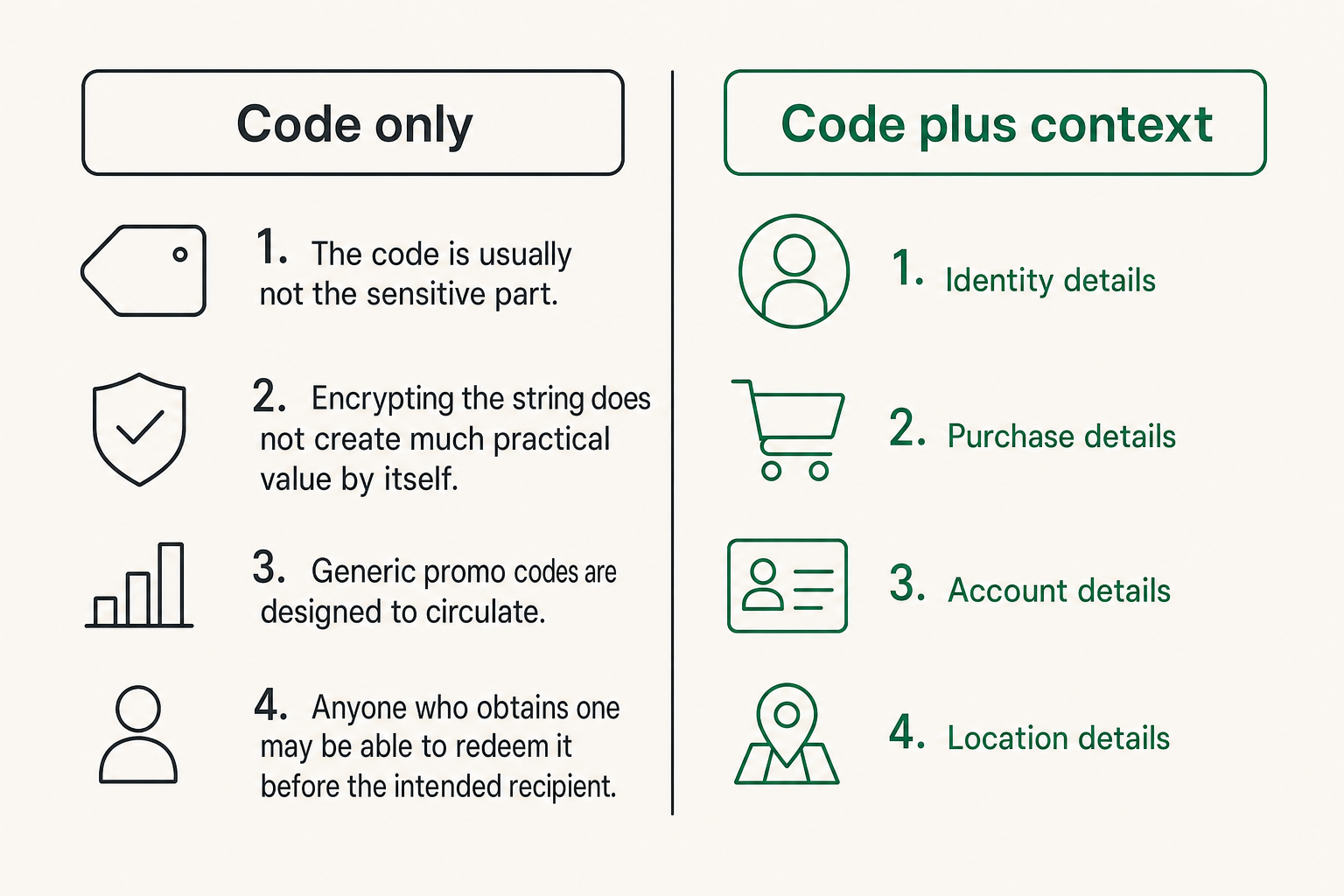
Most generic promo codes are designed to circulate. A code such as SAVE15 may appear on a merchant site, in an advertisement, or in thousands of emails. Encrypting that string does not create much practical value by itself.
The context around it is different. A message might say that an employee is ordering a replacement laptop, a family is booking travel on specific dates, or a customer is about to make a high-value purchase. Even when the coupon is public, that context can expose plans and relationships.
Some offers are also tied to a specific person or account. Single-use codes, employee benefits, loyalty rewards, referral credits, private beta offers, and customer-service concessions can function like bearer tokens. Anyone who obtains one may be able to redeem it before the intended recipient.
Practical rule: Classify the complete message, not just the coupon string.
Small messages create useful behavioral data
A stream of ordinary deal messages can build a detailed profile. It can show which merchants a person uses, when a company renews software, what equipment a remote team buys, or when someone expects to travel.
That information is useful for targeted phishing. An attacker does not need payment-card details if they know that a team is waiting for a shipment from a particular vendor. A convincing fake delivery update or account-renewal message may be enough to capture credentials.
This is why transport security, participant control, and retention matter even for conversations that look low risk in isolation.
Security should match the actual risk
The answer is not to treat every public discount as a state secret. Excessive controls cause people to route around the process, copy information into personal apps, or reuse unapproved channels.
A useful way to think about it is to apply stronger protection as the message accumulates sensitive elements. A public code with no context is low risk. A single-use code tied to an account is more sensitive. A checkout screenshot containing an address, order number, and email is sensitive even if the coupon shown in it is public.
That changes the conversation. The practical question is not “Should coupons be encrypted?” It is “Which coupon-sharing messages create enough exposure to require a private, limited, and short-lived channel?”
Define the threat model before choosing controls
Separate public offers from private entitlements
Start by separating reusable promotional codes from private entitlements. This prevents a team from applying the same controls to fundamentally different objects.
| Coupon type | Typical exposure | Main risk | Recommended handling |
|---|---|---|---|
| Public reusable code | Widely advertised | Fake or expired offer | Verify source; ordinary private chat is sufficient |
| Single-use code | Sent to one recipient | Theft before redemption | Share only with the intended recipient |
| Account-bound reward | Linked to a customer account | Account disclosure or misuse | Avoid forwarding; redeem inside the account |
| Employee or member benefit | Limited by eligibility | Policy violation and identity exposure | Use a scoped work channel and confirm eligibility |
| Referral link | Identifies or credits a referrer | Tracking and relationship disclosure | Explain ownership and remove unrelated parameters |
| Support-issued concession | Associated with an order or case | Order enumeration or impersonation | Do not include ticket details unless necessary |
The team at c0upons.com routinely works with the practical differences between promo codes, sales, deal roundups, and redemption conditions; that distinction is important because not every apparent “code” carries the same transfer rights or privacy risk.
Identify who could misuse the message
Threat modeling does not require a complex framework. Ask who should receive the message, who might gain access accidentally, and what either party could do with it.
Relevant actors can include former group members, compromised-device operators, malicious insiders, service administrators, link-tracking companies, or anyone who sees a notification preview. For business purchases, vendors and referral platforms may also connect the click to a company network, employee account, or campaign identifier.
The mistake teams make is focusing only on interception in transit. Messages can also leak from synchronized desktops, cloud backups, exported histories, screenshots, forwarded text, browser previews, and unlocked notification panels.
Decide what must remain private
Before choosing controls, list the assets in the workflow:
- The coupon or redemption token
- The merchant and intended purchase
- The sender and recipient relationship
- Account identifiers or eligibility status
- Order numbers, addresses, and travel dates
- Referral ownership and tracking data
- The fact that redemption succeeded or failed
Not all of these need the same protection. The classification should determine channel scope, expiration, and whether screenshots or files are acceptable.
Practical rule: If misuse would cost money, reveal identity, or expose business activity, limit both who can read the message and how long it remains available.
Understand the anatomy of a coupon message
Codes, links, and screenshots carry different risks
A plain-text code is easy to inspect. A link adds a destination, redirect chain, and tracking parameters. A screenshot can silently include account names, browser tabs, balances, addresses, filenames, notifications, and device information.
For that reason, plain text is often safer than a screenshot. A useful coupon message can usually be reduced to four fields:
Merchant: Example Store
Code: SAVE15
Condition: 15% off orders over $50
Expires: 2026-10-31
If a source is needed, identify the merchant page or campaign in words. The recipient can navigate independently rather than trusting an opaque short link.
Metadata can matter more than message text
End-to-end encryption protects message content between endpoints when implemented correctly. It does not automatically hide every piece of metadata. Depending on the service and configuration, information such as account identifiers, membership, message timing, device details, or connection records may still exist.
For most coupon sharing, this does not mean the channel is unusable. It means users should avoid assuming that encrypted content makes the complete interaction invisible. A procurement team discussing a specific vendor every quarter may reveal a pattern even if individual messages remain unreadable.
Notification behavior matters too. A private message displayed in full on a locked screen is not private from a nearby observer. Sensitive codes should not appear in message previews when device exposure is plausible.
Redemption changes the sensitivity
A code may become worthless after redemption, but the conversation can become more sensitive. Confirmation messages often add receipt numbers, payment status, names, addresses, or delivery estimates.
Avoid replying with a complete checkout screenshot just to say that a code worked. A short response such as “Redeemed successfully; code is no longer available” closes the operational loop without creating a lasting purchase record.
For a failed code, report the minimum useful reason: expired, eligibility mismatch, minimum spend not met, or already used. Do not paste an account page unless the recipient genuinely needs it.
Build a secure coupon-sharing workflow
Verify before sharing
A secure channel can faithfully deliver a malicious link. Verification therefore comes before encryption in the workflow.
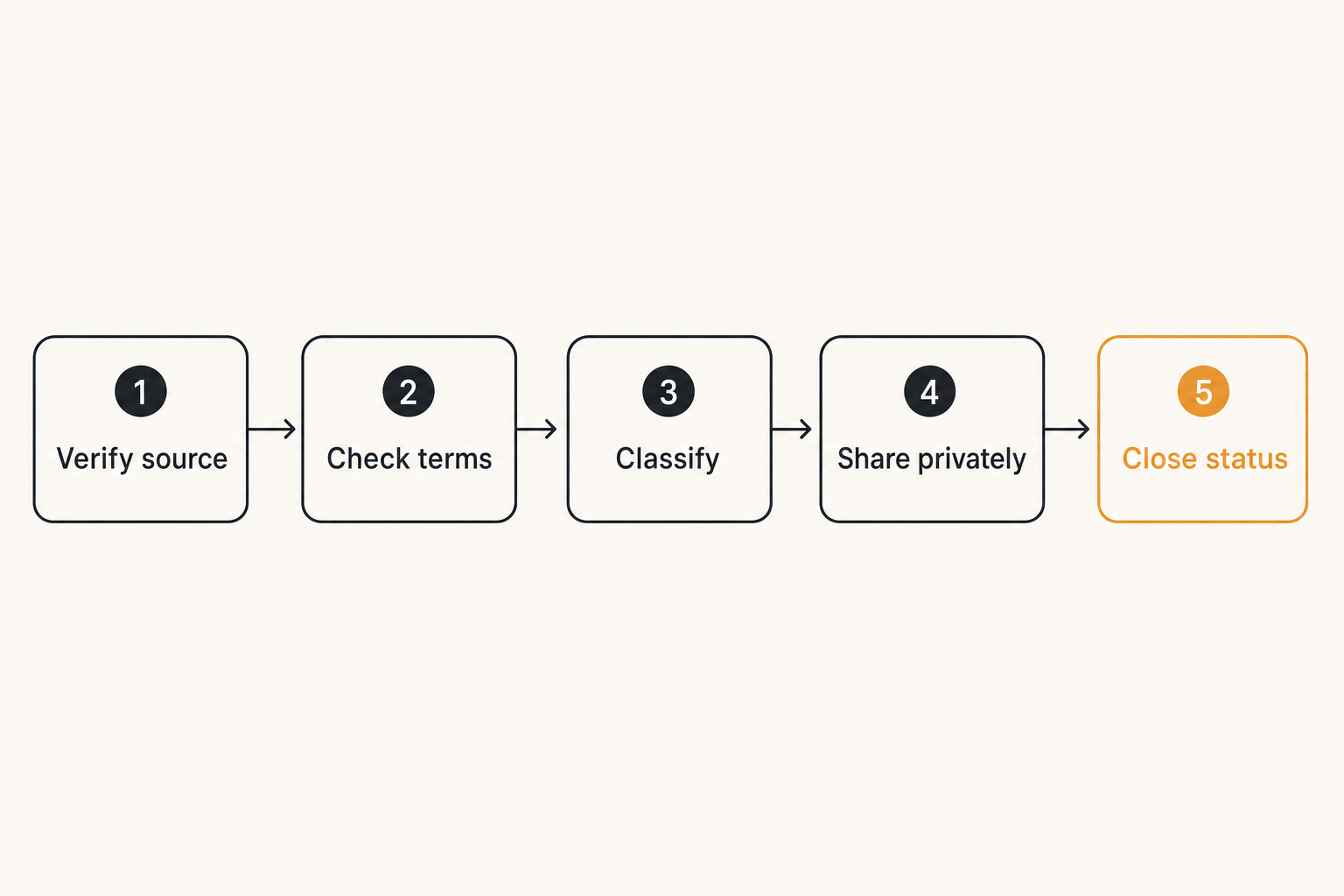
Use the following sequence:
- Identify the offer source. Determine whether it came from the merchant, a known publisher, a loyalty account, customer support, or an unknown message.
- Inspect the terms. Check the expiration, eligible products, region, minimum spend, account restrictions, and whether the code is single-use.
- Validate the destination. If a link is involved, inspect the actual domain and avoid relying on display text or a shortened URL.
- Classify sensitivity. Decide whether the offer is public, transferable, account-bound, or tied to an employee or customer identity.
- Choose recipients and retention. Share only with people who can use it legitimately, using an expiration appropriate to the offer.
- Record the outcome minimally. Mark the code as used, invalid, or still available without attaching unnecessary purchase data.
This process is intentionally short. If verification takes longer than the discount is worth, skip the offer rather than lowering the security standard.
Share the minimum useful information
A recipient typically needs the merchant, code, key terms, expiration, and confidence level. They rarely need the sender’s full promotional email or account screenshot.
A structured team message might look like this:
Offer: 20% off annual plan
Merchant: Example SaaS
Code: TEAM20-7K4P
Scope: Single use; business account only
Expires: 2026-10-12 18:00 UTC
Source: Vendor account manager
Owner: Procurement
Status: Available
This format makes restrictions visible and gives the code an owner. It also reduces follow-up messages that might expose more context.
Practical rule: Share enough to redeem and verify the offer, but not enough to reconstruct the buyer’s account or transaction.
Close the loop after redemption
Single-use codes create a small coordination problem. If nobody updates their status, multiple people may attempt redemption, generating confusion or causing fraud controls to trigger.
Use simple states: available, claimed, redeemed, invalid, and expired. The person who claims a code should update the message before checkout and confirm afterward. If the claim is abandoned, the code can return to available without exposing why the purchase was cancelled.
For ephemeral conversations, make sure status remains visible long enough to prevent duplicate attempts. Message expiration should follow the operational lifecycle rather than deleting the code before its recipient can use it.
Handle links without creating a phishing channel
Prefer merchant navigation over blind clicks
Coupon sharing often becomes link sharing, and that is where risk increases sharply. Fake storefronts can reproduce branding, product pages, and checkout screens. Encryption cannot tell the recipient whether a destination is authentic.
When possible, send the code as text and instruct the recipient to open the merchant through a known bookmark, official application, or manually entered domain. This adds a small amount of friction but removes several redirect and lookalike-domain risks.
If the discount works only through a campaign link, state that clearly. Include the expected merchant domain and ask the recipient to verify it before entering credentials or payment details.
Remove unnecessary tracking parameters
Marketing links may contain campaign identifiers, referral tokens, click IDs, email-recipient identifiers, and other parameters. Some are required for attribution or discount activation; others merely expand the data trail.
Do not remove parameters blindly because doing so may invalidate the offer. First compare the link’s base path and query parameters. If the offer works without unrelated analytics values, share the reduced version. If a referral component is intentional, disclose it rather than disguising it.
Shortened URLs are a poor default for private sharing because they hide the destination. Where unavoidable, the sender should identify the expected final domain in the message.
Treat urgency as a risk signal
Legitimate promotions expire, so urgency alone does not prove fraud. However, messages that combine a steep discount, immediate expiration, an unfamiliar domain, and a demand to log in deserve skepticism.
Attackers benefit when recipients feel they must act before verifying. A secure workflow gives recipients permission to lose a discount rather than gamble with an account or payment method.
Useful warning signs include:
- A domain that differs by one character from the merchant
- A request to install an application or browser extension
- A coupon requiring wallet recovery phrases or authentication codes
- Payment requested through an unrelated person or irreversible channel
- A supposed support agent asking for remote device access
- A deal that cannot be found through any official merchant path
Share coupon codes safely in remote teams
Use scoped rooms instead of broad channels
A company-wide channel is convenient, but it expands visibility and retention. Offers for software, travel, equipment, or client-related purchases can reveal operational plans to people who do not need them.
Use a small room for procurement, finance, or the specific project. Review membership when roles change. Contractors and temporary staff should not retain access indefinitely simply because they once needed a discount code.
For general public promotions with no business context, a broad social room may be reasonable. The important distinction is whether the surrounding conversation exposes budgets, vendors, renewal schedules, or customer work.
Assign ownership for business purchases
The practical question is who owns verification and redemption. Without ownership, one person shares a code, another assumes finance approved it, and a third enters company payment details on an unverified page.
For material purchases, define three responsibilities:
- Finder: supplies the offer and its source.
- Verifier: confirms the merchant, terms, and transferability.
- Buyer: completes the approved purchase and reports status.
One person can hold multiple roles for low-value transactions. The value is not bureaucracy; it is preventing a discount message from bypassing purchasing controls.
Separate discounts from credentials
Never place a password, one-time authentication code, recovery code, API key, or payment credential in the same message as a coupon. A recipient who needs purchasing access should receive it through the organization’s approved credential workflow.
Shared merchant accounts create an additional issue. A coupon conversation can reveal that an account exists and who controls it. Keep authentication in a password manager or access-management system, not in chat history.
The same applies to gift cards and stored-value vouchers. Although users may call them coupons, they behave more like cash. Treat the number and PIN as financial credentials, use a one-to-one channel, and confirm the recipient’s identity through an established contact.
Recognize what breaks in practice
Encrypted delivery does not validate content
The most common conceptual failure is treating secure transport as content verification. End-to-end encryption can protect a message from intermediaries while still delivering a fraudulent coupon from a compromised friend or colleague.
What works is combining private delivery with source validation and recipient judgment. What fails is attaching institutional trust to anything posted in an encrypted room.
Account compromise is especially dangerous because the message arrives from a familiar identity. Unexpected deals involving login pages, payment changes, or software downloads should be confirmed through a separate established path.
Screenshots leak more than expected
What breaks in practice is the habit of using screenshots as universal evidence. A screenshot may capture the browser profile, bookmarks, extensions, open tabs, email address, loyalty balance, partial card number, or another conversation.
Cropping helps but does not guarantee safety. Image metadata, hidden interface elements, or overlooked text can remain. Redaction must remove information rather than placing a translucent mark over it.
Plain text is preferable when the goal is to communicate a code and terms. If visual proof is necessary, capture only the relevant region, inspect the final file, and avoid showing order or account pages.
Permanent history becomes an informal database
A long-lived deals channel can become a searchable record of purchasing behavior. Members joining later may gain access to old conversations, and departing members may retain exports or synchronized copies.
Deletion cannot guarantee recall from every endpoint, but retention controls still reduce routine exposure. Set messages to expire after the offer lifecycle unless accounting, policy, or dispute handling requires a record.
Do not use a chat log as the official purchasing ledger. Finance records should live in the approved system with appropriate access controls and retention. The chat should coordinate activity, not become a shadow database.
Implement controls without adding excessive friction
Set a simple message format
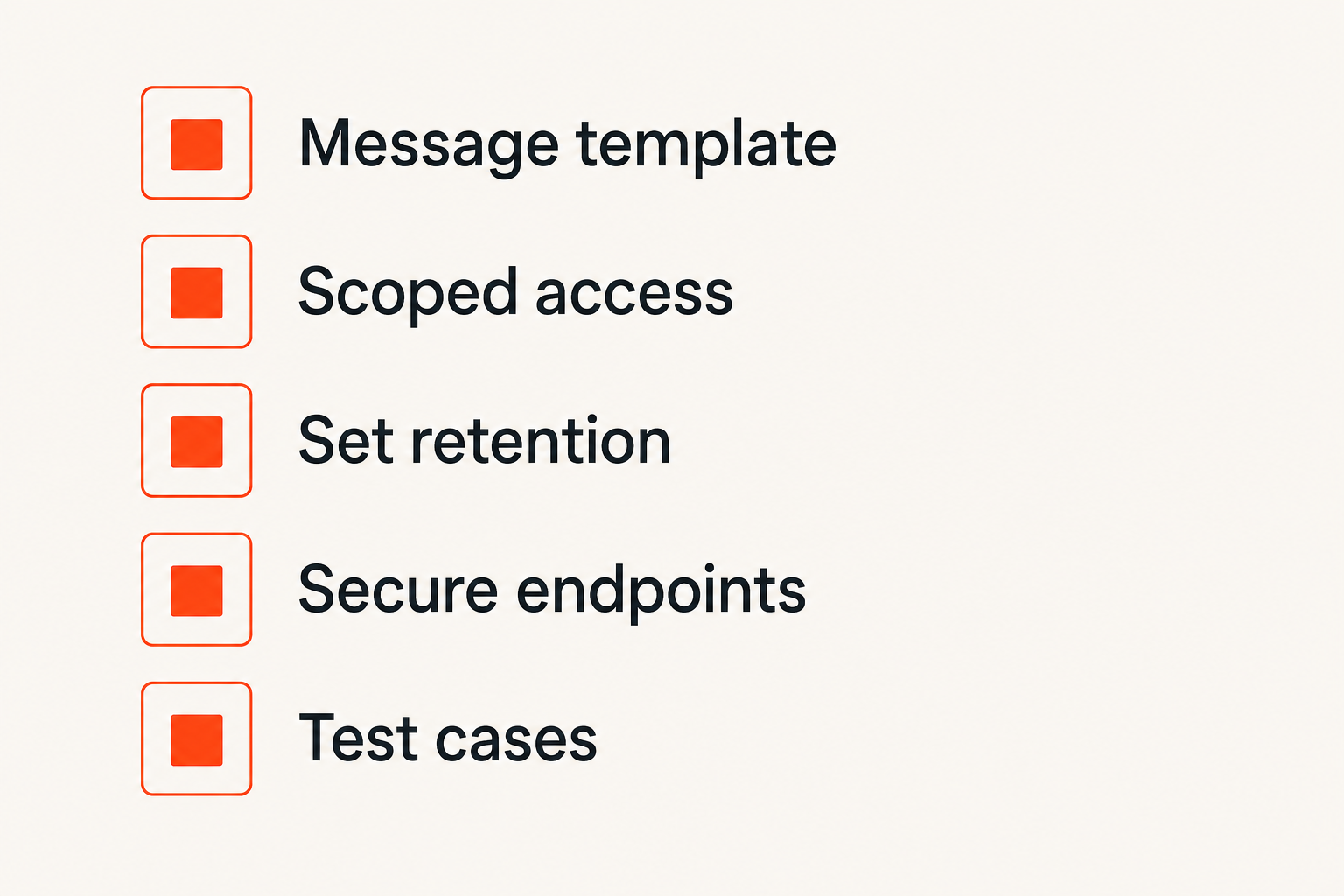
A practical implementation begins with a template, not a lengthy policy. Require the fields that allow another person to assess and use the offer safely:
- Merchant name
- Code or clearly identified campaign link
- Main conditions and expiration
- Public, single-use, or account-bound classification
- Source confidence
- Owner and current status
For higher-risk messages, add a warning such as contains referral tracking, employee eligibility required, or do not forward. Consistent labels are easier to scan than free-form explanations.
A moderation bot is not essential and may introduce another data processor. If automation is used, keep it narrow. It might remind users when a code expires or flag common URL shorteners, but it should not copy private messages into an external analytics service.
Configure retention and membership
Channel settings should follow the classification model. A reasonable baseline is:
- Public reusable codes: normal private-room retention
- Single-use codes: expire shortly after redemption or offer expiry
- Account-bound rewards: one-to-one conversation with short retention
- Business procurement offers: scoped room; retain decisions in the procurement system
- Gift cards or stored value: one-to-one delivery and immediate status confirmation
Review whether new members can read history. For sensitive rooms, history should not automatically appear to every future participant. Also examine linked desktops, browser sessions, backup behavior, notification previews, and lost-device procedures.
Practical rule: Message encryption is one control; membership, endpoints, notifications, backups, and retention complete the system.
Test the workflow with realistic cases
A policy that works only for a clean public code will fail under pressure. Test it with representative cases:
- A reusable code copied from a merchant homepage
- A single-use loyalty reward sent by email
- A referral link containing multiple tracking parameters
- An employee discount for business equipment
- A checkout screenshot containing personal data
- A gift card mistakenly described as a coupon
- A deal message sent from a colleague’s compromised account
For each case, ask whether users know where to share it, how to verify it, what to omit, and when to delete it. If the answer depends on a security specialist being present, simplify the workflow.
Implementation succeeds when the safe action is also the obvious action: paste a minimal template into a trusted private room, verify unusual links, and close the status after use.
Choose the right channel for the sensitivity
Match the channel to the coupon type
Not every offer needs the same channel. The following decision model keeps controls proportional:
| Situation | Suitable channel | Avoid |
|---|---|---|
| Public code with no personal context | Private group or direct message | Posting with account screenshots |
| Single-use transferable code | Direct encrypted message | Large rooms and permanent archives |
| Account-bound loyalty offer | Keep within the account | Forwarding login or account details |
| Team procurement discount | Scoped encrypted work room | Public social channels |
| Gift card or cash-equivalent voucher | Verified one-to-one exchange | Email chains or shared documents |
| Suspicious or unverified link | Do not distribute until checked | Assuming encryption makes it safe |
The mistake teams make is choosing a channel based only on convenience. Channel selection should account for participant scope, identity assurance, endpoint security, retention, and forwarding risk.
Know what encryption does and does not solve
Encryption can protect content against network observers and service-side access, depending on the system’s architecture and implementation. It can also reduce exposure when users must coordinate across untrusted networks.
It does not fix a compromised endpoint, careless recipient, malicious sender, fake merchant, weak device passcode, or visible notification. Nor does it determine whether a coupon is legitimate or transferable.
This distinction keeps expectations realistic. Secure messaging is the protected coordination layer. Verification, purchasing controls, and endpoint hygiene remain separate responsibilities.
Escalate when identity or payment data appears
A coupon conversation should stop being treated as casual deal sharing when it includes payment credentials, identity documents, tax information, complete addresses, travel records, or account-recovery material.
Move the transaction into the merchant’s verified checkout or the organization’s approved procurement process. If support must review a failed discount, use the merchant’s authenticated support channel and provide only the fields requested.
No discount justifies sending a seed phrase, password, complete card number, or one-time login code. A promotion requesting those items is not merely unusual; it should be treated as hostile.
Make secure sharing the default
A short policy for individuals and teams
A workable coupon codes secure messaging policy can fit into seven lines:
- Verify the merchant and offer before sharing.
- Send codes as text when possible.
- Identify whether the offer is public, single-use, or account-bound.
- Use a private, appropriately scoped conversation.
- Do not include credentials, payment data, or unnecessary screenshots.
- Mark single-use codes as claimed and redeemed.
- Delete or expire messages when they no longer have operational value.
This policy protects the information that actually matters without pretending every discount is highly confidential. It also gives users clear reasons to pause when a routine message starts accumulating sensitive context.
Where private messaging fits
Private messaging works best as part of a broader workflow. The sender verifies the offer, minimizes the content, selects the right recipients, and communicates through a channel designed to protect the conversation. The recipient independently checks unusual destinations and redeems through the official merchant path. Both sides avoid leaving a permanent record unless one is required.
For privacy-conscious users and remote teams, a service such as qrypt.chat can provide the private coordination layer for direct or group conversations. Product fit depends on the full threat model: users should still secure devices, verify contacts, control room membership, and avoid treating encrypted delivery as proof that a deal is authentic.
The broader lesson is simple. Coupon codes secure messaging is not about hiding every promotional phrase. It is about preventing an ordinary discount workflow from exposing accounts, identities, relationships, purchasing plans, or credentials.
Try qrypt.chat
Use private messaging for sensitive coordination, without turning routine communication into a public record. Try qrypt.chat.