
Sharing a coupon code looks harmless. Paste a code into a chat, add the store link, and help someone save money. In practice, that message can reveal what a person plans to buy, which accounts they use, where they work, or which internal project is about to incur an expense.
The risk is not usually the coupon itself. It is the link around it, the context attached to it, and the messaging system that retains it. A fake promotion can also become a credible phishing lure when it arrives from a trusted colleague or family member.
Teams think the problem is choosing between coupon codes and secure messaging. The real problem is designing a verification and sharing workflow that does not turn a small discount into a durable record of identity, intent, and account activity.
That changes the conversation. The practical question is not simply whether a chat application claims to be encrypted. It is whether the complete path—from discovering a promotion to redeeming it and cleaning up the conversation—preserves trust at every step.
Table of contents
- Why coupon codes secure messaging is a workflow problem
- Build a realistic threat model
- Design the coupon codes secure messaging architecture
- Verify a deal before you share it
- Use a safer sharing workflow
- What works and what fails
- Common failure modes in private deal sharing
- Implement coupon sharing for remote teams
- Measure whether the workflow is actually safer
- Private deal sharing with qrypt.chat
Why coupon codes secure messaging is a workflow problem
The phrase “coupon codes secure messaging” sounds like two unrelated topics forced together. Operationally, they meet whenever someone discovers a promotion on the open web and moves it into a trusted conversation.
That transition matters. A public offer becomes endorsed by a known sender. Recipients are less likely to inspect it carefully, especially when the message includes urgency such as “expires tonight” or “use this before it is gone.” The communication channel has added trust that the original source did not earn.
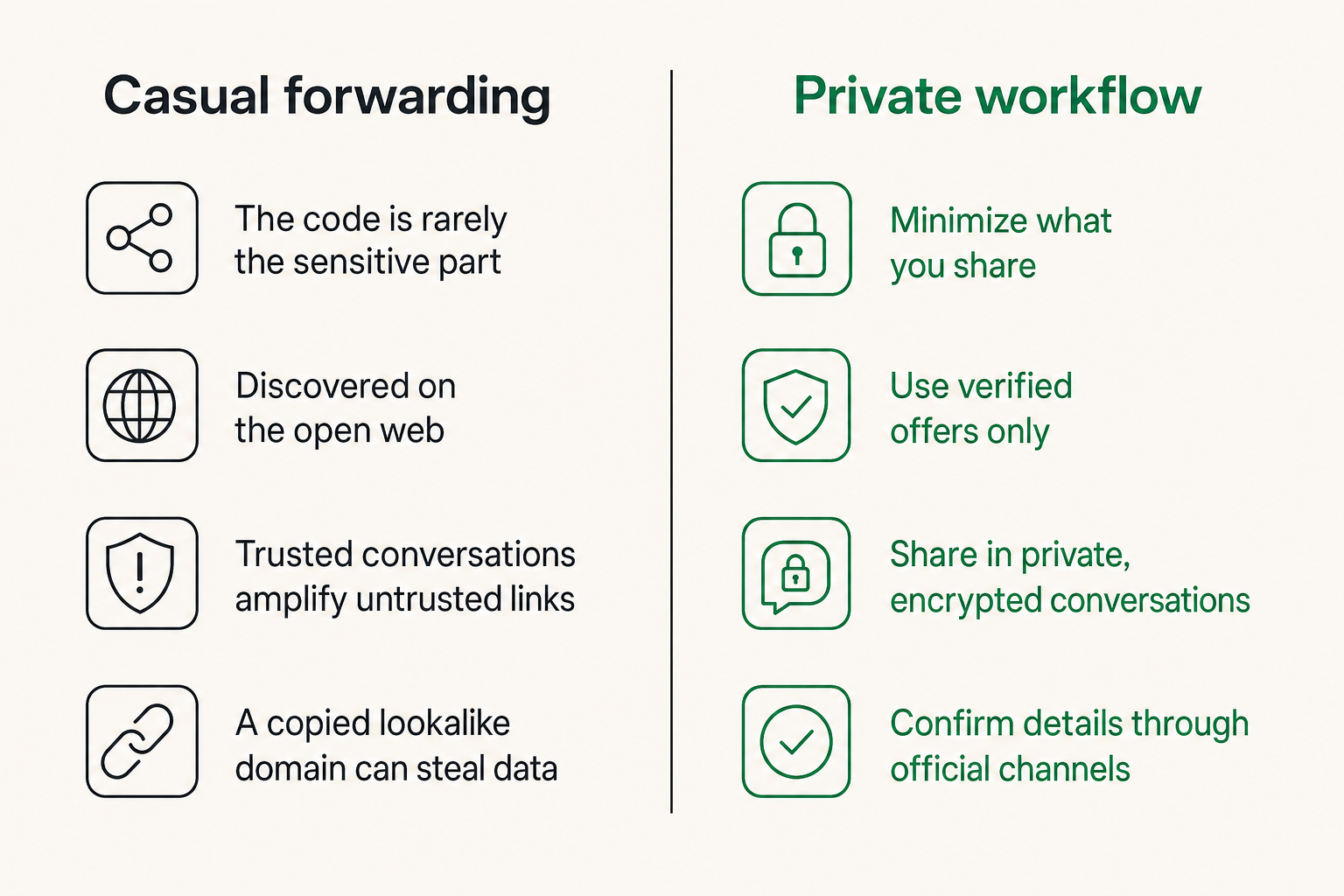
The code is rarely the sensitive part
A generic code such as SAVE15 may be public and reusable. The surrounding message can be much more revealing:
- A software discount can expose which tools a company is evaluating.
- A travel offer can disclose dates, destinations, or planned absences.
- A medical or wellness promotion can reveal sensitive interests.
- A code tied to an account can expose an email address, membership, or purchase history.
- A screenshot can include names, tabs, order numbers, and notification previews.
The mistake teams make is classifying the message by its smallest field. “It is only a coupon” ignores the rest of the payload.
Trusted conversations amplify untrusted links
Attackers do not need to defeat encryption if users willingly open a malicious destination. A copied lookalike domain, compromised deal page, or redirect through an unknown tracker can travel perfectly well inside an encrypted conversation.
Secure transport protects a message while it moves between participants. It does not certify that the sender evaluated the destination correctly. Encryption and verification solve different problems, and a safe workflow needs both.
Privacy depends on the entire path
A useful way to think about it is as a chain:
discovery → verification → sharing → opening → redemption → retention
Weakness at any point can defeat the rest. A verified code shared in a public channel exposes context. An encrypted message containing a malicious link protects the attacker’s lure. A private conversation retained indefinitely creates a searchable purchasing history.
Practical rule: Protect the context around a coupon with the same care you apply to the code, link, and checkout account.
Build a realistic threat model
Before choosing settings or writing policy, define what could go wrong. A household, privacy group, and distributed finance team will not have identical risks. The goal is not to model every theoretical adversary. It is to identify credible failures and put controls where they reduce actual harm.
Identify what the message reveals
Start with the content visible to participants and potentially stored on their devices. Look beyond the code:
- Merchant name and product category
- Intended buyer or department
- Timing and purchasing urgency
- Referral identifiers
- Loyalty status or account eligibility
- Billing region or currency
- Screenshots, receipts, and order references
Ask whether the same message would still be acceptable if it appeared in a device backup, notification history, forwarded chat, or support ticket. If not, reduce the payload before sending it.
Separate content protection from metadata
End-to-end encryption is designed to keep message content unavailable to intermediaries. It does not automatically hide every form of metadata. Depending on the service and configuration, observable data may include participant identifiers, message timing, IP-related information, device details, group membership, or notification content.
Metadata can still be revealing. A burst of messages in a procurement group immediately before a vendor purchase may expose intent without exposing the exact coupon.
This does not make encrypted messaging useless. It means the architecture should avoid promising anonymity when the system is primarily providing message confidentiality.
Decide which adversaries matter
For most deal-sharing workflows, practical threats include:
- A scammer distributing fake promotions.
- An advertising network correlating clicks and accounts.
- An unauthorized person reading an unlocked device.
- A former group member retaining old messages.
- A compromised participant account forwarding trusted links.
- A curious platform, administrator, or backup provider collecting more data than expected.
Rank these by likelihood and impact. A remote team may prioritize access control and offboarding. A privacy-conscious individual may care more about tracking parameters, metadata, and local retention.
Design the coupon codes secure messaging architecture
The best architecture does not ask one tool to perform every function. Deal discovery, source verification, conversation, authentication, payment, and recordkeeping have different trust requirements.
Treat discovery verification and sharing as separate stages
Discovery is noisy by nature. Offers arrive through search results, newsletters, social posts, browser extensions, and deal sites. Verification should be a deliberate checkpoint before anything enters a trusted chat.
Sharing is a distribution step, not proof of validity. The sender should be able to state where the offer came from, what was checked, and what uncertainty remains. Recipients should not have to infer those facts from confidence or tone.
For practical deal-finding context, the guest team at c0upons.com works with coupon codes, promotions, sales, and shopping conditions; that domain knowledge is useful only when paired with disciplined link and privacy checks before sharing.
Minimize data at every boundary
Data minimization is more dependable than trying to secure unnecessary data forever. Before posting, remove:
- Email addresses embedded in copied text
- Referral and affiliate parameters that are not required
- Order numbers and customer identifiers
- Full-page screenshots when a short text description will do
- Personal explanations that reveal why someone needs the item
- Login links, session tokens, and password-reset URLs
Do not “clean” a URL by guessing which parameters are safe to delete and then assume it still represents the same destination. Open the merchant’s known domain independently and locate the promotion there when possible.
Keep redemption outside the conversation
Chat should carry the minimum information required to locate and evaluate an offer. Authentication, address entry, payment, and final redemption belong on the verified merchant property—not inside chat, a bot, or an embedded form sent by another participant.
Never paste one-time login codes, card details, recovery phrases, or account passwords alongside a promotion. If an offer requires another person’s credentials, it is not a shareable coupon workflow. It is account sharing, with a much larger security boundary.
Practical rule: Use chat to coordinate the purchase, not to become the checkout, identity provider, or payment processor.
Verify a deal before you share it
Coupon verification has two dimensions. Commercial verification asks whether the offer works and under which terms. Security verification asks whether the destination and redemption path can be trusted. Passing one does not imply passing the other.
Inspect the source and destination
Read the registered domain from right to left and look for substitutions, added words, unusual subdomains, or characters that resemble others. A merchant name appearing somewhere in a long URL does not make that merchant the destination.
Prefer navigating from a known merchant homepage over opening an unfamiliar short link. Check whether the promotion appears in the merchant’s own sale pages, account area, or checkout. If a coupon came from a screenshot, manually type the code rather than following any QR code or obscured URL shown beside it.
A code failing at checkout is not automatically fraudulent; exclusions and expiration are common. But a page requesting unrelated credentials, software installation, notification permission, or payment to “unlock” a discount should stop the workflow.
Watch for tracking and redirect chains
Marketing links often pass through several redirects. Some are ordinary attribution systems, but each additional party can receive request data and creates another place where destinations may change.
Link previews can also contact a site before the recipient chooses to open it. Depending on implementation, the preview request may come from a service proxy or the user’s device. Either way, it can reveal that someone in the conversation received or interacted with a URL.
Where possible, share the canonical merchant page and place the code in plain text. If the promotion depends on a tracked referral link, say so explicitly so recipients can decide whether the discount is worth that disclosure.
Confirm the commercial terms
Check the details that commonly cause confusion:
- Expiration date and time zone
- New-customer or account-specific restrictions
- Minimum order value
- Product, region, or payment-method exclusions
- Automatic renewal after a discounted period
- Whether the code can be combined with another offer
- Return terms for discounted items
Do not convert uncertainty into a claim. “Reported to work on annual plans” is more useful than “works everywhere” when coverage has not been verified.
Use a safer sharing workflow
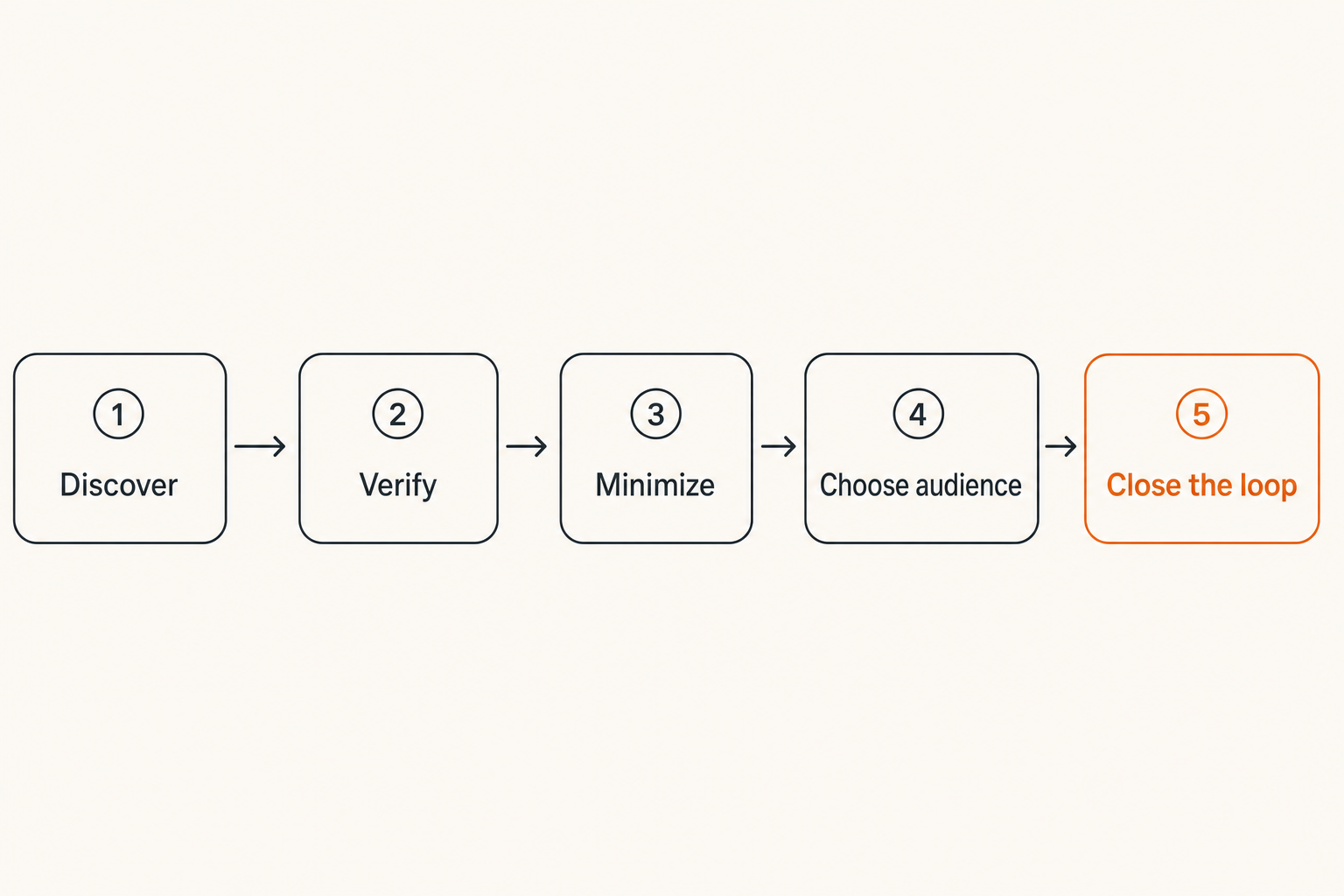
Security improves when the safe action is repeatable. A lightweight sequence is more effective than telling every participant to “be careful,” because caution is difficult to apply consistently under time pressure.
Follow a six-step sequence
- Discover the offer. Record the code and claimed terms without immediately forwarding the original message.
- Verify the source. Confirm the merchant domain, destination, eligibility, and expiration from the best available source.
- Reduce the payload. Remove account details, unnecessary trackers, screenshots, and personal purchasing context.
- Choose the audience. Send only to people who need the offer, using an encrypted one-to-one or tightly scoped group conversation.
- Label uncertainty. State whether the code was tested, merely published, account-bound, or dependent on a referral link.
- Close the loop. Report whether it worked, then remove obsolete messages according to the group’s retention rule.
This workflow separates endorsement from forwarding. The sender becomes responsible for describing what was actually checked.
Share the minimum useful context
A good message might contain four fields:
Merchant: Example Store
Code: SAVE15
Terms: 15% off selected items; reported expiry 30 Sep
Source status: Domain checked; code not personally tested
If a canonical sale page is necessary, add it without surrounding browsing parameters. Avoid saying who plans to buy, which company card will be used, or why the purchase is needed unless that information is operationally necessary.
The minimum useful message is not always the shortest. A bare link creates more ambiguity and may increase risk because recipients cannot judge the destination without opening it.
Handle account-bound offers carefully
Some promotions are generated for one customer, email address, loyalty account, device, or payment method. Sharing them may fail, violate terms, or expose identity.
Before posting an account-bound offer, ask:
- Is the code transferable?
- Does it contain an encoded customer identifier?
- Will redemption expose the original account holder?
- Does sharing affect loyalty points or referral credit?
- Could repeated attempts trigger account security controls?
If these answers are unclear, share the existence of the promotion rather than the unique code. Recipients can check their own accounts independently.
Practical rule: If a promotion is tied to identity, treat it as account data first and a coupon second.
What works and what fails
The controls that work are usually modest: verify the destination, reduce context, restrict the audience, and avoid indefinite retention. What fails is relying on one impressive feature while leaving the rest of the workflow open.
Compare common sharing approaches
| Approach | What works | What breaks in practice |
|---|---|---|
| Public social post | Broad reach and easy discovery | Exposes interests, attracts abuse, and strips audience control |
| Email thread | Familiar and searchable | Easy forwarding, long retention, visible headers, and accidental reply-all |
| General workplace channel | Convenient for teams | Oversharing, broad membership, unmanaged history, and unclear ownership |
| Encrypted direct message | Strong content confidentiality and narrow audience | Recipient endpoint, metadata, malicious links, and screenshots remain risks |
| Encrypted private group | Useful for recurring deal coordination | Membership drift, forwarding, and stale content require active management |
| Password manager note | Suitable for tightly controlled sensitive records | Poor discussion workflow and inappropriate for casual public codes |
The table does not identify one universal winner. It shows why channel choice should follow the sensitivity and lifespan of the context.
Use expiration as damage control
Disappearing messages reduce the amount of old conversational data available later. They are useful for short-lived offers, especially when a promotion expires within hours or days.
They are not remote deletion. A recipient may copy, screenshot, export, photograph, or back up a message before it disappears. Notifications and linked devices may preserve fragments. Retention controls should therefore complement data minimization rather than justify sharing more.
A practical rule is to set expiration slightly beyond the deal’s useful life, leaving enough time to report success or failure. Teams should preserve formal purchase records in the approved accounting system, not in the coupon conversation.
Treat link previews as external requests
Automatic previews improve convenience but complicate privacy. The system may fetch page titles, images, and metadata as soon as a URL is pasted or delivered. That request can disclose timing and associate the chat workflow with a destination.
For sensitive groups, disable automatic previews where possible or generate them only after explicit action. Send a merchant name and coupon code without a URL when recipients can safely navigate to the known site themselves.
What breaks in practice is assuming that “nobody clicked” means “no request left the device or service.” Preview behavior needs to be tested, not guessed.
Common failure modes in private deal sharing
Most failures do not involve broken cryptography. They involve people placing too much trust in an encrypted channel, forwarding information beyond its intended audience, or using compromised endpoints.
Encryption creates false confidence
A padlock icon can make a message feel vetted. It only indicates something about transport and access, depending on the product’s design. It does not prove that:
- The deal is genuine.
- The sender’s account is uncompromised.
- The domain is correctly spelled.
- The recipient’s device is safe.
- The offer complies with merchant terms.
- The message will not be copied elsewhere.
Teams should avoid language such as “safe because it was sent here.” The correct statement is narrower: the channel reduces exposure of message content to parties outside the conversation.
Forwarding destroys the original boundary
The sender may choose a small group, but recipients can move the content into email, ticketing systems, social feeds, or other chats. Forwarded screenshots are particularly problematic because they preserve surrounding names, timestamps, avatars, and previous messages.
Make forwarding expectations explicit. If broader distribution is acceptable, create a sanitized version containing only public deal information. If it is not acceptable, state that the promotion is account-specific or context-sensitive and should not leave the conversation.
No technical setting can fully prevent a legitimate recipient from reproducing information they can see. Audience selection remains a trust decision.
Endpoints remain the weak point
Encrypted messages become readable on participant devices. Malware, unlocked screens, shared browser profiles, notification previews, clipboard managers, and cloud backups can expose them after decryption.
Basic endpoint discipline matters:
- Use device encryption and a strong unlock method.
- Install operating system and browser updates.
- Review linked sessions and remove old devices.
- Hide sensitive notification content on lock screens.
- Avoid shared accounts for private deal groups.
- Treat browser extensions with access to all pages as part of the risk boundary.
A perfectly encrypted message opened on an unmanaged shared laptop is not a private workflow.
Implement coupon sharing for remote teams
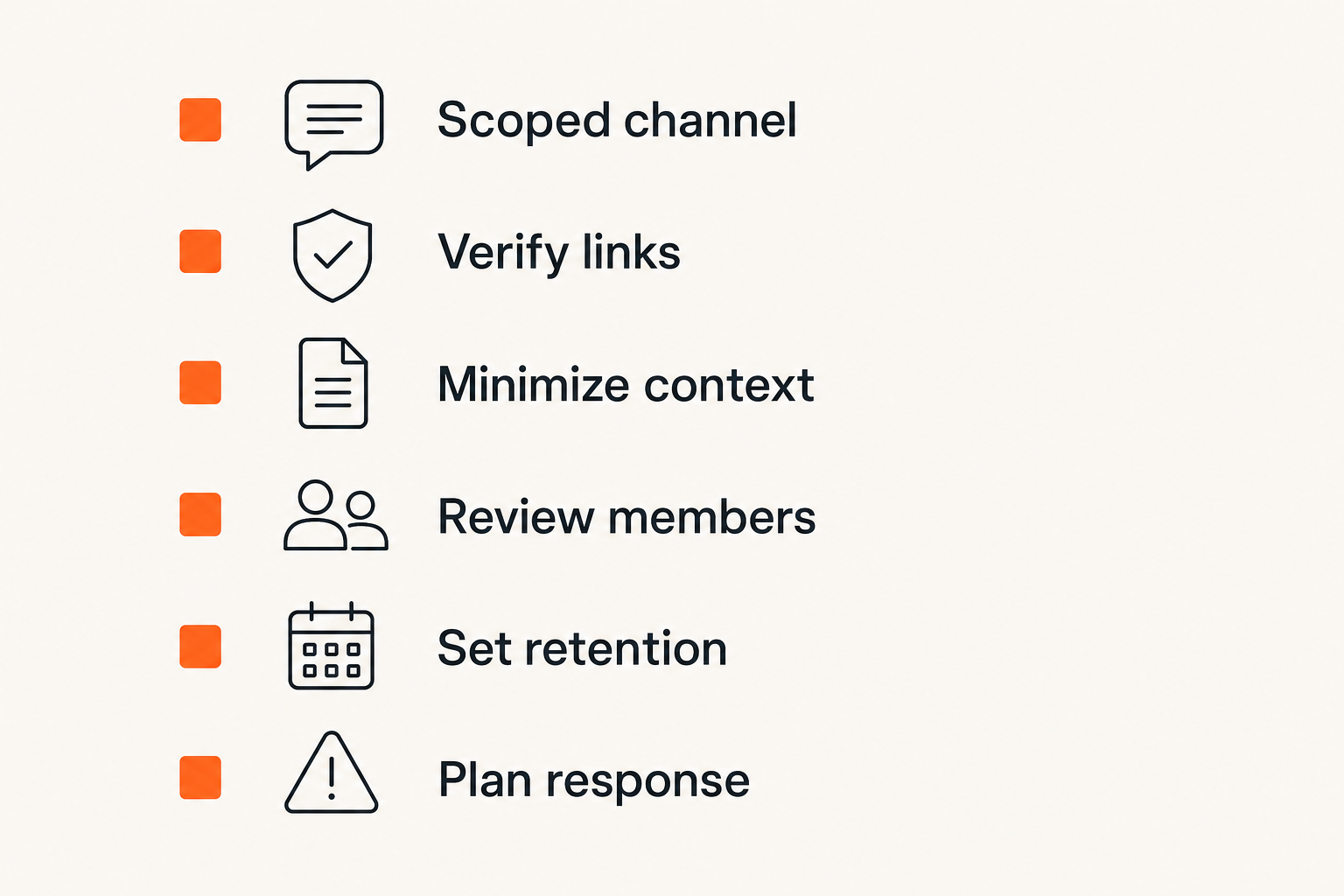
Remote teams often share software discounts, travel offers, equipment promotions, and vendor credits. Informal sharing can reduce cost, but it can also disclose procurement plans or create unofficial purchasing processes. Implementation should fit existing approval, security, and accounting controls.
Define channels and ownership
Create a narrowly scoped conversation for offers rather than mixing them into project rooms. Limit membership to people who need to discover, evaluate, or approve purchases. Assign an owner responsible for membership review and stale-message cleanup.
Define which content is allowed. Generic public codes may be fine. Customer-specific quotes, invoices, card data, credentials, and contract terms should use approved systems designed for those records.
The channel owner does not need to validate every discount personally. Ownership means maintaining the workflow, resolving ambiguous cases, and ensuring that “temporary” access does not become permanent.
Create a compact message template
Consistency makes suspicious omissions visible. A remote team can use this template:
Vendor:
Offer/code:
Canonical destination:
Eligibility and expiry:
Verification performed:
Tracking/referral disclosure:
Owner for questions:
Do not make every field mandatory when it does not apply. The purpose is to capture trust-relevant context without turning a quick share into paperwork.
For higher-risk purchases, add an approval status but keep procurement authorization separate from coupon verification. A valid discount does not authorize a purchase, and an approved purchase does not make an unverified link safe.
Set retention and incident rules
Decide how long offer messages remain available. The period should reflect their operational value, not the maximum storage the platform allows. Expired codes generally do not need to remain in chat once results have been recorded.
Document what participants should do after discovering a malicious or compromised link:
- Stop further sharing and label the message as unsafe.
- Notify the group without repeating the active link.
- Identify who opened it and what information they entered.
- Reset affected credentials from a known-good device if necessary.
- Revoke sessions, review payment activity, and contact the merchant through an independently verified channel.
- Remove the message after preserving only the incident evidence required by policy.
Speed matters, but so does precision. Vague warnings such as “do not click that” are less useful than stating which message, domain, and behavior were involved.
Measure whether the workflow is actually safer
Security controls need feedback. The goal is not to maximize message volume or count how many coupons were posted. It is to find whether participants verify sources, understand uncertainty, and contain mistakes quickly.
Track operational signals rather than vanity metrics
Useful internal signals include:
- Percentage of shared offers with a clear source status
- Number of messages containing unnecessary personal data
- Time taken to flag and contain a malicious link
- Number of stale members removed during access reviews
- Frequency of account-bound codes posted to broad groups
- Reports of tracking or referral links shared without disclosure
These measurements can be reviewed qualitatively for small groups. Do not build invasive monitoring that defeats the privacy objective. Sampling sanitized workflow outcomes is usually more appropriate than collecting every message centrally.
Review exceptions and near misses
A code that almost caused harm is valuable evidence. Review why participants trusted it. Was the sender known? Did urgency reduce scrutiny? Did the URL preview hide the actual domain? Was the group too broad?
Focus on system changes rather than blame. If several people miss the same deceptive pattern, the workflow needs a clearer checkpoint. If participants routinely bypass a rule, determine whether the rule is unrealistic or the safe path is too difficult.
Near misses should produce small improvements: a revised template, disabled previews, a membership review, or clearer rules for referral links.
Test the process periodically
Run a tabletop exercise with a fictional expired or suspicious offer. Ask participants to explain how they would verify it, what they would share, and how they would respond if someone entered credentials.
Also test product behavior directly:
- Does pasting a link generate a remote preview?
- What remains after a disappearing message expires?
- Are messages included in device or cloud backups?
- Can removed group members read prior history?
- What information appears in lock-screen notifications?
Configuration labels are not enough. Observed behavior is the reliable basis for policy.
Private deal sharing with qrypt.chat
Secure messaging is one layer of the coupon-sharing architecture. Its job is to protect conversation content and provide a controlled place for people to coordinate. Verification, endpoint security, audience discipline, and safe checkout behavior remain separate responsibilities.
Know where secure messaging fits
For privacy-conscious users and remote teams, qrypt.chat can provide the communication layer for sharing verified offer details with an intended recipient or private group. That is useful when ordinary public posts, broad workplace channels, or persistent email threads expose too much context.
The fit is strongest when participants already follow a simple operating model:
- Verify before posting.
- Prefer canonical destinations.
- Disclose referral or tracking behavior.
- Keep identity and payment data out of chat.
- Restrict group membership.
- Remove obsolete purchasing context.
The product should support the workflow, not replace judgment. Coupon codes secure messaging works when encryption and operational discipline reinforce each other.
Use a practical deployment checklist
Before using any encrypted chat for private deal sharing, confirm:
- Participants know how to verify identities and active sessions.
- Devices use screen locks, updates, and sensible notification settings.
- Groups have named owners and narrow membership.
- Link-preview behavior is understood.
- Retention settings match the short lifespan of most deals.
- Incident instructions are available before a bad link appears.
- Formal receipts and approvals are stored in the appropriate business systems.
Start with a small group and inspect actual behavior. The mistake teams make is rolling out a tool widely, then discovering that membership, notifications, previews, and retention do not match their assumptions.
A secure channel cannot make every coupon legitimate. It can prevent a verified, carefully minimized message from being unnecessarily exposed while it moves between trusted participants. That is the right standard: not magical safety, but a smaller and better-managed attack surface for coupon codes secure messaging.
Try qrypt.chat
Use private encrypted messaging to share verified deal details without turning them into a public record. Try qrypt.chat.