
A coupon code looks harmless. Then someone pastes it into a group chat with a checkout screenshot, customer email, order total, shipping region, and a link that nobody verifies before opening.
The code was never the main risk. The surrounding context was.
Teams think the problem is whether coupon codes belong in secure messaging. The real problem is designing a sharing workflow that protects account data, limits phishing opportunities, preserves useful context, and does not create a permanent archive of customer or employee activity.
That distinction matters in 2026 because promotional offers increasingly arrive through personalized emails, loyalty accounts, creator channels, support conversations, and private communities. Some codes are public. Others are tied to a customer, a session, a payment method, or a limited-use entitlement. Treating every code as either completely secret or completely harmless leads to bad decisions.
This guest contribution draws on the deal-verification experience of the team at c0upons.com, but the operational question here is broader than shopping: how should privacy-conscious users and remote teams move promotional information through a messaging system without moving unnecessary risk with it?
Table of contents
- Why coupon codes need a secure messaging workflow
- Build the threat model before choosing the channel
- Classify the coupon and its context
- Compare sharing channels by failure mode
- A coupon codes secure messaging workflow
- Verify the offer without trusting the message
- Operate coupon sharing across remote teams
- What breaks in practice
- Implementation checklist for secure coupon sharing
- Where private messaging fits
Why coupon codes need a secure messaging workflow
A useful way to think about coupon codes and secure messaging is as a small data-handling system. The system has an input, a source, a recipient, a verification step, a redemption event, and an expiration state. Each stage can expose information or introduce fraud.
The code is only one field
A generic code such as FALL10 usually has little confidentiality value. It may already appear on advertisements, public deal pages, or merchant banners. Yet the message carrying it may reveal:
- Which vendor a person or company uses.
- What product is being purchased.
- The expected order value.
- A customer's email address or loyalty status.
- An internal procurement deadline.
- A screenshot containing an address, partial card data, or account identifier.
The mistake teams make is classifying the message based only on the apparent sensitivity of the code. Classification should follow the most sensitive attached context, not the least sensitive field.
Public does not mean risk free
A public code can still be used as phishing bait. An attacker does not need to hide the coupon itself. They only need to place it next to a convincing link, fake expiration notice, or request to sign in again.
Forwarding makes this worse. Once a message has moved through several people or channels, recipients often trust the social path instead of checking the commercial destination. “A colleague sent it” becomes the verification method.
Practical rule: Treat a coupon as public data, but treat links, screenshots, identities, and checkout context as separate security decisions.
Privacy and validity are separate
Encryption can protect a message while it travels between participants. It cannot prove that the offer is current, that the sender's account is uncompromised, or that the linked store is genuine.
That changes the conversation. The practical question is not “Was this code sent through encryption?” It is “Can the recipient authenticate the source, verify the merchant independently, and redeem the offer without exposing more information than necessary?”
Build the threat model before choosing the channel
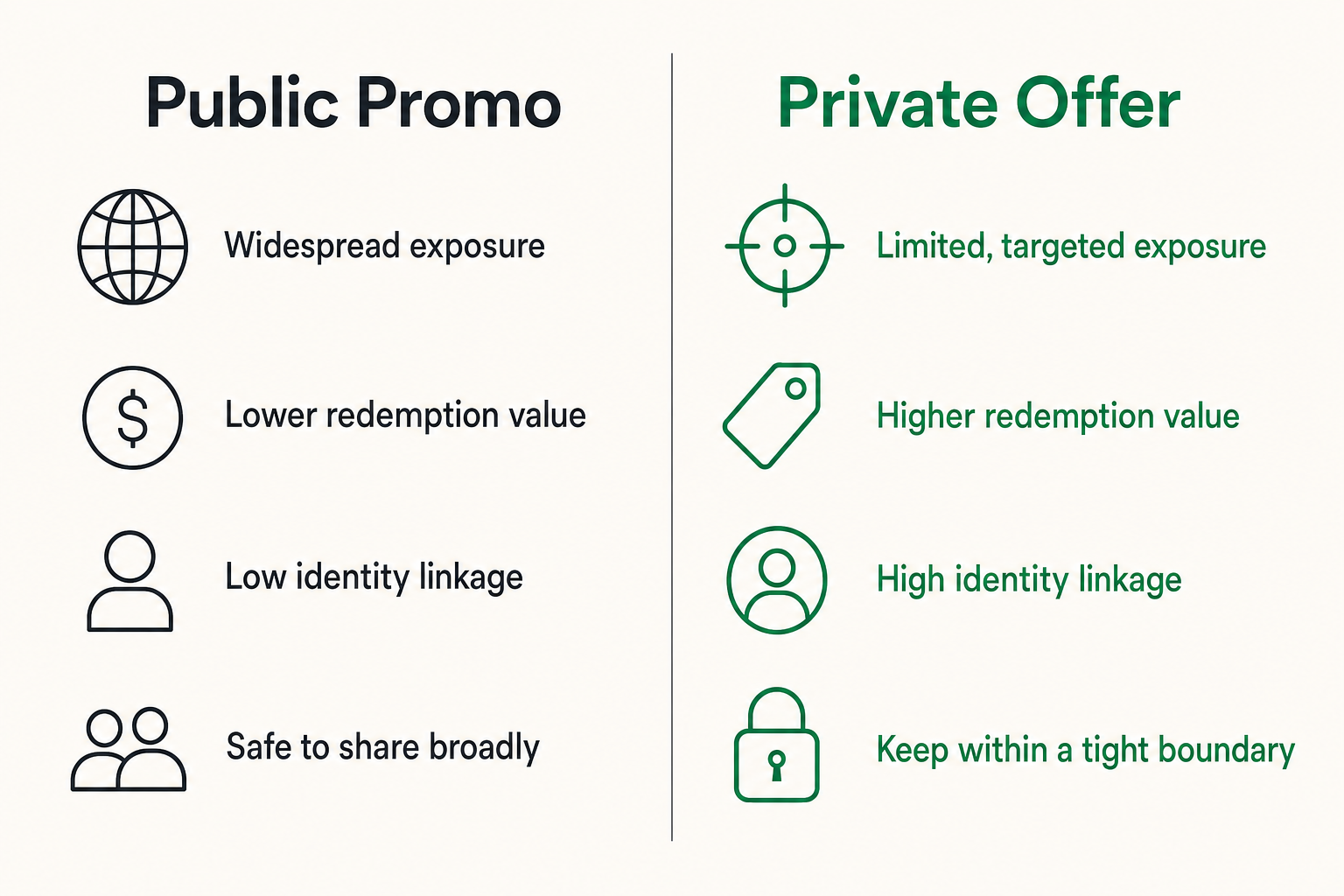
Not every coupon needs a locked-down process. A public sitewide offer shared between family members has a different risk profile from a single-use travel credit sent by a finance team. The channel should follow the threat model.
Identify what an attacker wants
Consider plausible outcomes rather than abstract fear. An attacker may want to:
- Redirect a recipient to a fake storefront.
- Steal credentials through a copied login page.
- Redeem a single-use code before its owner.
- Infer purchasing activity from message history.
- Collect customer information from screenshots.
- Impersonate a known teammate and alter payment instructions.
The threat is often not interception of the coupon text. It is manipulation of the workflow around redemption.
Separate content security from endpoint security
End-to-end encryption protects message content from intermediaries when implemented correctly. It does not protect content after a participant opens it on an infected, unlocked, shared, or poorly managed device.
A compromised endpoint can capture notifications, clipboard contents, screenshots, keystrokes, or decrypted messages. Remote teams should therefore combine private communication with device controls such as screen locks, current operating systems, limited notification previews, and rapid account revocation.
Practical rule: Encryption protects a route between trusted endpoints; it does not make an untrusted endpoint safe.
Account for metadata
Message content is only part of the privacy surface. Depending on the service and configuration, metadata may indicate who communicated, when they communicated, room membership, device activity, or message frequency.
For casual sharing, that may be acceptable. For purchasing teams, journalists, security groups, or people in sensitive locations, relationship metadata can matter. Ask what the provider retains, what administrators can inspect, how invitations work, and whether departed members remain visible in old rooms.
Classify the coupon and its context
Classification does not need to become a compliance project. Three practical categories cover most situations and help users decide what to send.
Public promotional codes
These are broadly advertised codes without a meaningful connection to a specific person or account. Examples include a seasonal percentage discount or free shipping above a published threshold.
Public codes can usually be shared with low friction. Still, remove tracking parameters from links, avoid unnecessary screenshots, and state the merchant domain in plain text. The primary risks are stale terms and malicious links, not disclosure of the code.
Personalized and single-use offers
A personalized offer may be bound to an email, loyalty account, region, payment instrument, referral relationship, or one-time redemption token. Even if the token does not expose an identity by itself, it may grant value to whoever uses it first.
Share these only with the intended recipient. Do not place them in large rooms, searchable documents, public issue trackers, or channels connected to external bots. If the offer is transferable, say so. If that is unclear, assume it is not.
Sensitive checkout context
The highest-risk category is not a type of code. It is a bundle containing the code plus account or transaction details.
| Shared item | Typical sensitivity | Safer handling |
|---|---|---|
| Public code only | Low | Share as text with terms |
| Single-use token | Medium | Send directly to intended recipient |
| Checkout screenshot | Medium to high | Crop and redact before sending |
| Customer or employee identity | High | Omit unless operationally required |
| Payment or address details | High | Never include with the coupon |
| Password or one-time login code | Critical | Do not share as coupon context |
If a recipient needs help debugging checkout, send the error text, merchant name, product class, and discount behavior. They rarely need a full image of the checkout page.
Compare sharing channels by failure mode
Choosing a channel by familiarity is convenient, but it hides tradeoffs. Compare channels according to retention, access, forwarding, verification, and integration behavior.
Email and conventional team chat
Email is easy to search and forward, which is useful until a personalized code remains in multiple mailboxes for years. Conventional team chat improves coordination but may expose history to administrators, integrations, broad channels, or newly added members.
These systems are not automatically inappropriate. They are simply optimized for organizational availability and retrieval, not necessarily data minimization. If they are used, limit the audience and remove expired sensitive offers.
Encrypted messaging
Encrypted messaging is a stronger fit when the message should be readable only by defined participants during transport and storage. Direct conversations can also reduce accidental audience expansion.
What works is pairing encryption with authenticated contacts, controlled room membership, sensible notification settings, and independent merchant verification. What fails is assuming the lock icon validates every link and every participant.
Shared documents and deal boards
A shared sheet can be effective for public, reusable promotions. It creates one place to record the merchant, terms, expiration date, and validation status. It is a poor location for customer-specific offers unless access and retention are tightly managed.
Deal boards also create a freshness problem. An expired code can look authoritative because it remains in a polished table. Every persistent record needs an owner, a last-checked field, and an expiration or removal rule.
A coupon codes secure messaging workflow
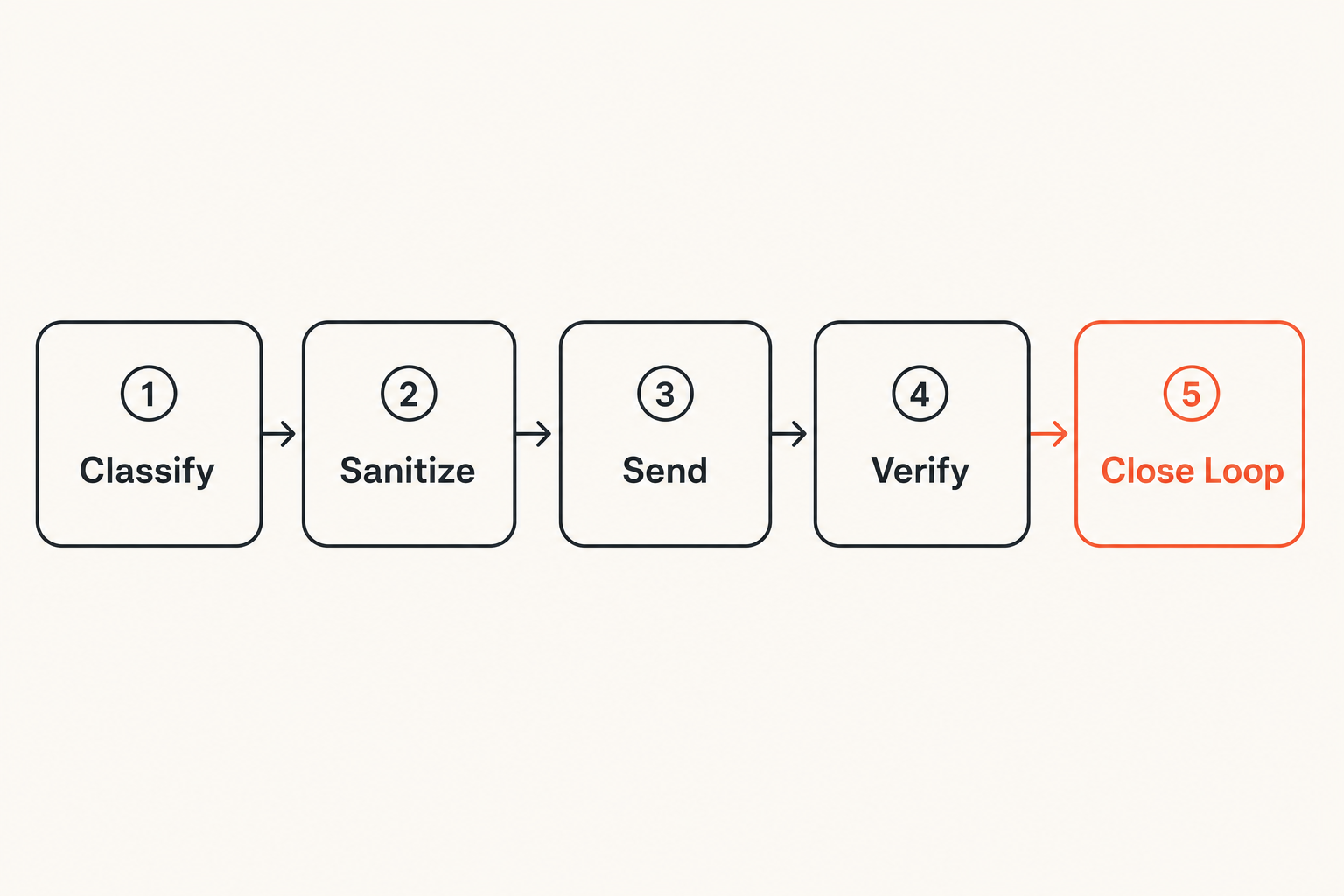
The workflow should be short enough that people actually use it. A five-minute security ceremony for a public shipping code will be ignored. A reusable message pattern and a few verification rules create more protection with less friction.
Step 1 sanitize before sharing
Before copying anything into a conversation:
- Decide whether the code is public, personalized, or single-use.
- Remove names, email addresses, order numbers, addresses, and payment details.
- Crop screenshots to the smallest relevant region, or replace them with text.
- Strip unnecessary tracking parameters from the URL.
- Confirm that the recipient needs the information.
Sanitization should happen before upload. Deleting an image later does not guarantee that notification services, backups, other participants, or connected tools did not receive it.
Step 2 send structured context
A bare code is ambiguous. A useful message includes enough context to validate and use the offer, but not enough to expose the shopper.
A simple format is:
Merchant: Example Store
Code: FALL10
Benefit: 10% off eligible items
Terms: Minimum order may apply
Expires: 2026-10-05, if merchant time zone applies
Source: Merchant newsletter
Link: Omitted; navigate to the merchant independently
Status: Not yet tested
For team automation, the same concept can be represented as a small event:
{
  "merchant": "Example Store",
  "code": "FALL10",
  "scope": "public",
  "expires_on": "2026-10-05",
  "verification": "unverified",
  "contains_customer_data": false
}
Structured context reduces repeated questions and makes risky deviations visible. A message containing unexplained login instructions should stand out from the normal pattern.
Step 3 verify outside the message
Recipients should open a known merchant app, use a saved bookmark, or type the merchant domain rather than treating the shared link as authoritative. Search results can also contain deceptive advertisements, so “search for it” is not always sufficient.
If a link must be sent, state the expected domain separately. On mobile devices, inspect the actual destination before entering credentials. Shortened links and lookalike domains deserve extra scrutiny.
Step 4 close the loop
After redemption, reply with one of a few clear states:
- Works as described.
- Works with different terms.
- Expired.
- Account-specific.
- Already redeemed.
- Suspicious; do not use.
Delete single-use tokens after they are consumed when the platform and retention policy allow it. For public codes, update the shared record rather than generating repeated screenshots and contradictory message threads.
Practical rule: A coupon-sharing workflow is complete only when the offer has a recorded outcome, not when the code has been sent.
Verify the offer without trusting the message
Secure delivery and trustworthy redemption are different controls. Verification must survive the possibility that the sender made a mistake or that their account was compromised.
Navigate independently
Independent navigation breaks the connection between a convincing message and a malicious destination. Use the merchant's known application, a previously saved domain, or an address from trusted records.
Check the hostname, not just the logo or page design. Attackers can copy a storefront faster than they can obtain control of the merchant's real domain. Be especially cautious when a coupon message leads directly to a login, wallet connection, browser extension installation, or payment update.
Treat urgency as an input
Promotions naturally use deadlines. That makes urgency a weak indicator by itself, but it is still operationally important. A message claiming that an offer expires in minutes should not bypass normal authentication or payment controls.
The mistake teams make is treating urgency as evidence of legitimacy because discounts often expire. Instead, treat it as a reason to slow down when the requested action is unusually sensitive.
Confirm the final checkout state
A code being accepted does not mean the expected discount was applied correctly. Before payment, verify:
- The discount amount.
- Eligible and excluded items.
- Shipping charges.
- Subscription enrollment.
- Trial conversion terms.
- Currency and tax behavior.
- The final payable total.
Some promotions replace another discount rather than stacking with it. Others reduce the visible item price while adding a subscription or changing shipping eligibility. Security includes protecting transaction intent, not only protecting message secrecy.
Operate coupon sharing across remote teams
For a household, informal rules may be enough. For support, procurement, marketing, or community teams, coupon sharing becomes an access and lifecycle problem.
Assign ownership
Every persistent offer list should have an owner responsible for validity and removal. Without ownership, old offers accumulate, users stop trusting the list, and unofficial channels appear.
Ownership can be lightweight. One person or rotation verifies public offers, while account-specific discounts remain with the account owner. Support agents should not redistribute a customer's private concession merely because it resembles a coupon.
Use minimum necessary access
Do not add an entire company to a room because several people occasionally need promotions. Separate public deal discovery from private redemption details.
A practical model uses:
- A broad room for public codes and general terms.
- Restricted conversations for personalized offers.
- A private path for customer-related troubleshooting.
- No room at all for passwords, payment credentials, or authentication codes.
Access should also expire. Contractors, former employees, and temporary event participants should not retain room membership indefinitely.
Define retention and deletion
Retention should follow business need. Public codes may be retained for performance analysis if they contain no personal data. Single-use offers should usually disappear after redemption or expiration. Customer-linked screenshots should be avoided and removed according to support policy.
Disappearing messages can reduce casual accumulation, but they are not a guarantee of erasure. Recipients can copy content, photograph screens, or capture notifications. Use expiration as hygiene, not as a substitute for trust and authorization.
What breaks in practice
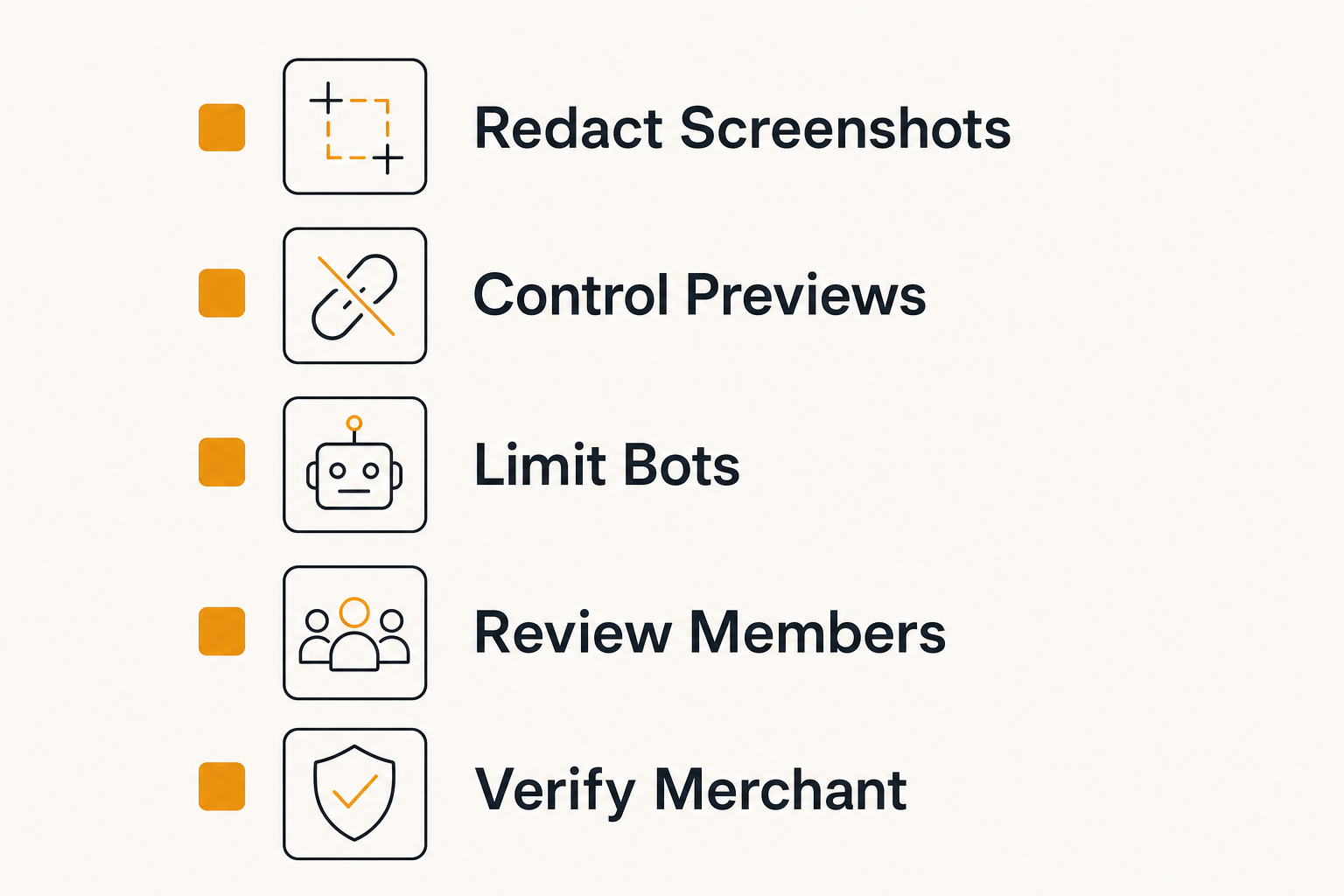
Most failures do not involve breaking encryption. They involve normal product features interacting in unexpected ways.
Screenshots leak more than expected
A checkout screenshot may contain browser tabs, bookmarks, profile pictures, order history, loyalty balances, location indicators, email addresses, or partial payment details. Mobile screenshots may include notification banners from unrelated conversations.
What works is reproducing the relevant error as text. If an image is necessary, crop it locally, redact sensitive fields with a tool that permanently removes pixels, and inspect the final exported file before sending it.
What fails is placing a translucent shape over text in an editable document. The hidden content may remain recoverable.
Link previews create hidden requests
Messaging services may fetch a URL to generate a title, image, and description. Depending on the architecture, that request can reveal the link to a preview service or trigger tracking parameters before the recipient opens it.
For public merchant pages, the impact may be minor. For personalized links containing tokens, preview generation can consume the link, expose it to an intermediary, or record an unexpected access. Disable previews for sensitive links or avoid sending the link entirely.
Bots weaken the trust boundary
A room may be encrypted between users while a bot, bridge, notification service, or archiving integration receives message content. Integrations often need plaintext to perform their function.
Before adding automation, document:
- Which messages the integration can read.
- Where it sends or stores them.
- Which operator controls its credentials.
- How access is revoked.
- Whether it needs historical messages.
A coupon-validation bot should receive public offer fields, not full conversations or customer screenshots.
Encryption becomes a substitute for judgment
The most damaging failure is cultural: users assume anything inside an encrypted room is authentic and safe. A compromised member account can send a malicious link through the same protected channel as legitimate messages.
Encryption provides confidentiality and, depending on the system, participant authentication properties. It does not make a sender infallible. Preserve the habit of verifying unusual requests through another known path.
Practical rule: Secure messaging reduces interception risk; process controls reduce impersonation, oversharing, and redemption risk.
Implementation checklist for secure coupon sharing
A good implementation changes defaults rather than relying on every participant to remember every rule.
Configure the room
Start with the communication boundary:
- Require authenticated accounts and current devices.
- Restrict invitations and review room membership.
- Limit notification previews on lock screens.
- Disable or control previews for tokenized links.
- Remove unnecessary bots, bridges, and exports.
- Define what happens when a device or account is lost.
For managed teams, test member removal. Confirm whether former members keep local history and whether administrators can revoke active sessions.
Standardize the message format
Pin a short template that requests merchant, code, terms, expiration, source, and verification status. Add one sentence telling users not to include customer identities, order screenshots, payment details, passwords, or login codes.
Avoid elaborate forms unless the volume requires them. The format should make the safe action faster than the unsafe action. Plain text is often preferable because it is searchable, accessible, and less likely to conceal extra data.
Measure workflow quality
Do not measure success by message count. Useful operational checks include:
- How many posted codes have an owner or source.
- Whether expiration dates are recorded.
- How quickly suspicious links are removed.
- Whether personalized offers enter broad rooms.
- How often screenshots are used when text would work.
- Whether departed members are removed promptly.
These are process observations, not reasons to monitor private conversations indiscriminately. For privacy-sensitive groups, use periodic manual reviews of shared structures and settings rather than collecting more message content.
Where private messaging fits
Private messaging is one control in the workflow, not the workflow itself. It is most valuable when participants need confidentiality, clear membership, and less exposure to intermediaries.
Choose for the operating model
Evaluate a messaging system against how people will actually use it:
| Requirement | Practical question |
|---|---|
| Confidentiality | Who can decrypt message content? |
| Membership | Who can invite, remove, or verify participants? |
| Device handling | What happens when a device is lost? |
| Metadata | What relationship and activity data is retained? |
| Integrations | Can bots or bridges read plaintext? |
| Retention | Can sensitive history be limited or deleted? |
| Usability | Will participants follow the workflow under time pressure? |
The strongest cryptographic design can still produce weak operational security if users cannot understand room membership, recover safely, or identify the real recipient.
Keep the architecture honest
Coupon codes secure messaging practices should reflect the value and context of the offer. A public seasonal code does not need the same controls as a private travel credit. Both still benefit from source labeling, minimal context, verified merchant navigation, and a recorded outcome.
The useful architecture has clear boundaries: messaging transports sanitized information, the merchant handles checkout, the account owner controls personalized entitlements, and no chat room becomes an accidental database of customer transactions.
That is the practical standard. Protect the conversation without pretending the conversation can authenticate every store, secure every endpoint, or correct every checkout condition.
Try qrypt.chat
Private communication for people and teams that want a clearer trust boundary around sensitive conversations. Build your coupon codes secure messaging workflow on a channel designed with privacy in mind: Try qrypt.chat.