
A coupon code looks harmless until it is tied to an account, a referral identity, an employee benefit, or a single-use balance. Then forwarding it in the wrong chat can expose more than a discount. Link previews may contact tracking servers, screenshots can outlive the offer, and compromised endpoints can turn a legitimate deal into a phishing path.
Teams think the problem is choosing an encrypted app. The real problem is controlling the entire path from discovery and verification to sharing, redemption, and deletion. Encryption protects part of that path. It does not verify a merchant, remove tracking parameters, secure a recipient's device, or revoke a screenshot.
A coupon codes secure messaging workflow therefore needs more than a private conversation. It needs a threat model, a rule for classifying codes, trusted verification, deliberate channel selection, and a clear retention policy. This matters to privacy-conscious shoppers, but it also matters to security teams, remote organizations, community administrators, and anyone distributing limited offers.
This guest contribution draws on practical deal-verification experience from the team at c0upons.com, while focusing on the privacy and messaging architecture surrounding those deals.
Table of contents
- Why coupon delivery is a security workflow
- Coupon codes secure messaging threat model
- Classify a code before sharing it
- Choose the right messaging channel
- Build a coupon codes secure messaging workflow
- Defend against coupon scams and malicious links
- Operate safely in remote teams and communities
- Control retention, metadata, and screenshots
- What breaks in practice
- Putting secure coupon sharing into operation
Why coupon delivery is a security workflow
The code is only one asset
The visible code may be SAVE20, but that string is rarely the complete object being shared. A useful message may also contain a merchant name, checkout URL, minimum spend, expiration date, account restriction, geographic condition, or referral identifier. Each field has a different risk profile.
A public code copied from a merchant homepage has little confidentiality value. A unique employee code with a fixed balance is closer to a bearer credential: possession may be enough to use it. A referral URL can expose who shared it. A screenshot can reveal order history, loyalty status, email addresses, or open browser tabs.
The practical question is not, “Is a coupon sensitive?” It is, “What can someone infer, redeem, correlate, or impersonate if this complete message escapes?”
The trust decision happens before encryption
End-to-end encryption can protect a message while it moves between participants. It cannot make the source truthful. If someone pastes a fake checkout domain into an encrypted room, the encryption faithfully delivers the malicious link.
That changes the conversation. Source validation must occur before distribution, not after recipients click. For a high-value or restricted offer, the sender should independently visit the merchant's known domain, confirm the terms, and remove unnecessary tracking data before posting anything.
Practical rule: Encrypting an unverified coupon preserves confidentiality, not legitimacy.
Risk depends on context
The same code can move between risk classes. A public seasonal promotion is low risk when shared without personal data. It becomes more sensitive when bundled with a private customer-service transcript explaining why a specific account qualifies.
Context also changes with scale. Sending a code to one known person is different from placing it in a 500-member room. Group history, guest access, unmanaged devices, and turnover increase the number of places where the offer can persist.
A useful way to think about it is to classify the complete sharing package rather than the code alone. Include the code, URL, terms, sender identity, recipient set, attached media, and expected lifetime in that decision.
Coupon codes secure messaging threat model
Identify what an attacker wants
Threat modeling does not need to become an academic exercise. Start with likely outcomes:
- Redeem a limited or single-use code before the intended recipient.
- Replace a legitimate merchant link with a credential-stealing page.
- Correlate a referral identifier with a real person or chat account.
- Learn that a team uses a particular vendor, benefit, or purchasing schedule.
- Harvest phone numbers, usernames, room membership, or purchasing interests.
- Reuse screenshots or message exports outside the original audience.
For a public coupon, integrity may matter more than secrecy. Recipients need confidence that the merchant, terms, and destination have not been changed. For a unique voucher, confidentiality, access control, and fast expiration become equally important.
Separate transport risk from endpoint risk
Secure transport protects data between endpoints. Endpoint security determines what happens before encryption and after decryption. A message can be protected in transit while still appearing in notification previews, clipboard history, local backups, desktop search indexes, screen recordings, or malware logs.
This distinction is central to secure messaging. If the sender's browser is compromised, the attacker may alter the link before it reaches the chat. If the recipient's device is unlocked, anyone nearby may read the code. If cloud backups contain readable message history, deletion inside the app may not remove every copy.
The mistake teams make is treating the encryption boundary as the system boundary. The real boundary includes devices, operating systems, backups, identities, browser sessions, and people.
Account for metadata
Message contents are only one layer. Depending on the service and configuration, metadata may reveal who communicated, when they communicated, which room was used, the approximate size of a message, or the devices associated with an account.
Coupon sharing can create commercially meaningful patterns. Repeated messages about travel discounts may indicate planned travel. Vendor-specific employee offers can suggest where someone works. A burst of messages around a private launch can disclose timing even when the codes remain unreadable.
Metadata minimization means limiting unnecessary group membership, avoiding descriptive room names for sensitive programs, reducing retention, and not attaching identity-rich screenshots. It also means understanding what the messaging provider can technically observe rather than relying on a vague “private” label.
Classify a code before sharing it
Public promotional codes
Public promotional codes are broadly advertised and reusable. Their confidentiality requirement is usually low, but integrity still matters. A manipulated URL, false expiration date, or fabricated discount can waste time or send a recipient to a hostile site.
For these codes, a secure workflow should prioritize source verification, clear terms, and clean links. There is usually no reason to include a screenshot containing personal account information when the code and merchant domain are sufficient.
Restricted and single-use codes
Restricted codes deserve stronger controls. Examples include employee benefits, customer-service credits, loyalty rewards, invitation codes, event access vouchers, and codes generated for one account or one transaction.
| Code type | Primary concern | Suitable handling |
|---|---|---|
| Public reusable promotion | Integrity and scam links | Verified source, clean URL, ordinary private chat |
| Referral code | Identity correlation | Disclose referral relationship, limit tracking data |
| Employee or member offer | Eligibility and distribution | Approved group, membership review, short retention |
| Single-use voucher | Unauthorized redemption | Direct encrypted message, expiration, confirmation |
| Stored-value gift code | Theft and financial loss | Avoid chat when possible; split or use a controlled portal |
A unique code should be sent to the smallest reasonable audience. If it has cash-like value, consider whether messaging is appropriate at all. A merchant's authenticated transfer function or a controlled secrets channel may offer better redemption tracking and revocation.
Practical rule: Treat single-use and stored-value codes as bearer credentials, not casual chat content.
Codes that should not be sent
Do not send payment card data, account passwords, recovery phrases, authentication cookies, or identity documents merely because they appear next to a coupon. A support agent or colleague may ask for “the full checkout screenshot,” but the coupon is rarely the only visible information.
Crop images aggressively or, better, replace them with text. If eligibility depends on sensitive documentation, use the merchant's official submission process. Secure chat reduces exposure during transport; it does not transform an inappropriate data-sharing request into a safe one.
Choose the right messaging channel
What secure messaging should provide
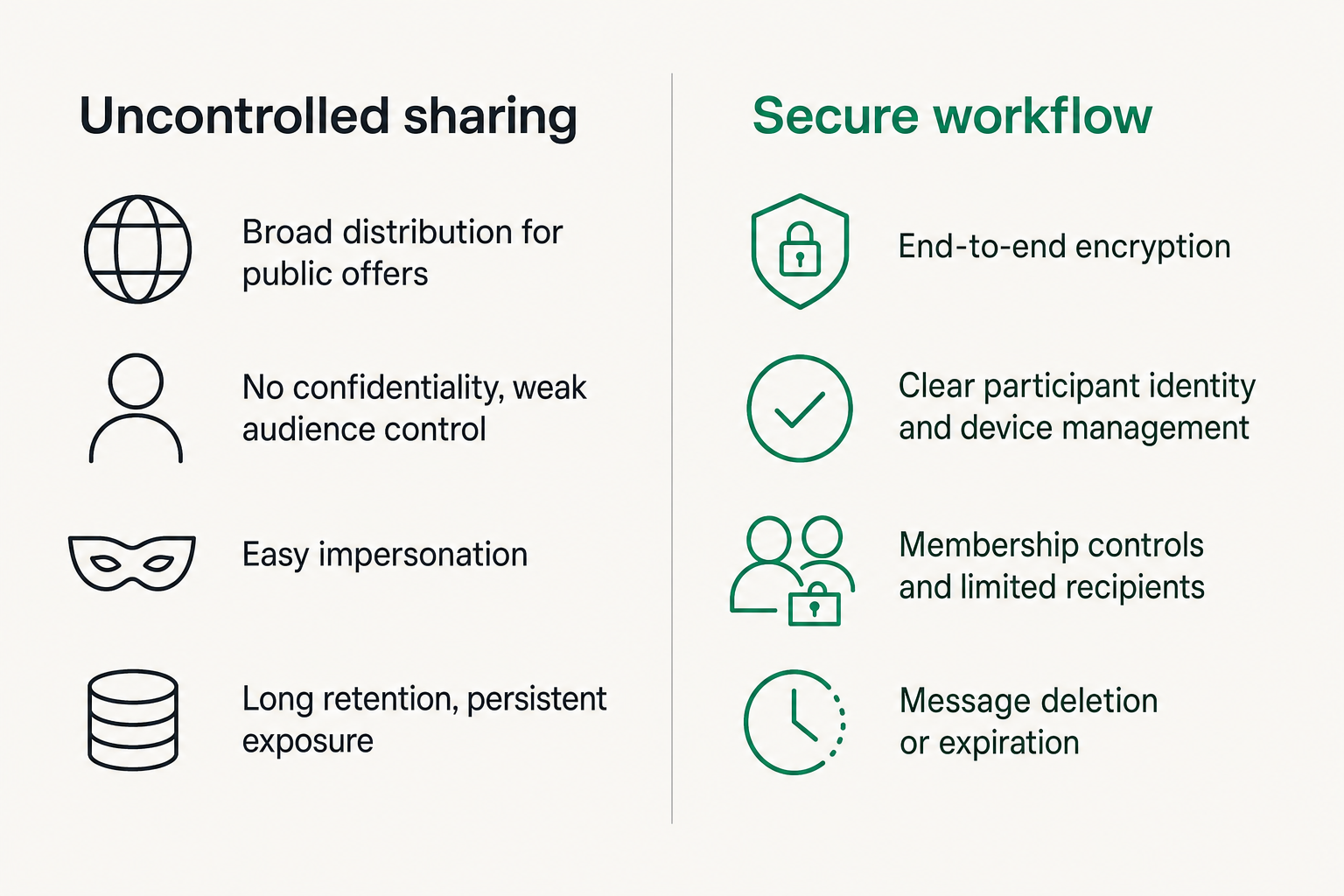
For coupon sharing, useful messaging controls include end-to-end encryption, clear participant identity, device management, membership controls, message deletion or expiration, and resistance to accidental exposure through previews or exports. The exact feature set matters less than how it supports the workflow.
Ask operational questions. Can a removed member still read downloaded history? Are new devices clearly announced? Can administrators silently add participants? Are link previews generated on the sender's device, the recipient's device, or an external server? Do disappearing messages affect local media copies and notifications?
No single answer makes a channel secure. The purpose is to identify residual risk and select a channel proportionate to the code.
Compare channels by failure mode
| Channel | What works | What fails |
|---|---|---|
| Public social post | Broad distribution for public offers | No confidentiality, weak audience control, easy impersonation |
| Familiar, searchable, supports detailed terms | Forwarding, long retention, mailbox compromise, noisy threads | |
| Conventional team chat | Fast group coordination | Broad integrations, persistent history, unclear guest access |
| End-to-end encrypted direct message | Stronger content confidentiality and narrow delivery | Endpoint compromise, screenshots, identity mistakes |
| Encrypted group room | Efficient controlled distribution | Membership drift, exports, one compromised member affects the room |
| Merchant account portal | Strong account binding and redemption context | Merchant controls privacy and may retain extensive activity data |
What works is matching the channel to the asset. What fails is announcing one approved app and assuming every message sent through it is equally safe.
Treat group membership as access control
A private room is an access-control list with a conversation attached. If membership is stale, the room is stale. Before posting a restricted coupon, check who is present, whether guests can view history, and whether former employees or contractors remain members.
Large rooms also make identity verification harder. Similar display names and changed avatars can hide mistakes. For valuable codes, use a direct conversation and verify the recipient through an established identity or a second channel when impersonation is plausible.
Practical rule: The security of a group coupon drop is bounded by its least-controlled member and device.
Build a coupon codes secure messaging workflow
Verify and normalize the offer
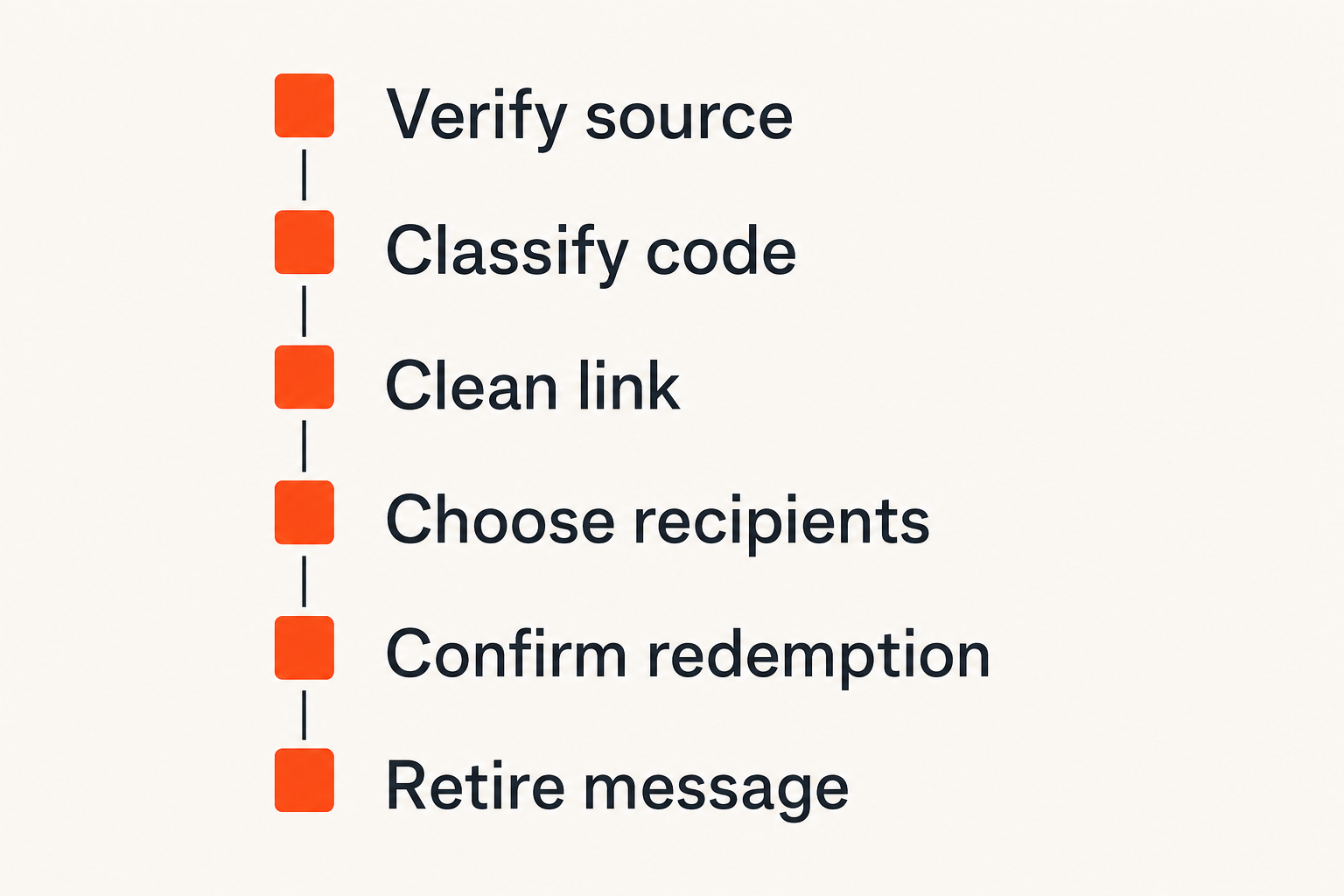
A repeatable coupon codes secure messaging process should remove improvisation. Use this sequence:
- Acquire the offer from a known source. Prefer the merchant's official site, authenticated account area, or a previously trusted deal source.
- Classify the code. Decide whether it is public, referral-based, eligibility-restricted, single-use, or stored value.
- Verify the destination. Navigate independently to the known merchant domain and confirm the code or terms where practical.
- Normalize the message. Remove tracking parameters, crop personal data, state restrictions, and use an unambiguous expiration time.
- Select recipients and channel. Match confidentiality and audience controls to the classification.
- Send and confirm. For unique codes, ask the intended recipient to acknowledge receipt without reposting the code.
- Retire the message. Mark the code used or expired, delete unnecessary copies, and remove obsolete posts.
Normalization is underrated. In production, ambiguity causes as many problems as interception. “Expires Friday” is unclear across time zones. “Works for me” does not explain account eligibility. “Use this link” gives the recipient no safe reference point if the URL looks unusual.
Send the minimum useful package
A good message contains enough information to validate and redeem the offer without carrying unrelated data. A simple template is:
Merchant: Example Store
Offer: 20% off eligible items
Code class: Public reusable
Code: SAVE20
Expires: 2026-10-31 23:59 UTC
Restrictions: New orders; selected regions
Destination: Type the known merchant domain manually
Source checked: 2026-10-07
For a unique code, add the intended recipient and a request not to forward it. Avoid embedding account numbers, email addresses, order receipts, or a long redirected URL unless they are necessary.
The mistake teams make is optimizing for the fewest taps. The better target is the fewest unsafe assumptions. Typing a known domain manually may add friction, but it separates the discount value from an untrusted link.
Close the loop after redemption
Unique-code workflows need state. Without it, several people may try the same code, assume a failure is malicious, or leave usable value in chat history.
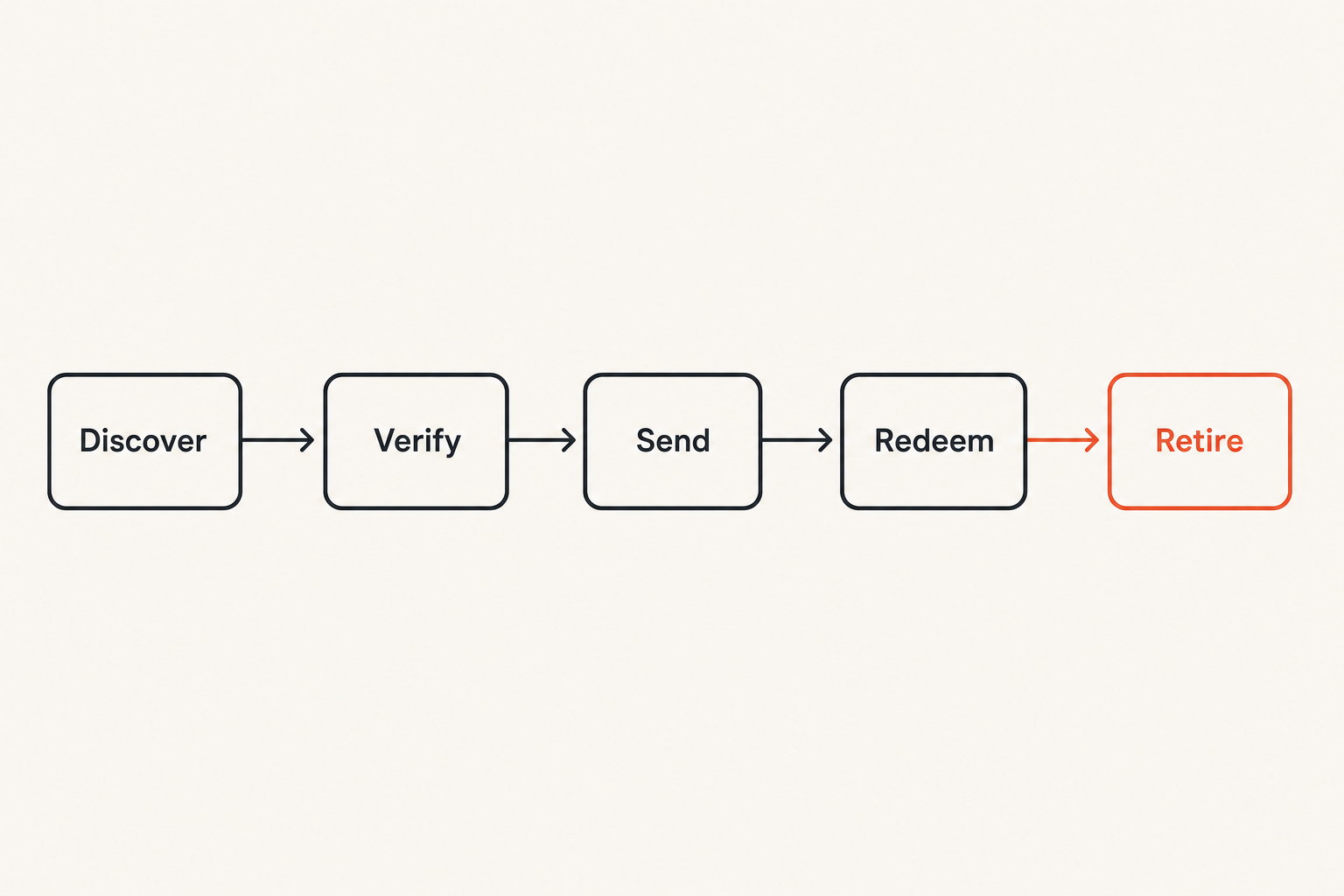
Use a compact lifecycle such as verified → shared → received → redeemed → retired. The sender does not need a complex database for a few codes, but teams distributing offers regularly should track status without storing the secret itself. A record can contain an internal identifier, owner, classification, recipient, expiration, and final state.
Do not ask recipients to prove redemption with a full checkout screenshot. A simple “redeemed” acknowledgment is usually enough. If troubleshooting is necessary, redact order identifiers, addresses, payment details, and loyalty balances before sharing evidence.
Defend against coupon scams and malicious links
Verify outside the message
A common scam uses a familiar discount as the reason to click. The page may imitate a merchant login, request payment details for a fake shipping fee, or demand an app installation. Secure delivery does not make those requests legitimate.
Verify claims independently. Open a fresh browser session, use a saved bookmark, or type the merchant domain. Search the official site for the promotion. If the offer allegedly came from customer support, contact support through the published site rather than replying through contact details in the message.
Be skeptical of urgency, especially when paired with secrecy: “redeem in ten minutes,” “do not tell support,” or “install this certificate to unlock the discount.” Legitimate coupons can expire quickly, but urgency should not disable verification.
Control previews and redirects
Link previews can leak data or create misplaced confidence. A polished preview only shows that a server returned suitable metadata; it does not prove the destination is safe. Preview generation may also contact the site before the recipient chooses to visit it.
Strip obvious advertising parameters such as campaign identifiers when they are not needed for redemption. Do not alter signed parameters or unique redemption tokens blindly, because doing so may break the offer. When a shortened URL hides the destination, prefer a direct merchant URL or tell recipients to navigate independently.
Redirect chains deserve attention. A legitimate marketing service may redirect to the merchant, but each intermediate service learns something and creates another place where routing can be changed. For high-value offers, fewer intermediaries are better.
Use a compact validation checklist
Before sending, check:
- Is the merchant domain spelled correctly?
- Is the source known or independently confirmed?
- Does the offer require credentials, payment, or software installation unexpectedly?
- Is the code public, restricted, single-use, or stored value?
- Does the message expose a referral identity or account detail?
- Can unnecessary tracking parameters and screenshots be removed?
- Is the recipient set appropriate for the offer?
This checklist should take less than a minute for ordinary promotions. Escalate only when the code has meaningful value, sensitive eligibility, or unusual redemption instructions.
Practical rule: If recipients cannot verify an offer without trusting the forwarded message, the workflow has a validation gap.
Operate safely in remote teams and communities
Assign ownership
Shared deal rooms often fail because everyone can post but no one owns verification. Assign a moderator or rotating owner for restricted offers. The owner confirms the source, labels the code class, states the expiration, and retires outdated messages.
Ownership does not mean every public discount requires formal approval. It means uncertain or sensitive offers have a clear escalation path. Members should know who can pin an authoritative version, remove a malicious post, or announce that an account has been compromised.
For recurring programs, document a small policy:
public_codes: approved-room
restricted_codes: direct-message
stored_value: approved-portal-only
link_shorteners: discouraged
personal_screenshots: redact-or-reject
default_retention: 7-days
incident_owner: security-operations
The specific values will differ. The benefit comes from making defaults visible rather than forcing every sender to invent them.
Keep bots on a short leash
Bots can collect promotions, expand links, test codes, and post reminders. They can also become a privileged surveillance and distribution layer. A bot with access to every room may see restricted offers, participant identities, and message history.
Grant a bot access only to the rooms and commands it needs. Avoid sending single-use codes through third-party automation unless the service is explicitly trusted for that data. Store API tokens outside source code, rotate them, log administrative actions, and define what happens when the integration fails.
What breaks in practice is silent fallback. A bot fails to post in the private room, so an operator copies the code into a broader channel. Design an explicit failure path: queue the message, notify the owner, and require manual confirmation of the destination.
Design for departures and compromised accounts
Remote teams change membership frequently. Contractors leave, personal devices are replaced, and accounts are recovered. Restricted-code rooms should be reviewed on a schedule and immediately after relevant departures.
If an account is suspected of compromise, assume accessible active codes may also be exposed. Remove the account, rotate or revoke codes where the issuer allows it, warn intended recipients, and inspect recent messages for altered links. The response should focus on current exposure rather than debating whether encryption was technically broken.
For high-value programs, avoid posting batches of future codes. Release them close to use. This reduces the amount available to a compromised account and makes incident cleanup manageable.
Control retention, metadata, and screenshots
Set expiration by sensitivity
Disappearing messages are useful, but they are not retroactive access control. A recipient can copy a code before deletion, and media may already exist in local storage. Expiration reduces passive accumulation; it does not guarantee erasure.
Match retention to utility. A public monthly promotion may remain available until its published expiration. A single-use voucher can disappear shortly after acknowledgment. A restricted employee offer may remain pinned only while the campaign is active.
Choose durations that leave room for time zones and offline recipients. Extremely short timers can cause people to create screenshots as a workaround, increasing uncontrolled copies. Security controls should reduce risk without predictably pushing users into worse behavior.
Reduce searchable history
Persistent chat history turns a room into an informal coupon database. That can expose purchasing interests, vendors, employee programs, and old links to anyone who later gains access.
Use dedicated rooms when deal sharing is frequent, but do not assume separation alone solves retention. Archive or delete expired posts, unpin outdated offers, and prevent search results from presenting old codes without context. Labeling an offer as expired helps, but removing an unnecessary secret is better.
Exports are another concern. Team backups, compliance archives, and user-requested exports may retain content after it disappears from the active interface. Understand the difference between deletion from a device, deletion from a room, and deletion from provider-controlled storage.
Assume recipients can copy
No ordinary messaging interface can reliably stop a determined recipient from photographing a screen. Screenshot blocking may reduce accidents on some devices, but another camera bypasses it.
Design around recipient trust and limited value. Send a unique code only to the person entitled to use it. Avoid combining the code with identity evidence. Use issuer-side expiration, account binding, or revocation where available. If unauthorized copying would create unacceptable harm, do not distribute the asset through chat.
That changes the conversation from “Can we prevent screenshots?” to “Can we make a copied message less useful?” Account-bound redemption, short validity, one-time use, and minimal surrounding data are practical answers.
What breaks in practice
Encryption becomes a false guarantee
The most dangerous failure is not weak cryptography. It is overconfidence. People lower their guard because a room is encrypted, then accept unfamiliar links, post sensitive screenshots, or skip recipient verification.
Encryption should remove one class of exposure: content interception between intended endpoints. Keep separate controls for authenticity, endpoint health, membership, retention, and human verification. When teams combine these concerns into a single “secure app” decision, gaps become difficult to see.
Convenience creates uncontrolled distribution
Forwarding, cross-posting, and automation can turn a limited offer into an uncontrolled broadcast. A member copies a restricted code to another team, a bot mirrors a room, or an email notification contains the full message.
Prefer links to an access-controlled source only when that source is genuinely safer and does not create excessive tracking. Otherwise, mark restricted messages clearly, disable unnecessary integrations, and tell recipients what may be shared. Policy will not stop deliberate misuse, but it reduces accidental redistribution.
Common warning signs include:
- Codes repeatedly redeemed before intended recipients use them.
- Old offers resurfacing through search or pinned messages.
- Members asking whether a bot or guest can read the room.
- Screenshots containing unrelated account or payment information.
- Redirect links that no one can explain.
- No reliable answer about who can remove a malicious post.
No one owns cleanup
Most workflows describe posting and redemption but omit retirement. As a result, expired promotions, exposed unique codes, and obsolete merchant links remain searchable.
Make cleanup part of the same action that records redemption or expiration. For a small group, the sender can delete or edit the post. For an organization, an owner or lightweight scheduled process can identify stale offers. Do not let automation delete evidence during an active security incident; preserve the minimum necessary record in an approved incident system first.
A useful metric is not the number of coupons shared. It is the number of sensitive or expired offers still available to people who no longer need them. Even without a formal dashboard, periodic sampling reveals whether the process is working.
Putting secure coupon sharing into operation
When qrypt.chat fits
A privacy-focused encrypted conversation can be an appropriate delivery layer when participants already know one another, the recipient set is controlled, and the organization wants to reduce exposure of message contents. It is especially useful for direct sharing of restricted offers or small private groups coordinating verified deals.
The channel still needs supporting behavior. Verify the source before posting, keep groups current, minimize attached data, and retire codes after use. qrypt.chat should be treated as part of the architecture rather than a substitute for merchant verification, device security, or recipient judgment.
The practical fit test is straightforward: does the channel protect the message content and support the intended audience without creating broader history, integration, or identity exposure than the coupon warrants? If yes, it can replace less controlled paths such as public posts, broad email threads, or conventional rooms with unclear access.
Use a deployment checklist
Before standardizing a coupon codes secure messaging workflow, confirm that users can answer these questions:
- Which code classes may be sent through chat?
- Which offers require direct messages rather than groups?
- How are merchant domains and terms verified?
- Are link previews and notification contents understood?
- Who reviews group membership?
- What is the default message-retention period?
- How are redeemed or expired codes retired?
- What happens after a compromised account or malicious link?
Start with a narrow use case, such as sharing verified employee discounts in one controlled room. Observe where users create workarounds. Then adjust retention, templates, and ownership before expanding. Secure workflows improve through visible operational feedback, not through a one-time tool announcement.
The closing principle is simple: coupon codes and secure messaging work well together when confidentiality is paired with validation, minimal disclosure, lifecycle control, and accountable ownership. Without those pieces, encryption protects a message that may still be false, overexposed, or retained too long.
Try qrypt.chat
Private, encrypted messaging for conversations that should stay between intended participants. Try qrypt.chat.