
A message can be encrypted and still expose who contacted whom, when they spoke, which devices they use, and how their accounts can be recovered. It can also be copied from a compromised endpoint, leaked through notifications, or retained indefinitely in an unmanaged backup.
That is the uncomfortable reality behind many end-to-end encrypted messaging apps. The lock icon may be correct, but it describes only one part of the system.
Teams think the problem is choosing an app with strong encryption. The real problem is designing a communication workflow in which identity, devices, metadata, recovery, retention, and human behavior do not quietly defeat that encryption.
In 2026, this is an architecture and operations decision, not a feature-comparison exercise. The practical question is not simply, “Is this chat encrypted?” It is, “What information remains exposed, who controls the keys, what happens when a device is lost, and can users operate the system safely under real pressure?”
Table of contents
- Start with the threat model
- What end-to-end encrypted messaging apps actually protect
- Metadata is part of the security model
- Key management determines whether encryption holds
- Multi-device messaging creates hard tradeoffs
- Recovery backups and retention can undo privacy
- A practical evaluation workflow
- What breaks in real deployments
- Deploy end-to-end encrypted messaging apps for teams
- Measure security without creating surveillance
- Where qrypt.chat fits
Start with the threat model
Most messaging comparisons begin with features: disappearing messages, group size, desktop support, file limits, or video calls. Those details matter eventually, but starting there produces a polished shortlist with no defensible security rationale.
A useful way to think about it is to treat secure messaging as a protected data flow. Information originates on one endpoint, passes through networks and service infrastructure, reaches one or more recipient devices, and may then be synchronized, backed up, exported, screenshotted, or retained. Each transition has an owner and a failure mode.
Define the information that needs protection
List the actual information classes carried through chat. A remote product team may exchange credentials, unreleased designs, customer records, personnel issues, incident details, and ordinary coordination. Those categories do not require identical controls.
For each class, ask:
- Must message content remain unavailable to the service operator?
- Is the participant list sensitive?
- Would timing or frequency reveal operational activity?
- How long may recipients retain the information?
- Can files be downloaded to unmanaged storage?
- Is a regulatory, contractual, or legal record required?
The last question matters because maximum deletion and mandatory retention can conflict. A system cannot simultaneously guarantee that every copy disappears and preserve an authoritative business record. That changes the conversation from “Which app is most private?” to “Which workflow applies to this type of communication?”
Practical rule: Classify conversations before selecting controls. Do not force incident response, casual chat, legal approvals, and credential exchange into one retention model.
Separate likely threats from theoretical threats
Threat models should name actors and capabilities. Common concerns include a stolen phone, malicious account recovery, an abusive group participant, endpoint malware, an internet service provider, a compromised messaging provider, legal demands, and long-term cryptographic collection.
These threats are not interchangeable. End-to-end encryption can reduce provider access to content, but it cannot stop an authorized recipient from photographing a screen. Device encryption can help with a powered-off stolen phone, but it does little if malware is reading messages after unlock.
Do not dismiss long-term threats, but do not let exotic scenarios hide immediate weaknesses such as shared accounts or unlocked laptops. The highest-impact fix is often operational rather than cryptographic.
Map consequences before comparing features
Assign a consequence to each plausible failure. Could exposure cause inconvenience, account takeover, physical danger, contractual breach, or loss of privileged information? Then connect the consequence to a control.
This prevents vague requirements such as “military-grade security.” It also helps distinguish mandatory controls from preferences. If exposure of group membership creates risk, metadata minimization is mandatory. If users regularly lose access in the field, a carefully designed recovery path may be mandatory even though recovery adds attack surface.
For a broader baseline, the existing guide to end-to-end encrypted messaging apps in 2026 covers the major deployment dimensions. The goal here is to turn those dimensions into an operating model.
What end-to-end encrypted messaging apps actually protect
End-to-end encryption should mean that plaintext is available only at participating endpoints, not to the messaging service while content travels through or rests on its servers. That is a meaningful property. It is not a complete security guarantee.
Encryption in transit is not end-to-end encryption
Transport Layer Security protects a connection between an app and a server. The server may still receive plaintext, process it, store it, and encrypt it again for the next connection. In genuine end-to-end encryption, message content is encrypted for recipient keys before the service can read it.
The difference affects breach impact, insider access, server-side search, moderation, account recovery, and lawful access. Ask whether the provider can technically obtain plaintext—not merely whether policy says it will not.
Also determine which objects receive end-to-end protection. Text may be encrypted while link previews, contact discovery, profile photos, reactions, filenames, call signaling, or backups follow different paths.
Endpoints remain inside the security boundary
The phrase “end-to-end” tells you exactly where the difficult boundary sits: at the ends. If either endpoint is compromised, cryptography between them cannot preserve message secrecy.
Relevant endpoint controls include:
- full-disk encryption and a strong device passcode;
- prompt operating system and application updates;
- protected notification previews;
- biometric or PIN reauthentication inside the app;
- controls for clipboard, downloads, screenshots, and exports;
- remote session review and device revocation;
- malware resistance appropriate to the threat model.
A desktop client often deserves more scrutiny than the phone. Desktops may have browser extensions, broad filesystem access, persistent sessions, shared user profiles, or weak screen-lock behavior. Convenience does not make a linked laptop a passive accessory; it makes it another decryption endpoint.
Protocol claims need operational context
Protocol names and algorithm lists are useful but insufficient. Review whether the implementation has public documentation, independent scrutiny, secure update delivery, sensible defaults, and a process for vulnerability handling. The QryptChat security information is the appropriate place to examine the product’s stated cryptographic and implementation posture rather than relying on a short feature label.
An open protocol does not automatically make every client build trustworthy. A proprietary implementation is not automatically insecure either, but it requires users to place more confidence in the vendor’s assertions and review process. The practical question is what can be independently evaluated and what must be trusted.
Practical rule: Treat end-to-end encryption as one control in a system. Verify the endpoints, identity layer, recovery path, metadata behavior, and update channel around it.
Metadata is part of the security model
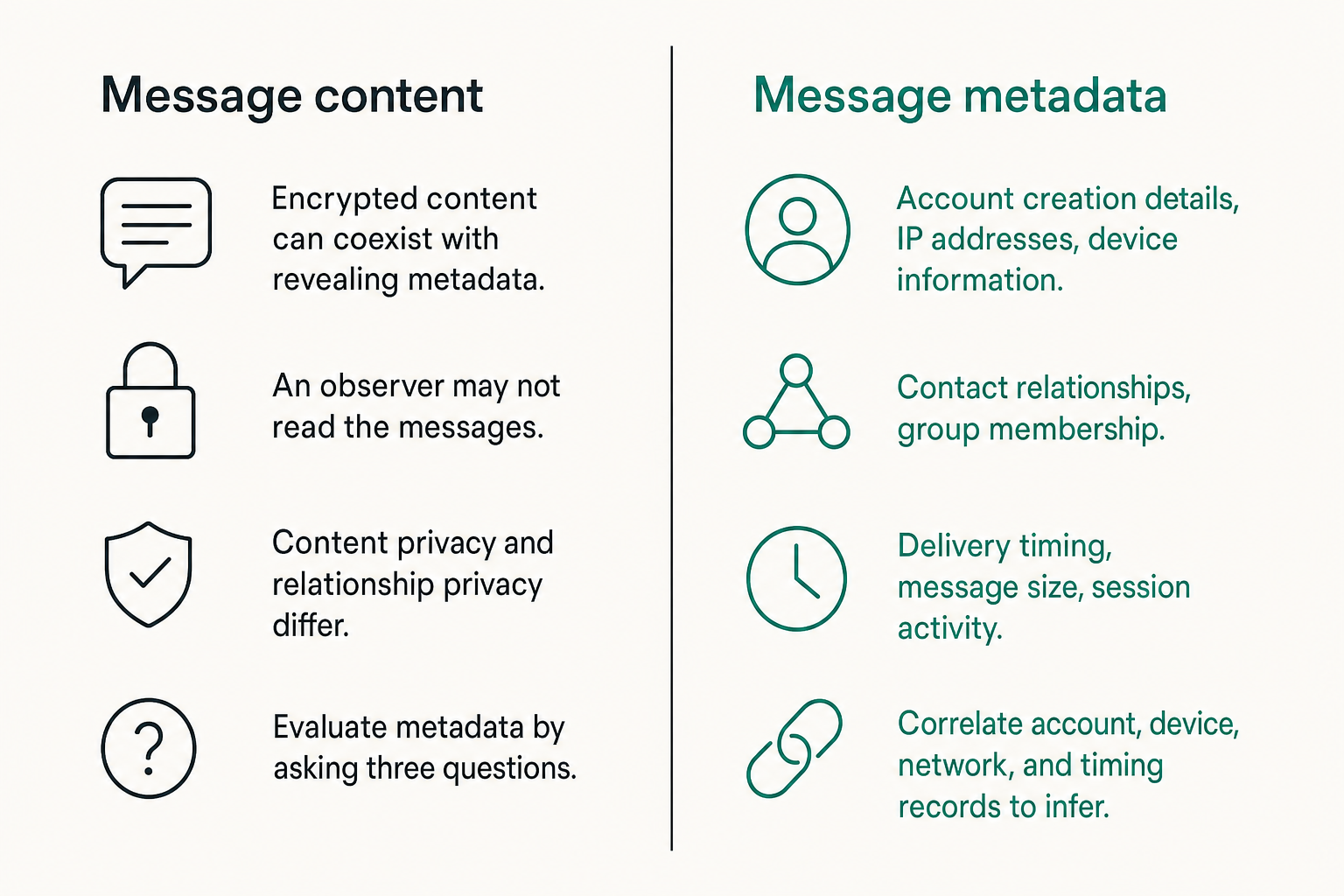
Encrypted content can coexist with revealing metadata. Depending on the architecture, a service may observe account creation details, IP addresses, device information, contact relationships, group membership, delivery timing, message size, and session activity.
Content privacy and relationship privacy differ
Consider a crisis-response group. An observer may not read the messages, but learning that a lawyer, executive, security lead, and outside investigator created a high-volume group at 02:00 can be valuable intelligence.
Evaluate metadata by asking three questions:
- What does the service need to route and deliver a message?
- What does it retain after delivery, and for how long?
- What can it infer by correlating account, device, network, and timing records?
Some metadata is operationally necessary at least briefly. Skepticism is warranted when a provider claims to collect “no metadata” without defining the term. Look for precise descriptions of collection, retention, and disclosure.
Account identifiers change exposure
Phone-number identity is convenient because users already have a reachable identifier. It can also enable address-book discovery, expose social relationships, and tie an account to a telecom identity. Email has similar linking risks. Usernames or random identifiers may reduce some exposure while making discovery and recovery harder.
There is no universally correct identifier. For a family group, contact discovery may be acceptable. For a sensitive research team, separation from personal phone numbers may be mandatory. Enterprise directories simplify onboarding but create a central source of membership data.
Review the provider’s privacy terms and data handling disclosures for the facts that protocol diagrams do not answer: account data, operational logs, cookies, retention, and service providers.
Push notifications create another boundary
Mobile push services can learn that an application received activity at a particular time. Poorly designed notifications may also include sender names or message content visible on a lock screen or passed through platform notification infrastructure.
Test the actual behavior on supported operating systems. Disable previews for high-risk users and confirm whether generic notifications still support an acceptable workflow. Security that causes users to miss urgent messages will often be bypassed.
Related reading from our network: the IPTV legality verification workflow addresses a different market, but its evidence-first approach is relevant: verify provider identity, data handling, payment exposure, and application behavior instead of trusting the interface.
Key management determines whether encryption holds
Encryption algorithms receive most of the attention. Key lifecycle decisions determine whether those algorithms protect the right people over time.
Key generation and storage
Find out where identity and session keys are generated, whether private keys leave the device, how local keys are protected, and what happens when users link another endpoint. Hardware-backed storage can improve resistance to extraction, although availability and behavior vary by platform.
Server-generated or server-escrowed decryption keys create a fundamentally different trust model from device-generated keys unavailable to the provider. Enterprise key escrow may be an intentional compliance requirement, but it should never be confused with a system where only conversation participants can decrypt content.
Key rotation matters too. Long-lived identity keys simplify recognition, while frequently changing session material can limit the effect of compromise. The architecture should distinguish identity from message encryption state.
Identity verification and key changes
Encryption to an unknown key does not prove who controls it. Secure messaging apps may offer safety numbers, fingerprints, QR codes, or another verification mechanism. Teams often ignore these features until an incident occurs.
Define when verification is required. Requiring out-of-band checks for every casual conversation will fail. Requiring them before exchanging credentials, approving a financial change, or discussing highly sensitive material is workable.
Key-change alerts also need clear instructions. Users must know whether a change probably reflects a reinstallation, a newly linked device, or an active interception attempt. A warning without a response workflow becomes background noise.
Practical rule: Verify identities at moments of consequence, not indiscriminately and not never. Document what users must do when a key unexpectedly changes.
Forward secrecy and post-compromise recovery
Forward secrecy aims to keep prior messages protected if a current key is later compromised. Post-compromise security aims to restore protection for future communication after an attacker temporarily obtains session state and then loses access.
These are protocol properties, but device behavior affects them. Archived plaintext, notification databases, exports, and cloud backups can preserve messages even when the transport protocol protects old ciphertext. Do not advertise forward secrecy as retrospective deletion.
For long-lived confidential conversations, examine how sessions rotate, how inactive devices are handled, and whether compromise of one group member affects future group state. Group messaging is harder than a two-person exchange because membership and key distribution evolve.
Multi-device messaging creates hard tradeoffs
Users expect one conversation to work on phones, tablets, desktops, and browsers. Every additional endpoint improves availability while increasing the number of places where plaintext and keys may exist.
Every linked device expands the attack surface
A sound multi-device design treats each endpoint as an identifiable participant with its own cryptographic material. Users or administrators should be able to see linked devices, recognize when they were added, and remove them.
Ask whether adding a device requires approval from an existing trusted endpoint, a password, a recovery key, an email link, or only control of a phone number. Each method has different resistance to phishing, SIM swapping, stolen sessions, and support abuse.
Browser clients deserve specific attention. Determine whether code is downloaded anew on each session, how local state is stored, and how the user verifies that the expected client is running. A browser deployment can be appropriate, but its update and integrity assumptions differ from an installed application.
Message history synchronization needs scrutiny
New devices are useful only if they can participate in current conversations, but users often expect full history immediately. That history might be transferred from an existing endpoint, restored from a backup, or retained in encrypted form by the service.
These designs are not equivalent:
| Design choice | Operational benefit | Security cost or question |
|---|---|---|
| No prior history | Small exposure window | Users lose context on new devices |
| Transfer from trusted device | Provider need not hold recoverable history | Requires an available trusted endpoint |
| Encrypted cloud history | Convenient recovery and synchronization | Key protection becomes critical |
| Server-readable archive | Easy search and administration | Breaks the usual end-to-end trust model |
The mistake teams make is evaluating “multi-device support” as a checkbox. The real issue is how trust is extended and how historical plaintext becomes available.
Device removal must have real effect
Removing a device should prevent it from decrypting new messages. It cannot reliably erase plaintext or screenshots already stored on that device. This distinction should appear in incident procedures.
Test revocation under realistic conditions: remove an offline laptop, send new messages, reconnect it, and observe what becomes available. Check whether group sessions rotate and whether other participants receive a useful warning.
If former employees retain unmanaged devices, revocation may protect future traffic but not prior downloads. Employment policy, device management, and data minimization remain necessary.
Recovery backups and retention can undo privacy
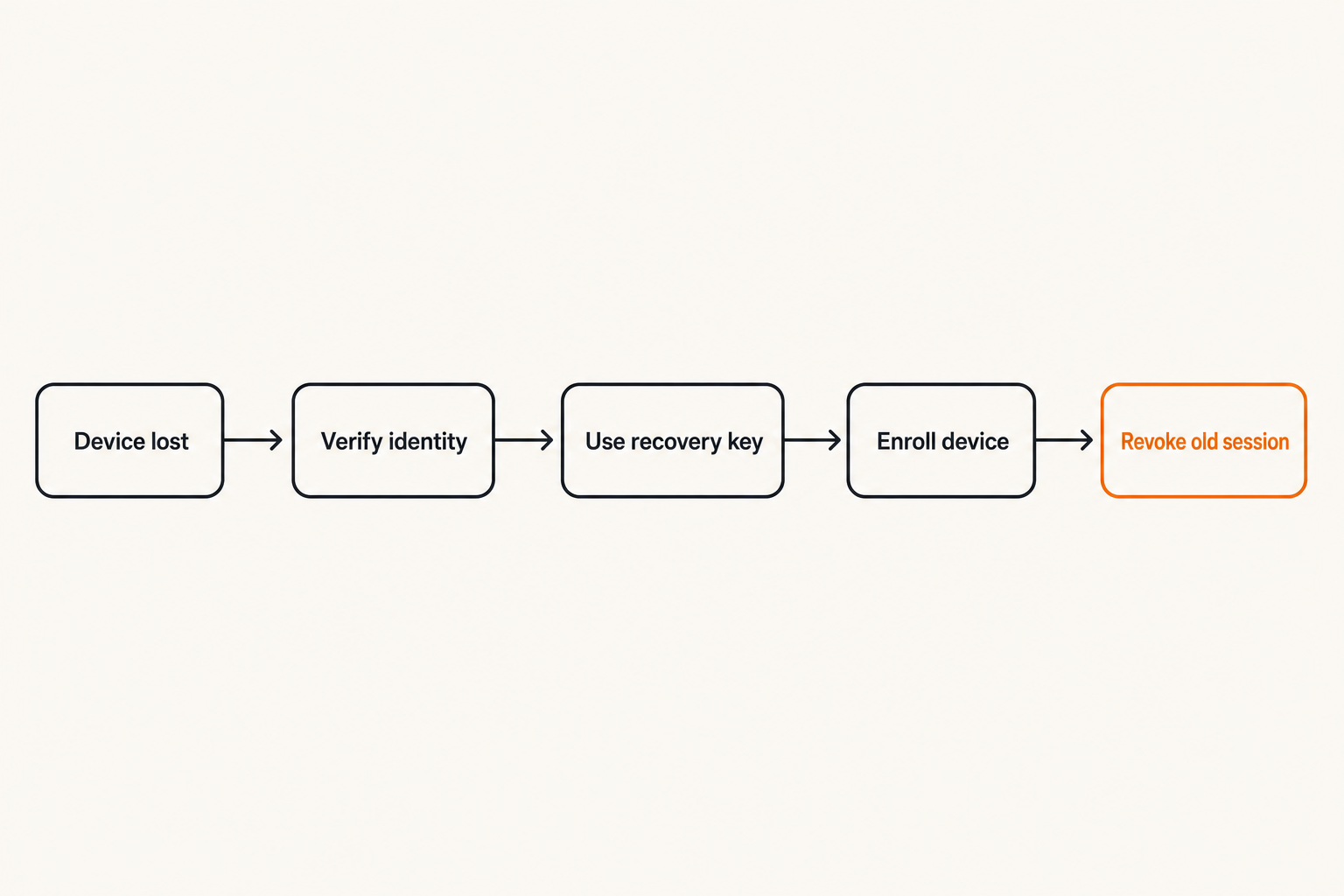
Recovery is where secure systems often weaken. Users lose phones, forget secrets, replace hardware, and expect support teams to restore access. Attackers know that the recovery desk may be easier to defeat than the cryptography.
Recovery is an alternate authentication path
Map every path back into an account: SMS codes, email links, recovery phrases, trusted contacts, administrator resets, support intervention, and restored device backups. The effective security level is set by the weakest path that restores decryption capability or authorizes a new device.
A recovery secret should have enough entropy, be stored separately, and be explained in language users understand. Security questions based on discoverable personal information are not an adequate substitute. If there is intentionally no recovery path, users need to understand that lost keys can mean lost history.
Support processes matter. An operator who can override account controls under social pressure may function as a decryption gate even when the primary login is strong.
Encrypted backups still need a threat model
“Encrypted backup” raises several questions:
- Who creates and controls the backup key?
- Can the provider reset or derive it?
- Is it protected by a user password vulnerable to offline guessing?
- Does the mobile platform include app data in a broader cloud backup?
- Are attachments and contact information covered?
- Can old backup versions survive after in-app deletion?
End-to-end encrypted backup can preserve the service’s content-confidentiality model if keys stay under user control. It also transfers responsibility to the user and may complicate organizational recovery.
Deletion is a distributed systems problem
A disappearing-message timer is a local policy implemented across several devices, not a guarantee that information ceases to exist. Recipients can capture content, quote it elsewhere, photograph it, or preserve it in backups. Offline devices may process deletion instructions later.
Use expiration to reduce routine accumulation, not to promise impossible control over an authorized recipient. For highly sensitive material, reduce detail in chat, limit group membership, and move formal records into a system with suitable access and retention controls.
Practical rule: Treat recovery and backup as part of the encryption architecture. If they are evaluated after deployment, they will become the easiest route around it.
A practical evaluation workflow
Selecting end-to-end encrypted messaging apps should resemble a security architecture review followed by a usability pilot. A feature spreadsheet alone cannot show what happens when accounts change, devices go offline, or people make mistakes.
Build a requirements matrix
Start with a short list of testable requirements, each linked to a threat or business need. A workable sequence is:
- Classify communication. Identify the messages, files, identities, and metadata requiring protection.
- Define adversaries. Include realistic endpoint, provider, network, insider, and recovery threats.
- Set mandatory controls. Specify identity, device, backup, retention, and administrative requirements.
- Document trust assumptions. State which providers, platforms, administrators, and participants can affect security.
- Create test cases. Convert each requirement into observable behavior.
- Assign exceptions. Decide who can approve a weaker workflow and for how long.
Avoid requirements that cannot be tested, such as “best-in-class encryption.” Prefer statements such as, “Adding a desktop requires approval from an existing trusted device,” or, “The provider cannot reset the backup decryption secret.”
Test behavior instead of reading feature pages
Build a small lab with multiple accounts and device types. Link and remove devices. Change phone numbers. Reinstall the client. Trigger key-change warnings. Restore a backup. Invite and remove group members. Allow one endpoint to remain offline during membership changes.
Observe notification content, local file storage, clipboard behavior, session persistence, and exported media. Capture what an administrator can see. Review what the provider says it retains, then compare that statement with available account controls and logs.
Related reading from our network: this SaaS pricing comparison framework makes the adjacent procurement point well: total cost includes implementation effort, workflow fit, contract risk, and operational overhead—not just a visible subscription price.
Run a limited operational pilot
Technical testing does not reveal whether people can use verification, recovery, and device controls correctly. Pilot with a representative group rather than only security specialists.
Include users with multiple devices, limited technical confidence, travel constraints, accessibility needs, and poor connectivity. Give them realistic tasks: verify a colleague, recover from a lost phone, report an unknown session, move a sensitive file, and remove a departing participant.
Record confusion and workarounds. If users repeatedly send screenshots through email because file handling is awkward, that behavior is part of the security result. Fix the workflow or revise the use case before broad deployment.
What breaks in real deployments
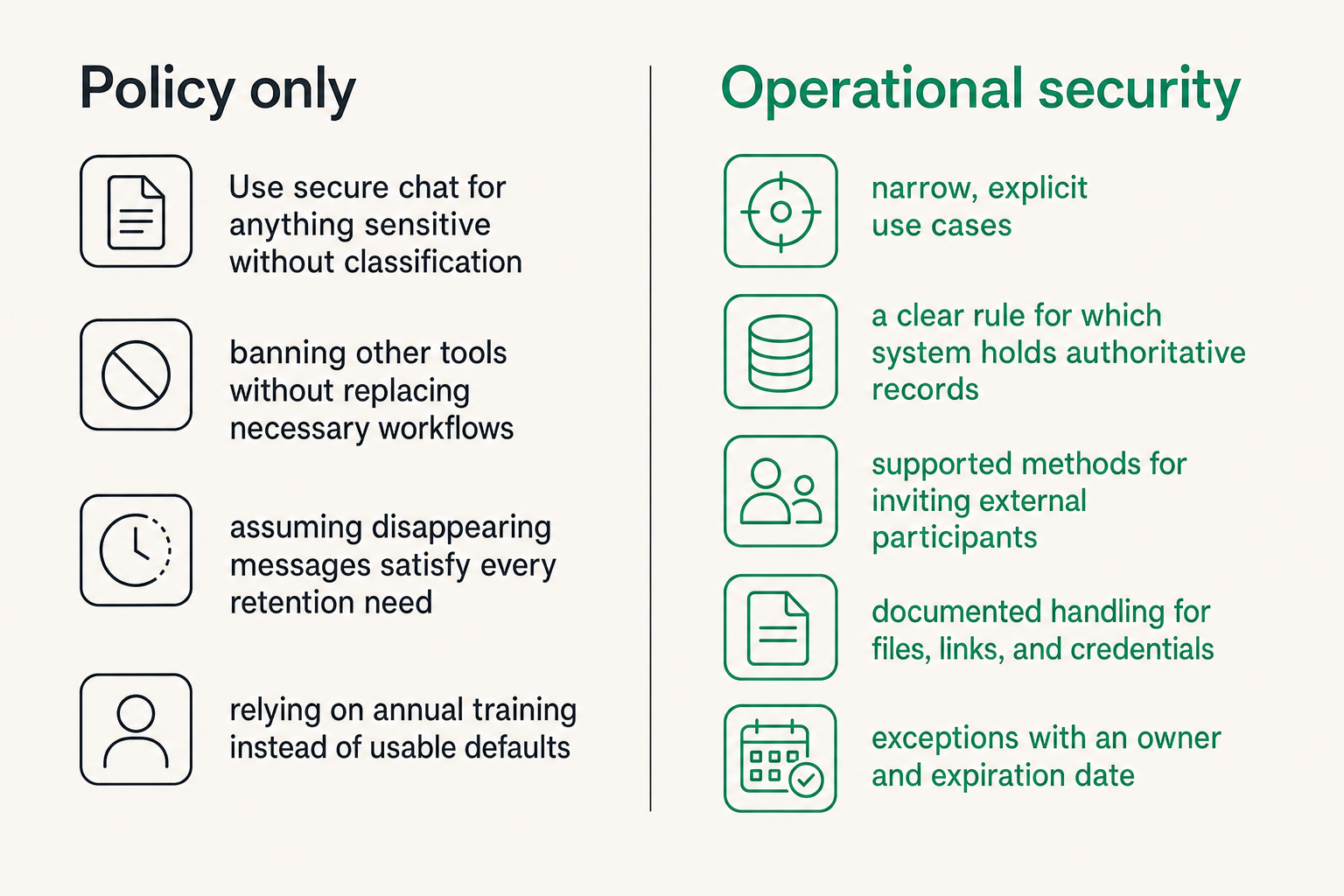
The strongest protocol cannot rescue a deployment built around ambiguous policy, unmanaged endpoints, and informal exceptions. What breaks in practice is usually the seam between the messaging app and the surrounding organization.
The policy and workflow mismatch
A policy may require sensitive discussion in the encrypted app while approvals, calendar invitations, and files remain in ordinary email. Users then reproduce the sensitive context outside the protected channel.
Another common failure is selecting a tool that lacks a necessary business function. If external collaborators cannot join, users create parallel groups elsewhere. If message retention conflicts with legal obligations, employees manually export conversations. Shadow workflows are predictable responses to architecture gaps.
What works:
- narrow, explicit use cases;
- a clear rule for which system holds authoritative records;
- supported methods for inviting external participants;
- documented handling for files, links, and credentials;
- exceptions with an owner and expiration date.
What fails:
- “Use secure chat for anything sensitive” without classification;
- banning other tools without replacing necessary workflows;
- assuming disappearing messages satisfy every retention need;
- relying on annual training instead of usable defaults.
Unverified identities and unmanaged devices
A team may mandate end-to-end encryption but never verify high-risk contacts. Users may retain old phones, share desktop profiles, or approve new devices without scrutiny. Departing personnel may remain in groups because nobody owns membership review.
Require stronger identity checks for consequential actions. A request to change payment details, disclose credentials, or grant access should be confirmed through a known channel or cryptographic verification. Messaging history and a familiar profile image are not enough if an account can be taken over.
For organizational devices, combine messaging controls with screen locks, supported operating systems, update requirements, and a loss-reporting process. Bring-your-own-device deployments need an explicit boundary: what the organization can enforce, what it can observe, and what users remain responsible for.
Sensitive data escapes through adjacent tools
Content commonly leaves chat through downloaded attachments, screenshots, browser previews, keyboards, accessibility services, analytics SDKs, crash reports, and notification systems. Some of these components are necessary; none should be ignored.
Review integrations with bots and automation carefully. A bot that receives plaintext can become an additional endpoint, even if people describe it as a server integration. Document which conversations permit bots, what they store, and how credentials are rotated.
Related reading from our network: the AI agent platform pricing architecture guide is useful when automated agents enter communication workflows because metering, reliability, portability, and data boundaries all affect the real operating model.
Deploy end-to-end encrypted messaging apps for teams
Deployment should establish ownership and repeatable lifecycle procedures. Download links and a policy announcement are not a rollout plan.
Assign ownership before rollout
Name owners for security architecture, account administration, endpoint standards, user support, retention decisions, and incident handling. In a small team, one person may hold several roles, but the responsibilities should still be explicit.
Decide who can create official groups, invite external users, approve exceptions, and handle lost devices. Establish a route for reporting suspicious key changes or unknown sessions. Users should not have to decide whether an anomaly belongs to IT, security, legal, or a team lead.
Document the service dependency as well. If the provider is unavailable, which conversations stop? Is there an emergency channel? How will users authenticate messages on that channel rather than accepting an attacker’s convenient replacement link?
Create channel and retention rules
Keep the model simple enough to remember. For example:
- Operational chat: routine coordination, moderate retention, normal membership controls.
- Restricted chat: sensitive projects, verified participants, limited devices, short retention.
- Incident channel: preassigned ownership, urgent notification rules, controlled external access.
- Record system: final approvals, required evidence, and documents that must be retained.
The labels are less important than the transitions. Users need to know when discussion must move to a restricted channel and when an outcome must be copied into the authoritative record system.
Retention rules should cover local downloads and exports, not only server-side messages. If attachments persist in photo libraries or download folders, an in-app timer offers incomplete reduction.
Prepare incident and offboarding procedures
Write short procedures for a lost device, suspected account takeover, unexpected key change, exposed recovery secret, compromised group member, provider outage, and employee departure.
A lost-device procedure might include:
- Report the loss through a separate authenticated route.
- Revoke the missing endpoint and review linked sessions.
- Rotate credentials or secrets shared in recent high-risk conversations.
- Notify sensitive groups when exposure is plausible.
- Enroll and verify a replacement endpoint.
- Record the event without copying unnecessary message content.
Offboarding should remove users from groups, revoke organizational devices or sessions, transfer required records, and rotate shared secrets. Removing an account does not retract information already seen.
Measure security without creating surveillance
Security teams need evidence that a deployment works, but collecting conversation content or detailed social graphs to measure privacy can defeat the objective.
Measure system health not conversation content
Prefer aggregate, minimally invasive measures such as:
- percentage of supported app and operating system versions;
- number of stale or unrecognized linked devices reported;
- time required to revoke a lost endpoint;
- completion of high-risk contact verification during a pilot;
- frequency and reason for approved workflow exceptions;
- offboarding tasks completed within the required window;
- support incidents caused by recovery or backup confusion.
These measures identify operational weakness without reading messages. Collection itself needs retention limits and access control. Even an administrative event log can reveal relationships or working patterns.
Use exceptions to improve the workflow
Exceptions are signals. If people repeatedly need an unapproved file-sharing tool, investigate size limits, external access, or performance. If recovery calls are common, improve enrollment guidance and secure storage of recovery material. If users ignore key-change alerts, redesign the response instructions.
Do not treat every workaround as disobedience. Many reveal that the approved architecture does not support the work. The security team’s job is to reduce the gap between policy and reality while preserving the required threat model.
Periodic review should also cover provider changes. New backup features, AI assistants, federation options, advertising models, or account identifiers can alter data flows without changing the core encryption label.
Where qrypt.chat fits
qrypt.chat is relevant to users and teams evaluating private communication with end-to-end encryption and post-quantum cryptography. The useful way to assess that positioning is as part of the complete architecture, not as a reason to skip threat modeling.
Evaluate quantum resistance in context
Post-quantum cryptography addresses the risk that sufficiently capable future quantum computers could undermine widely used public-key algorithms. That concern is particularly relevant when adversaries can collect encrypted traffic now and attempt decryption later.
But quantum resistance does not secure an unlocked phone, prevent screenshots, minimize all metadata, or repair a weak recovery workflow. Algorithm choice and operational security solve different problems. A credible evaluation asks how post-quantum mechanisms are used, what classical protections remain, how keys are authenticated, and how the implementation is updated.
This is not an argument against preparing for long-term cryptographic risk. It is an argument for placing that preparation in the correct layer of the system.
Choose a system people can operate safely
For individual users, test device enrollment, identity verification, notifications, backup behavior, and recovery before moving sensitive conversations. For teams, add ownership, member lifecycle, incident response, and record-handling requirements.
The best fit is not necessarily the application with the longest feature list. It is the one whose trust boundaries match your threat model and whose defaults users can follow without constant expert intervention.
End-to-end encrypted messaging apps should reduce dependence on service operators while making device and participant trust visible. In 2026, that remains a workflow discipline as much as a cryptographic property.
Try qrypt.chat
You are writing for people who care about private communication, secure messaging, and practical digital security. Try qrypt.chat and evaluate it against your own devices, recovery needs, metadata concerns, and communication workflow.