
Installing an encrypted chat app takes minutes. Determining whether it protects the conversations, identities, devices, and operational workflows that matter can take considerably longer.
That gap causes expensive mistakes. A team sees an end-to-end encryption label, moves sensitive work into the app, and only later discovers that message previews appear on locked screens, backups are readable, former contractors retain access, or administrators cannot respond to a compromised device.
Teams think the problem is choosing the strongest encryption. The real problem is designing a communication system whose identity, device, metadata, recovery, retention, and response layers match the threat model.
In 2026, evaluating end-to-end encrypted messaging apps is therefore an architecture and workflow decision, not a feature-comparison exercise. The practical question is not simply whether an app encrypts messages. It is what remains exposed, who controls each trust boundary, and what happens when a person, endpoint, credential, or provider fails.
Table of contents
- Start with the threat model, not the app store
- How end-to-end encrypted messaging apps actually work
- Compare the security architecture, not the feature list
- Metadata is part of the privacy model
- Devices, backups, and recovery are the real endpoints
- Build an encrypted messaging deployment workflow
- What works and what fails in production
- Plan for incidents, offboarding, and legal constraints
- Measure whether private messaging is working
- Where qrypt.chat fits
Start with the threat model, not the app store
A messaging product can be well designed and still be wrong for your situation. A journalist protecting confidential sources, a remote software team discussing credentials, and a family avoiding commercial profiling do not face the same adversaries or consequences.
The mistake teams make is starting with product names. That encourages comparison by visible features: file limits, reactions, video calls, themes, or disappearing-message timers. Start instead with the information, people, systems, and failure conditions involved.
Define what requires protection
List the assets carried by the communication workflow. Include message bodies, attachments, voice calls, contact relationships, group membership, timestamps, location clues, account recovery details, and local notification content.
Then classify conversations by impact rather than applying one vague label such as “sensitive.” A practical scheme might distinguish public coordination, internal operations, confidential commercial work, privileged legal communication, and high-risk personal data. The classification determines whether convenience features such as cloud history, browser sessions, bots, exports, or link previews are acceptable.
Practical rule: Protect the conversation context, not only the message text. Who communicated, when, and from which device may be as sensitive as the words exchanged.
Identify realistic adversaries
An adversary model should include capability and access. Relevant threats can include a network observer, the messaging provider, an abusive insider, a stolen-phone thief, malware on an endpoint, a cloud-backup provider, a former employee, or an authority using lawful process.
Avoid designing exclusively around an attacker breaking modern cryptography. In practice, attackers usually pursue easier paths: unlock an endpoint, reset an account, read notifications, exploit an outdated client, persuade a participant to export a chat, or join a group through a compromised identity.
Our broader secure messaging architecture guide explains how these trust boundaries interact across accounts, devices, metadata, and operations.
Separate confidentiality from anonymity
End-to-end encryption can hide content from an intermediary without hiding that communication occurred. A phone-number-based service may protect message bodies while making identities easy to correlate. An email-based account may expose an organizational relationship. IP addresses may reveal approximate location or network affiliation.
If anonymity is required, evaluate registration identifiers, contact discovery, payment records, IP visibility, push-notification infrastructure, and user behavior separately. Encryption is necessary for private content, but it does not automatically produce an anonymous communication system.
Related reading from our network: operators assessing the legality and privacy of streaming services face a similar evidence problem, as shown in this IPTV legality verification workflow.
How end-to-end encrypted messaging apps actually work
The useful definition of end-to-end encryption is operational: plaintext should be available only at authorized endpoints. Servers may route and temporarily store encrypted data, but they should not possess the keys needed to recover message content.
That sounds simple until multiple devices, offline delivery, group membership, search, backups, recovery, link previews, and push notifications enter the design.
Encryption endpoints define the boundary
The endpoints are not abstract users. They are concrete clients running on phones, laptops, tablets, or browsers. If Alice links three devices, the system must decide whether Bob encrypts independently to all three, whether a group key reaches each device, and how a removed device loses future access.
A browser can also be an endpoint, but it introduces different risks. Code may be delivered again on every load, browser extensions can inspect content, and session state may outlive user expectations. A desktop client creates installation and update responsibilities instead. Neither model is automatically unsafe; each changes the attack surface.
Keys matter more than transport
TLS protects a connection to a server. End-to-end encryption protects content beyond that server by placing decryption keys with participants. The distinction matters because a service can use strong HTTPS while retaining full access to stored messages.
Inspect how identity keys are generated, where private keys reside, how session keys rotate, and what occurs after key changes. Strong systems usually provide forward secrecy, limiting how much historical content a newly stolen key can expose. Some also provide post-compromise security, allowing future sessions to recover after an attacker temporarily obtains key material.
Practical rule: If the provider can reset a credential and silently restore readable history, determine which recovery key or backup mechanism made that possible.
Server blindness is not server absence
An encrypted service still needs infrastructure for account discovery, message queues, abuse prevention, attachment delivery, update distribution, and push notifications. Those systems may observe metadata even if message bodies remain opaque.
The practical question is which server-side functions are necessary, what each function learns, and how long it retains that data. Claims such as “zero knowledge” should be translated into specific fields, keys, logs, and administrative capabilities rather than accepted as a complete security model.
Compare the security architecture, not the feature list
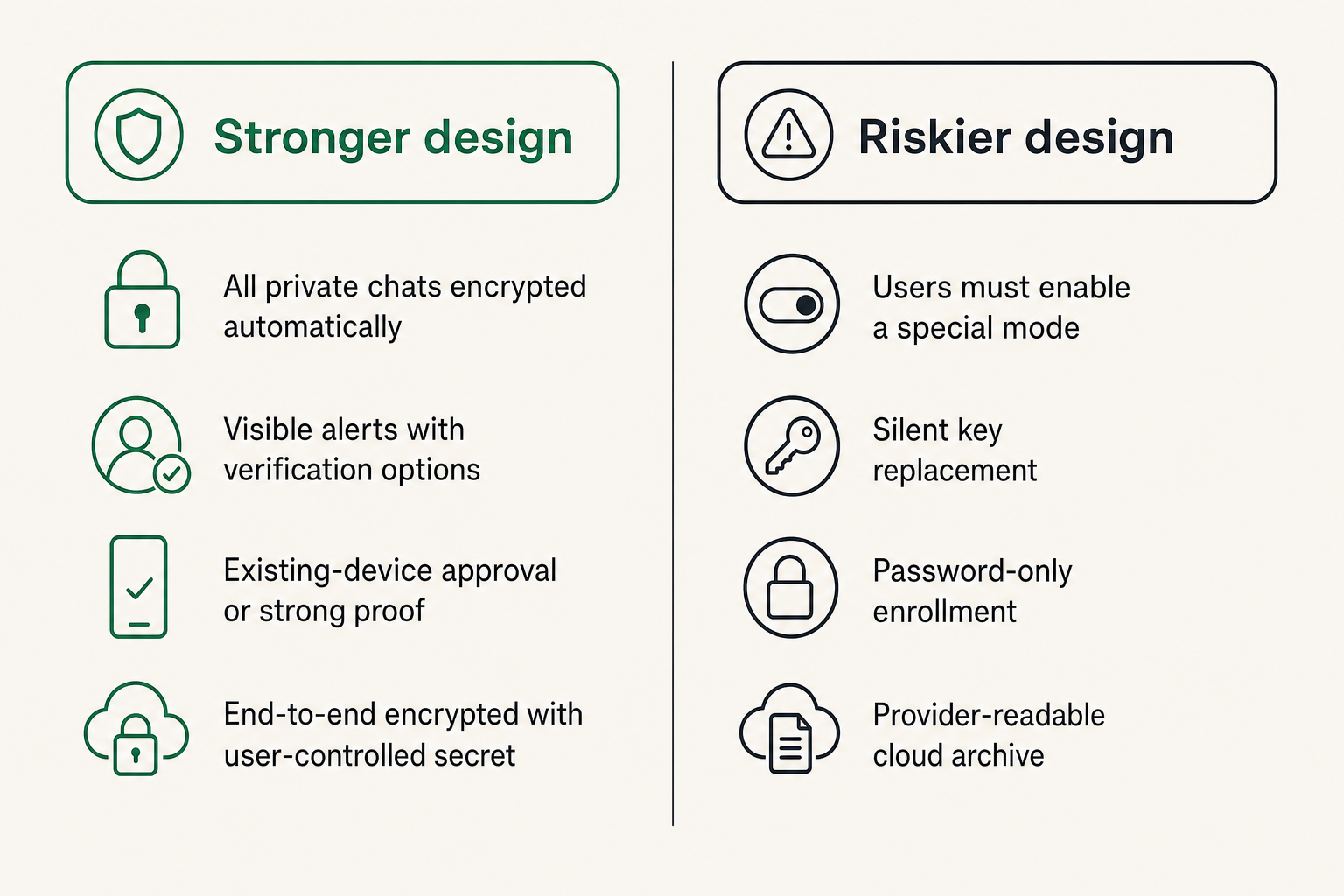
Two apps can both advertise end-to-end encryption while making materially different choices about key verification, source availability, group updates, backups, and device enrollment. A useful comparison separates protocol promises from product behavior.
| Evaluation area | Stronger approach | Riskier approach |
|---|---|---|
| Encryption default | All private chats encrypted automatically | Users must enable a special mode |
| Identity changes | Visible alerts with verification options | Silent key replacement |
| New devices | Existing-device approval or strong proof | Password-only enrollment |
| Backups | End-to-end encrypted with user-controlled secret | Provider-readable cloud archive |
| Group changes | Authenticated membership updates | Unclear or delayed participant state |
| Code assurance | Documented design and independent review | Proprietary claims without technical detail |
| Message deletion | Precise local and remote limitations | Absolute promises of erasure |
Evaluate protocols and implementations
A known protocol is helpful, but a protocol name does not validate the whole client. Key storage, random-number generation, attachment handling, database encryption, update signing, notification content, and user-interface decisions can undermine a sound cryptographic design.
Look for technical documentation, independent assessments, a vulnerability-reporting route, update history, and clear disclosure of limitations. Open source can improve inspectability, but source availability alone does not prove that the distributed binary matches the reviewed code or that anyone has performed a meaningful review.
The qrypt.chat security information is the appropriate place to examine the service’s stated cryptographic and security model rather than relying on a short app-store description.
Inspect identity and key verification
Encryption without authenticated identity can protect a conversation with the wrong endpoint. Safety numbers, fingerprints, QR codes, or authenticated key directories help participants detect substitution.
Verification must also survive normal operations. Ask what users see when a contact reinstalls the app, adds a laptop, changes a phone, or recovers an account. If warnings occur so often that everyone ignores them, the mechanism has failed as a workflow even if it remains cryptographically correct.
Treat group messaging as a separate system
Groups create state-management problems: membership changes, simultaneous updates, multiple administrators, offline participants, and devices with stale state. Verify whether removing a member rotates keys for future messages, how new members obtain history, and whether all participants receive authenticated membership updates.
For sensitive groups, establish who may add members and require a second person to confirm unexpected changes. A group title that looks familiar is not evidence that its current device membership is correct.
Metadata is part of the privacy model
Message encryption answers a narrow question: who can read content in transit or on the provider’s servers? It does not answer what the service knows about relationships, timing, devices, or network locations.
Map what the provider can observe
Create a metadata inventory. It should cover registration data, contact discovery requests, sender and recipient identifiers, group membership, message timing, delivery status, attachment size, IP addresses, device models, crash reports, and abuse signals.
Not every field can be eliminated. An online service usually needs enough routing information to deliver a message. The design objective is minimization: collect less, retain it briefly, separate identifiers where possible, and avoid turning operational logs into a permanent relationship graph.
Review the provider’s privacy policy for concrete descriptions of collection, retention, disclosure, and account rights. A broad claim of privacy is not a substitute for knowing which records exist.
Account identifiers create durable links
Phone numbers are convenient because they support familiar contact discovery, but they are persistent, externally issued identifiers. Email addresses can be similarly linkable. Random usernames reduce some exposure while creating challenges around impersonation and discovery.
Consider whether users can hide registration identifiers from contacts, whether address books are uploaded, and whether the provider can reconstruct social graphs. For organizational use, decide whether personal identifiers are acceptable or whether managed work identities are preferable.
Network privacy requires another layer
A local network, internet provider, or network observer may infer use of a messaging service even when it cannot read content. The service itself may see connection addresses unless proxies, anonymity networks, or privacy relays alter that path.
Do not promise users that an encrypted app hides their physical location or communication activity unless the network architecture supports that conclusion. For high-risk use, network privacy, device hardening, and behavioral discipline must complement content encryption.
Devices, backups, and recovery are the real endpoints
Most practical compromises do not defeat the message cipher. They obtain plaintext where it legitimately exists: on an unlocked screen, in a local database, inside a notification, in a screenshot, or in a restored backup.
The mistake teams make is treating endpoints as an implementation detail. They are the security boundary users touch every day.
Secure every linked device
Maintain an inventory of authorized devices and make it easy for users to inspect active sessions. Require screen locks, current operating systems, prompt client updates, storage encryption, and remote revocation where appropriate. High-risk teams may prohibit unmanaged browser sessions or personal desktops.
Notification previews deserve explicit treatment. A perfectly encrypted message can still appear on a lock screen, smartwatch, car display, or operating-system notification service. Set defaults according to conversation sensitivity, not convenience alone.
Verify backup encryption and control
Ask four direct questions:
- Is message history backed up automatically?
- Is the backup encrypted end to end before leaving the device?
- Who controls the decryption secret?
- Can account recovery grant the provider or an attacker access?
Operating-system backups can capture application databases or credentials outside the messenger’s intended model. Test actual restore behavior on a clean device rather than accepting a settings label. Include attachments, voice notes, and desktop caches in that test.
Design recovery without creating a bypass
Recovery is difficult because lost credentials and hostile recovery attempts can look identical. Email resets and SMS codes are convenient but may reduce account security to an inbox or mobile carrier. Recovery phrases offer stronger user control but can be lost, photographed, or stored in readable cloud notes.
A team deployment may use documented recovery custody, multiple approvers, or hardware-backed credentials. Consumer users may prefer a printed recovery secret stored offline. The right design depends on impact, but its security effect must be explicit.
Practical rule: Treat every recovery path as an alternative login protocol and test it against the same adversaries as the primary login.
Build an encrypted messaging deployment workflow
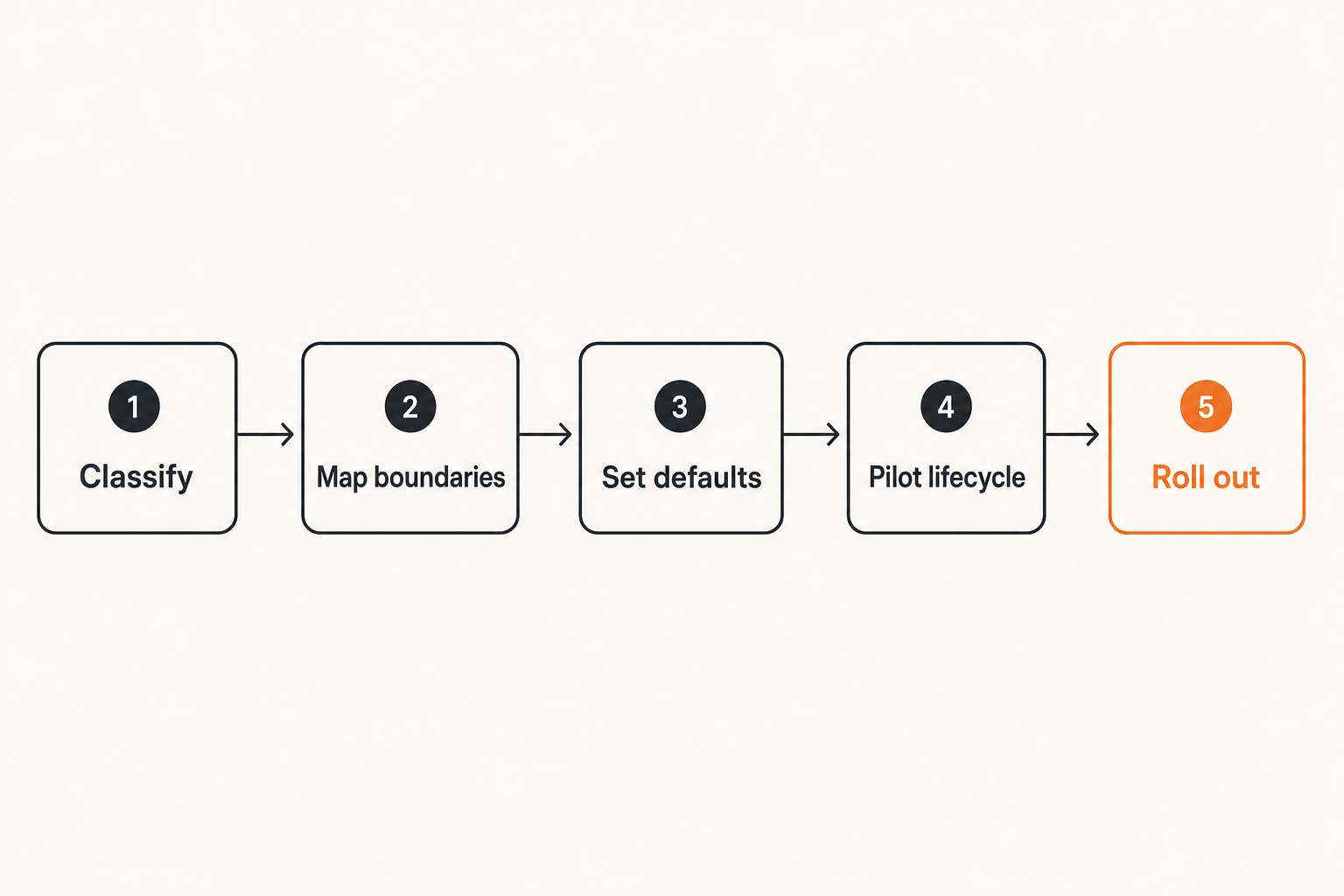
Downloading an app is not deployment. Deployment covers selection, configuration, participant enrollment, verification, normal use, device changes, incident response, and eventual offboarding.
A practical implementation sequence is:
- Classify communication. Identify which conversations and files belong in the encrypted channel and which require another system.
- Map trust boundaries. Document provider visibility, device storage, identity proof, backup control, and administrator powers.
- Configure secure defaults. Set notification privacy, disappearing-message policy, attachment handling, device limits, and recovery requirements.
- Pilot complete lifecycle events. Add and remove users, replace a phone, restore an account, revoke a laptop, and handle an identity-key change.
- Roll out with ownership. Assign support, security review, incident response, and policy-update responsibilities.
Pilot the complete lifecycle
A pilot that only sends test messages proves little. Include adverse and inconvenient events. Put one device offline during a group membership change. Attempt recovery without the original phone. Revoke a desktop session. Change an administrator. Test whether old exports and downloaded attachments remain available.
Record what users see at every step. Security controls that are invisible, ambiguous, or too disruptive will be bypassed. This is why selecting encrypted messaging SaaS resembles other production software decisions. Related reading from our network: this operator’s guide to encrypted messaging SaaS examines deployment, governance, and integration tradeoffs.
Document ownership and operating rules
A lightweight policy should answer:
- Who approves new members for sensitive groups?
- Are personal devices permitted?
- How quickly must lost devices be reported?
- Which backup and export methods are allowed?
- When must identities be reverified?
- Who handles abuse, legal requests, and account disputes?
- Which channel is used if the messaging service is unavailable?
The policy does not need to become a long compliance artifact. It needs to remove uncertainty during a real event.
Make verification usable
Verification should be risk-based. Requiring an in-person fingerprint comparison for every casual conversation will produce noncompliance. Never verifying keys leaves sensitive conversations exposed to identity substitution.
A workable model requires verification for executives, administrators, incident responders, high-value external contacts, and groups carrying regulated or privileged information. Teams can verify by a separate trusted channel, a live call with known participants, or an in-person QR scan.
What works and what fails in production
End-to-end encrypted messaging apps succeed when secure behavior is the default and exceptions are visible. They fail when security depends on every participant remembering a complicated ritual under pressure.
What works
Effective deployments generally share several properties:
- Encryption is automatic rather than conversation-specific.
- New device and identity events are visible.
- Group membership has clear owners.
- Users can review and revoke linked devices.
- Backup and recovery behavior is tested.
- Sensitive data has an approved destination outside chat when necessary.
- A separate incident channel exists.
- User guidance explains limits without claiming perfect secrecy.
This turns secure messaging into a maintained capability rather than a one-time procurement decision.
What fails
What breaks in practice is usually a boundary between the app and the surrounding workflow. Users copy content into email because an external participant cannot join. Teams export conversations to satisfy recordkeeping requirements. Files remain in download folders after disappearing from chat. A lost phone is reported days later because nobody knows whom to contact.
Another failure is policy contradiction. A company may mandate disappearing messages while also requiring long-term retention of business decisions. Users then create screenshots, manual notes, or unofficial archives. The security control has not removed retention; it has made retention uncontrolled.
The shadow channel problem
If the approved app is unreliable, difficult to enroll in, or missing necessary collaboration functions, users create fallback channels. Those channels often include ordinary SMS, personal email, consumer file sharing, or unapproved workspaces.
Map these escape routes during the pilot. The goal is not to make one messenger perform every business function. It is to define safe handoffs. A decision may move from encrypted chat into an access-controlled record system; a large file may move into encrypted storage; a public meeting link may travel through a less sensitive channel.
That changes the conversation from “Which app wins?” to “Which communication path handles each type of information safely?”
Plan for incidents, offboarding, and legal constraints
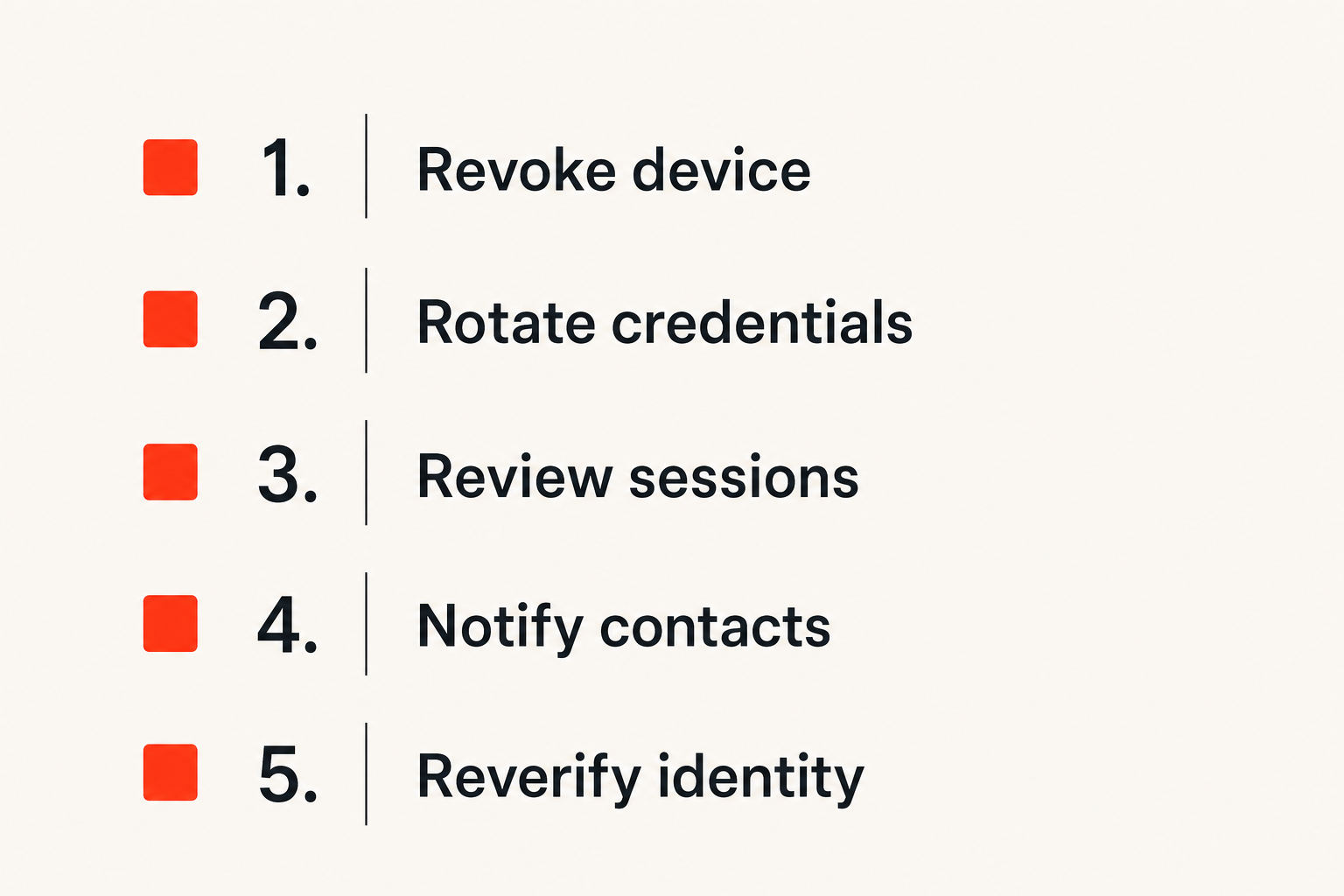
Security architecture is incomplete without failure handling. Teams should assume that devices will be lost, credentials will be phished, participants will leave, and legal or contractual duties will conflict with preferred privacy settings.
Respond to a compromised device
Prepare a short response runbook before an incident:
- Confirm the affected account and device through a trusted channel.
- Revoke the device or session from another authenticated endpoint.
- Rotate relevant credentials and recovery material.
- Review recent group additions, identity changes, exports, and linked devices.
- Notify affected participants without using the suspected channel.
- Reverify high-risk contacts and preserve permitted evidence.
Remote deletion can reduce exposure but cannot prove that plaintext was never copied. Scope the incident based on what the device could access, including cached files, notification history, screenshots, and other applications.
Remove people without pretending messages disappear
Removing a user should prevent future access, trigger the required key changes, and revoke managed sessions. It generally cannot erase information the person already read, downloaded, photographed, or backed up.
Offboarding therefore combines technical revocation with information minimization. Avoid placing secrets with long useful lives into group chats. Rotate credentials discussed in a channel when a participant leaves under risky circumstances. Review whether former members remain in secondary groups or on linked devices.
Resolve retention and compliance conflicts
Some organizations must preserve defined communications. Others need aggressive minimization. End-to-end encryption does not settle this policy question; it changes where retention can occur and who can access retained records.
If regulated records must be captured, define the capture boundary explicitly. Avoid secret provider-side access presented as encryption. A controlled endpoint export, restricted archive, or separate system of record may be more transparent, although it creates another high-value security boundary.
Architecture teams encounter similar questions when systems need identity, credentials, tools, and auditability without granting every intermediary unrestricted access. Related reading from our network: this open standards architecture guide for AI agents provides an adjacent example of making trust boundaries explicit.
Measure whether private messaging is working
Private communication should be measurable without collecting the sensitive content the system exists to protect. Focus on control coverage, lifecycle readiness, and preventable exposure rather than surveillance of individual conversations.
Track coverage and exposure
Useful operational indicators include:
- Percentage of managed users on supported client versions
- Number of stale or unrecognized linked devices
- Sensitive groups without a named owner
- Accounts lacking the required recovery setup
- Median delay between device-loss report and revocation
- Number of approved exceptions using unencrypted channels
- Frequency of backup and restore tests
These are not universal benchmarks. Establish a baseline, set risk-based targets, and investigate trends. A low incident count may indicate strong security, underreporting, or poor detection.
Measure response readiness
Run periodic exercises around a stolen phone, compromised administrator, malicious group invitation, provider outage, or exposed recovery phrase. Measure whether participants know the alternate channel, whether revocation works, and whether responders can identify affected groups.
Do not limit exercises to security specialists. Executive assistants, project owners, contractors, and support staff often administer the communication relationships attackers target.
Review trust assumptions regularly
Products change. Providers add features, operating systems alter notification behavior, and organizations adopt new device-management or retention requirements. Review major client releases, protocol changes, recovery updates, and privacy-policy revisions.
The practical cadence depends on risk. High-risk deployments may review changes continuously and perform formal quarterly checks. Personal users can still benefit from reviewing linked devices, backups, and privacy settings several times a year.
A useful way to think about it is configuration drift for communication. The app selected last year is not necessarily the system operating today.
Where qrypt.chat fits
Choosing qrypt.chat, or any other encrypted messenger, should follow the threat model and lifecycle work above. Product fit is strongest when its architectural assumptions match the users, devices, communication patterns, and adversaries involved.
Use post-quantum protection as one layer
Post-quantum cryptography addresses an important long-term risk: an adversary may collect encrypted traffic now and attempt decryption after future cryptographic advances. This matters when conversations must remain confidential for many years.
It does not remove endpoint risk, metadata exposure, weak recovery, careless screenshots, or compromised participants. Quantum-resistant design should therefore be evaluated as one layer in a complete messaging architecture, not as a replacement for device security and operational controls.
Evaluate the complete operating model
Before moving sensitive work, test qrypt.chat against concrete scenarios: multi-device enrollment, identity changes, offline delivery, group updates, account recovery, lost-device response, and participant removal. Decide which information belongs in chat and where durable records should live.
End-to-end encrypted messaging apps provide the most value when they reduce intermediary access without creating unusable workflows or hidden recovery paths. The practical secure messaging workflow guide can help teams turn that evaluation into repeatable rollout and response procedures.
The standard is not perfect security. It is an explicit, testable system in which encryption, identity, endpoints, metadata, and human operations support the same objective.
Try qrypt.chat
You are writing for people who care about private communication, secure messaging, and practical digital security. Try qrypt.chat and evaluate it against your real threat model, devices, and communication workflow.