
A message can be encrypted in transit and still be exposed on a compromised device, copied into a cloud backup, leaked through a notification, or retained in an administrator’s audit system. That is the operational problem hiding behind most claims about end-to-end encrypted messaging.
Teams think the problem is choosing an app with a lock icon. The real problem is controlling keys, devices, identity, metadata, recovery, and human behavior across the message lifecycle.
That changes the conversation. Instead of asking whether a product “has encryption,” you need to ask where plaintext exists, who can add a device, what happens when a member leaves, which metadata the service retains, and how the organization recovers from compromise without quietly creating a master decryption path.
In 2026, the practical question is not whether encryption matters. It is whether the complete messaging workflow preserves the security guarantees users think they are getting.
Table of contents
- End-to-end encrypted messaging is an architecture
- Start with a realistic threat model
- Understand the cryptographic workflow
- Control the device lifecycle
- Secure group messaging as membership changes
- Reduce metadata and operational leakage
- Compare end-to-end encrypted messaging systems
- Implement a secure messaging workflow
- Know what breaks in practice
- Choose an end-to-end encrypted messaging platform
End-to-end encrypted messaging is an architecture
Define the confidentiality boundary
End-to-end encryption means message content is encrypted on a sender-controlled endpoint and decrypted only on authorized recipient endpoints. The delivery service may route ciphertext, but it should not possess the ordinary capability to decrypt the conversation.
The important phrase is “authorized recipient endpoints.” Encryption does not establish that a laptop is trustworthy, that a newly enrolled phone belongs to the intended person, or that malware cannot read plaintext after decryption. Those controls come from device enrollment, identity verification, operating-system security, and revocation.
A useful way to think about it is as a boundary rather than a feature. Inside the boundary are authorized devices and plaintext. Outside it are relays, queues, databases, network observers, and infrastructure operators that should see ciphertext rather than message content.
Separate transport encryption from end-to-end encryption
Transport Layer Security protects a connection between a client and a server. The server terminates that connection and can normally access data sent through it. This is necessary for most web services, but it is not the same as end-to-end protection.
With end-to-end encryption, the client encrypts the payload before handing it to the transport layer. TLS still matters because it protects session metadata, resists network tampering, and hides protocol details from local observers. It simply serves a different boundary.
The mistake teams make is treating these layers as interchangeable. “Encrypted in transit” may mean plaintext is available to application servers, database workers, support tools, backups, and administrators.
Practical rule: If an application server can routinely render message content, the system does not provide a meaningful end-to-end confidentiality boundary for that content.
Map every plaintext location
Create a data-flow diagram before evaluating cryptographic terminology. Mark where content is composed, encrypted, queued, decrypted, indexed, displayed, copied, exported, cached, and deleted.
Include less obvious locations:
- Notification text shown on a locked screen
- Search indexes stored locally on a device
- Clipboard managers and operating-system screenshots
- Crash dumps containing application memory
- Browser extensions with page access
- Exported transcripts and downloaded attachments
- AI assistants, ticketing tools, or bots receiving copied content
- Unencrypted device or desktop backups
The encryption protocol can be sound while the workflow remains unsafe. Architecture review therefore has to extend beyond the message relay.
Start with a realistic threat model
Identify assets and adversaries
Start with the information being protected. A family conversation, an incident-response channel, executive communications, and a source-journalist exchange do not have identical risk profiles.
Then identify plausible adversaries. These might include a network observer, abusive account holder, compromised service operator, former employee, device thief, malware operator, or party able to compel stored records. Avoid designing exclusively around a cinematic attacker while ignoring ordinary account takeover and accidental disclosure.
Document which outcomes matter: reading message content, learning who communicated, impersonating a participant, adding an unauthorized device, changing group membership, or preventing delivery.
Treat devices and accounts as separate risks
An account answers who is permitted to use a service. A device key answers which endpoint can decrypt a message. Combining these concepts into one opaque login state creates dangerous recovery and enrollment behavior.
For example, an attacker who resets an account password should not silently inherit every historical message key. A legitimate user adding a new laptop should generate a detectable device event. Existing participants may need to verify the new endpoint before sensitive communication continues.
Strong account authentication reduces unauthorized enrollment. It does not replace cryptographic device identity.
Decide what metadata matters
Message content is only one class of sensitive information. A provider may still process sender and recipient identifiers, IP addresses, device tokens, timestamps, group membership, delivery status, message size, and abuse reports.
Not all metadata can be eliminated. A relay needs enough information to deliver a packet, and mobile notification systems need routing tokens. The design objective is minimization: collect only what the workflow requires, retain it briefly, and avoid joining separate records unnecessarily.
A service’s privacy disclosures should help users understand these boundaries. Read them alongside the technical architecture rather than assuming that encryption makes data practices irrelevant.
Related reading from our network: teams building shared defensive workflows face a similar distinction between useful context and uncontrolled data accumulation in this guide to community building for security operations.
Understand the cryptographic workflow
Identity keys and session keys do different jobs
Long-lived identity keys let participants recognize devices or accounts over time. Shorter-lived session or message keys encrypt conversation content. Keeping these roles separate allows the protocol to update encryption state without constantly replacing the identity relationship.
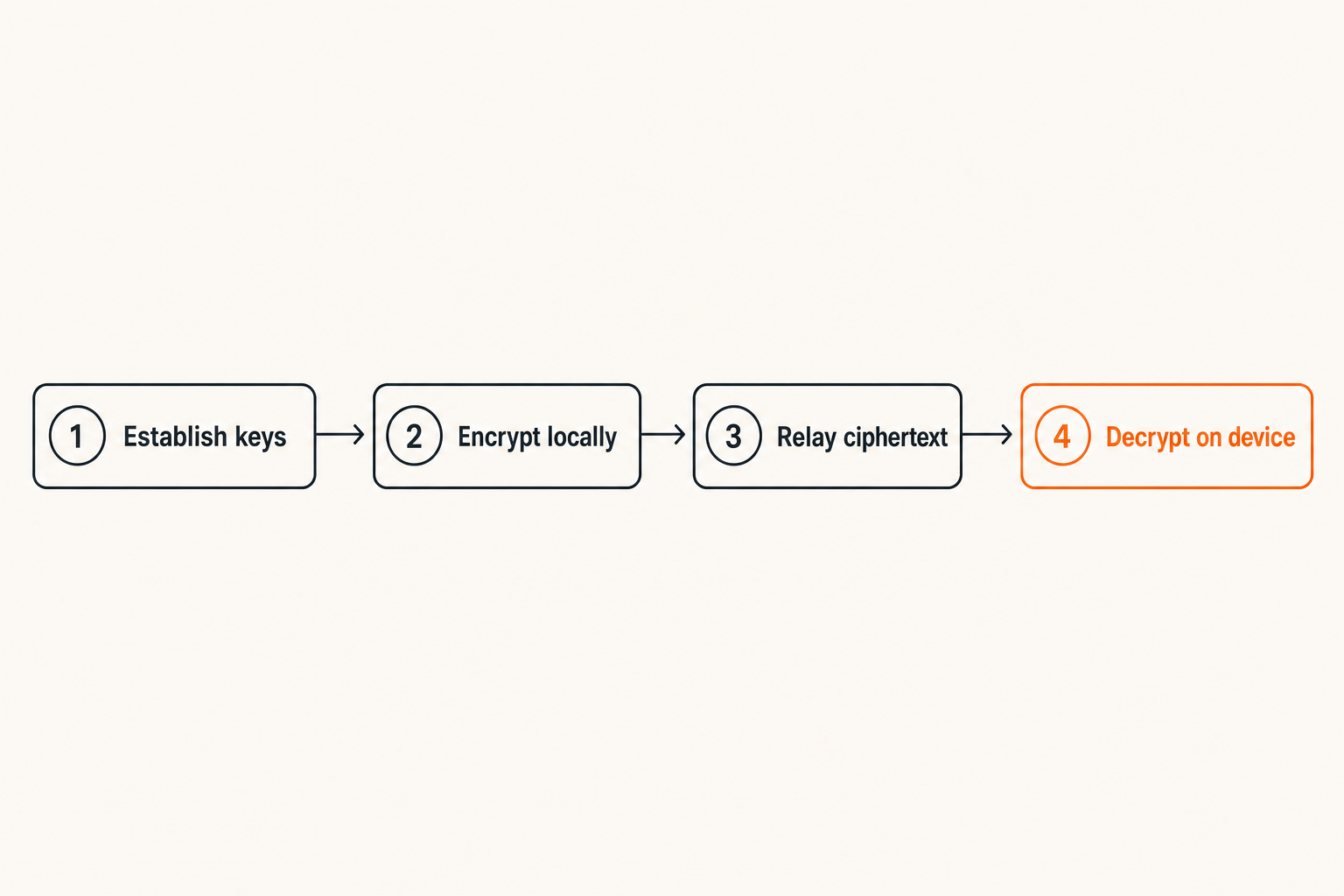
A simplified delivery flow looks like this:
- A client creates or retrieves its device identity key.
- The sender obtains authenticated public-key material for the recipient’s devices.
- The clients establish session secrets without sending those secrets as plaintext.
- The sender encrypts the message locally for the authorized recipient set.
- The relay stores and forwards ciphertext.
- Each recipient device authenticates and decrypts the payload locally.
Real protocols add replay protection, key derivation, transcript binding, device lists, acknowledgements, and state synchronization. The model still helps reviewers ask where trust enters the process.
Forward secrecy limits historical exposure
If one static key encrypts years of conversation history, stealing that key may expose years of captured ciphertext. Forward secrecy reduces this blast radius by evolving or replacing key material as communication proceeds.
Post-compromise security addresses the other direction: whether a session can recover after an attacker temporarily obtains active key state. Both properties depend on protocol details, correct state transitions, and successful key updates. They should not be inferred from the name of an encryption algorithm alone.
Practical rule: Evaluate compromise in time slices—messages before compromise, during compromise, and after remediation—rather than asking whether a product is simply “secure.”
Post-quantum readiness requires lifecycle planning
Quantum-resistant messaging is not achieved by inserting a new algorithm into an otherwise unchanged stack. Teams must consider identity establishment, session negotiation, key sizes, performance, protocol versioning, downgrade resistance, and cryptographic agility.
Hybrid designs may combine established classical mechanisms with post-quantum mechanisms so that an attacker must defeat both components to recover a shared secret. But hybrid construction does not remove implementation risk. Key serialization, randomness, error handling, and version negotiation still matter.
The “harvest now, decrypt later” concern is especially relevant when conversations have a long confidentiality lifetime. The architectural question is whether ciphertext captured today could become readable after future cryptanalytic advances. For a deeper adjacent treatment, see this 2026 guide to messaging architecture, operations, and trust.
Control the device lifecycle
Enrollment is a security decision
Multi-device access is convenient because users expect phones, desktops, tablets, and browsers to share conversations. Every added endpoint also expands the decryption boundary.
A defensible enrollment workflow should authenticate the account, create device-specific keys, display the new device to existing endpoints, and preserve an auditable event without logging message content. Higher-risk teams may require approval from an existing device or verification through a separate channel.
Device labels should be meaningful enough to act on. “Chrome session 8” is less useful than an approximate platform, creation time, and last-active time. Avoid collecting excessive fingerprinting data merely to improve the label.
Recovery can become a decryption backdoor
Recovery creates one of the hardest product tradeoffs. Users lose devices and credentials. Organizations also need continuity when employees leave. A recovery system that lets the provider reconstruct every key may defeat the claimed confidentiality boundary.
Possible models include recovery codes, user-held backup keys, encrypted key backups protected by a secret unknown to the provider, or starting with a new cryptographic identity. Each has a different balance of availability and confidentiality.
The correct choice depends on the threat model. What matters is being explicit about whether recovery restores the account, historical plaintext, contact identity, or all three. Those are not equivalent operations.
Revocation must produce visible state changes
Deleting a device from an account dashboard is not enough if the endpoint retains usable message keys or remains included in future encryption sets. Revocation should stop future delivery, rotate relevant state where required, and notify affected users.
Offline devices complicate this. A removed endpoint may retain content it already decrypted, and no cryptographic mechanism can make a recipient forget plaintext. Systems should distinguish prospective access control from remote erasure claims.
Useful revocation records include device identifier, actor, time, reason, and resulting key-state change. They should not include conversation content.
Secure group messaging as membership changes
Membership changes should rotate access
Groups make recipient management dynamic. When someone joins, the system must decide whether the new member can read previous history. When someone leaves, future messages must stop being encrypted to that member’s devices.
The mistake teams make is updating a visible member list without updating cryptographic state. The interface may say a person left while senders continue using a key known to that person.
A membership event should therefore be tied to authenticated group state and a key update. Participants should be able to see who made the change and which devices are currently eligible to receive new messages.
Administrator power needs boundaries
Organizational chat often requires administrators to provision accounts, enforce policy, or remove devices. That does not automatically mean administrators must be able to decrypt all conversations.
Separate administrative control planes from cryptographic access. An administrator may be authorized to suspend an account without possessing the keys needed to read its messages. If compliance requirements demand content retention or inspection, describe that mode accurately instead of calling it uncompromised end-to-end encryption.
This boundary should also cover support staff. A support workflow should diagnose delivery state, protocol version, and device enrollment without asking users to send plaintext transcripts.
Large groups change the engineering tradeoffs
Encrypting separately for every device can become expensive in a large, frequently changing group. Shared sender-key approaches may improve performance, but they introduce distribution, rotation, and consistency challenges.
What breaks in practice is often state convergence. One device sees the new membership epoch while another is offline. Messages arrive out of order. A participant reinstalls the application. The protocol needs deterministic rules for stale epochs, retries, and duplicate delivery.
A secure design fails closed when key state is ambiguous, but the interface also needs to explain why a message cannot be decrypted or sent. Silent fallback to weaker encryption is not an acceptable usability fix.
Reduce metadata and operational leakage
Encryption does not hide every interaction
A relay may need to know that one account has a packet waiting for another. Network observers may infer activity from timing and volume. Group size may be visible even when names and content are not.
Metadata protection techniques can include sealed sender designs, identifier separation, batching, padding, proxying, short retention, and limited logging. Each adds cost or complexity. The practical question is which metadata creates material risk for the target users.
Do not promise anonymity when the architecture only protects content confidentiality. Anonymous access, traffic-analysis resistance, and end-to-end encryption are separate properties.
Notifications and previews can expose plaintext
A carefully encrypted message can appear verbatim on a locked screen. Push notification providers may also receive content if the application sends plaintext previews through their infrastructure.
Safer designs send a generic wake-up event and let the client retrieve encrypted content. Users should be able to disable sender names and previews. Organizations should account for shared screens, meeting-room displays, wearable devices, and desktop notification history.
Link previews are another edge. If the server fetches a URL on the user’s behalf, it may learn the link. If the recipient fetches it directly, the destination learns the recipient’s IP address. Client-side preview generation can reduce central visibility but does not remove all tracking risk.
Logs should describe delivery without recording content
Operators need enough telemetry to detect outages, abuse, protocol failures, and retry storms. They do not need plaintext messages in application logs.
A privacy-preserving event might look like this:
{
  "event": "ciphertext_delivery_failed",
  "protocol_version": "v3",
  "recipient_device_count": 3,
  "failure_class": "stale_key_epoch",
  "retryable": true,
  "content_logged": false
}
Use short-lived pseudonymous identifiers where correlation is operationally necessary. Restrict access, define retention, and test redaction. Debug modes should not quietly disable content protections in production.
Related reading from our network: streaming services face a different domain but a comparable reliability problem across latency, rights, privacy, and delivery architecture in this analysis of IPTV alternatives for sports fans.
Compare end-to-end encrypted messaging systems
Compare guarantees instead of feature labels
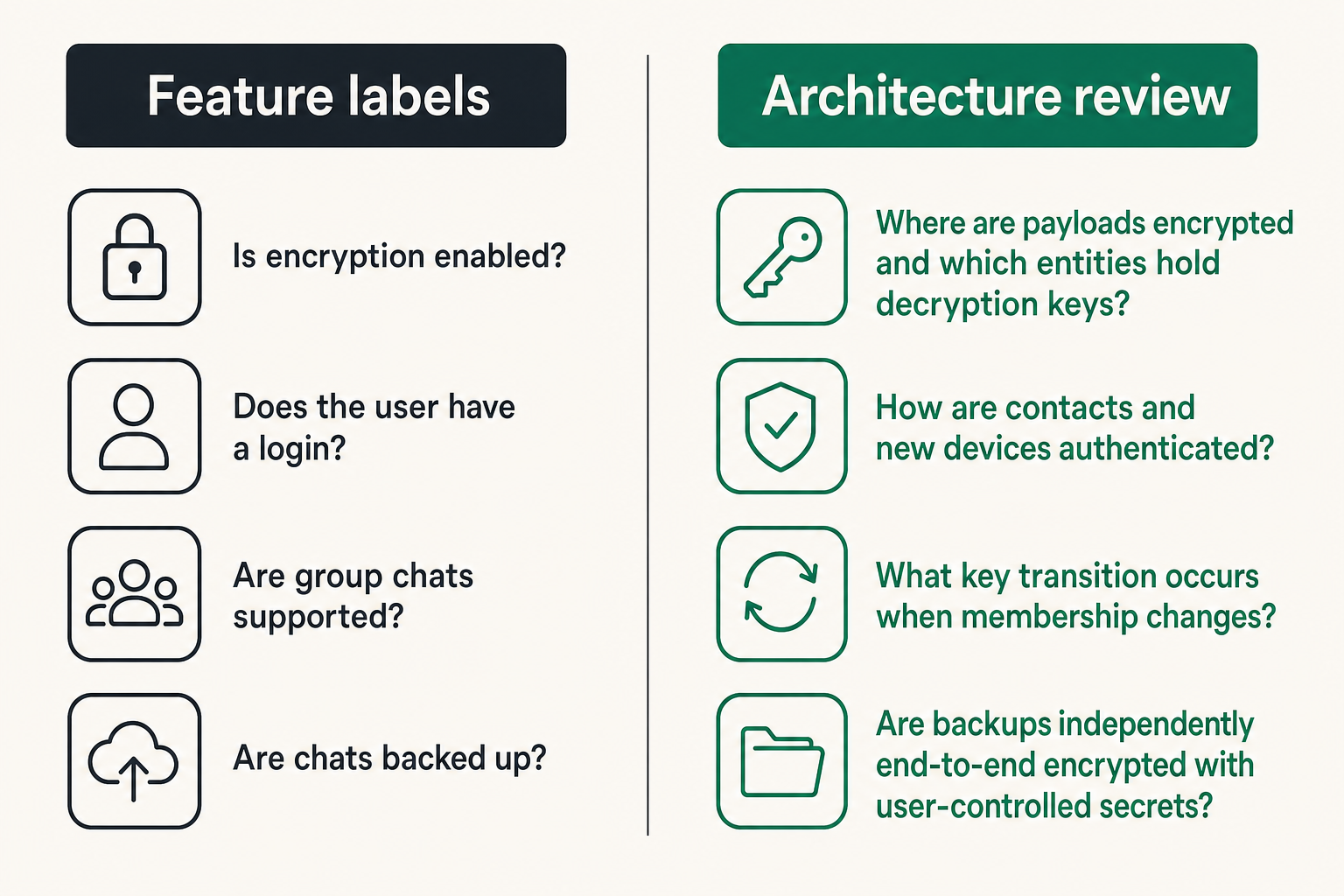
Product pages often compress complex designs into “military-grade encryption,” “zero knowledge,” or “secure chat.” These labels are not evaluation criteria.
Use a structured comparison instead:
| Area | Weak evaluation | Better architectural question |
|---|---|---|
| Encryption | Is encryption enabled? | Where are payloads encrypted and which entities hold decryption keys? |
| Identity | Does the user have a login? | How are contacts and new devices authenticated? |
| Groups | Are group chats supported? | What key transition occurs when membership changes? |
| Recovery | Can users recover access? | Can the provider recover message keys or only account access? |
| Metadata | Is content private? | Which routing and relationship records are retained, and for how long? |
| Backups | Are chats backed up? | Are backups independently end-to-end encrypted with user-controlled secrets? |
| Algorithms | Is a modern cipher named? | How are protocols versioned, reviewed, and protected from downgrade? |
| Operations | Is there an audit log? | Can useful events be logged without content or durable social graphs? |
This framing makes tradeoffs visible. A system can be strong in transit and weak in recovery. Another can protect content well but expose substantial relationship metadata.
Validate claims with observable behavior
Documentation is necessary but not sufficient. Test the lifecycle:
- Add a device and check whether existing devices are notified.
- Remove a device and confirm it no longer receives new ciphertext.
- Reset an account and observe whether history reappears automatically.
- Change group membership and inspect participant warnings.
- Disable previews and test mobile, desktop, and wearable notifications.
- Capture client traffic to verify message payloads are not plaintext.
- Review exports, backups, crash reports, and support diagnostics.
Public protocol descriptions, independent review, and a clear vulnerability process increase confidence. A published algorithm name alone proves little. The implementation and operational controls determine the real boundary.
The qrypt.chat security information is the appropriate place to inspect platform-specific security claims rather than relying on a summary sentence in an app listing.
Separate consumer and organizational requirements
Individuals often prioritize simple verification, safe recovery, and minimal metadata. Organizations may additionally need managed enrollment, access termination, policy controls, legal review, and incident visibility.
Some enterprise requirements conflict with strict confidentiality. Universal transcript search, invisible administrator access, or server-side content inspection requires plaintext access somewhere. Teams should document that tradeoff rather than hide it behind an encryption label.
Consumer ease and organizational governance can coexist when controls focus on identities, devices, and policy state instead of message content. But that separation must be designed from the beginning.
Implement a secure messaging workflow
Use a staged deployment sequence
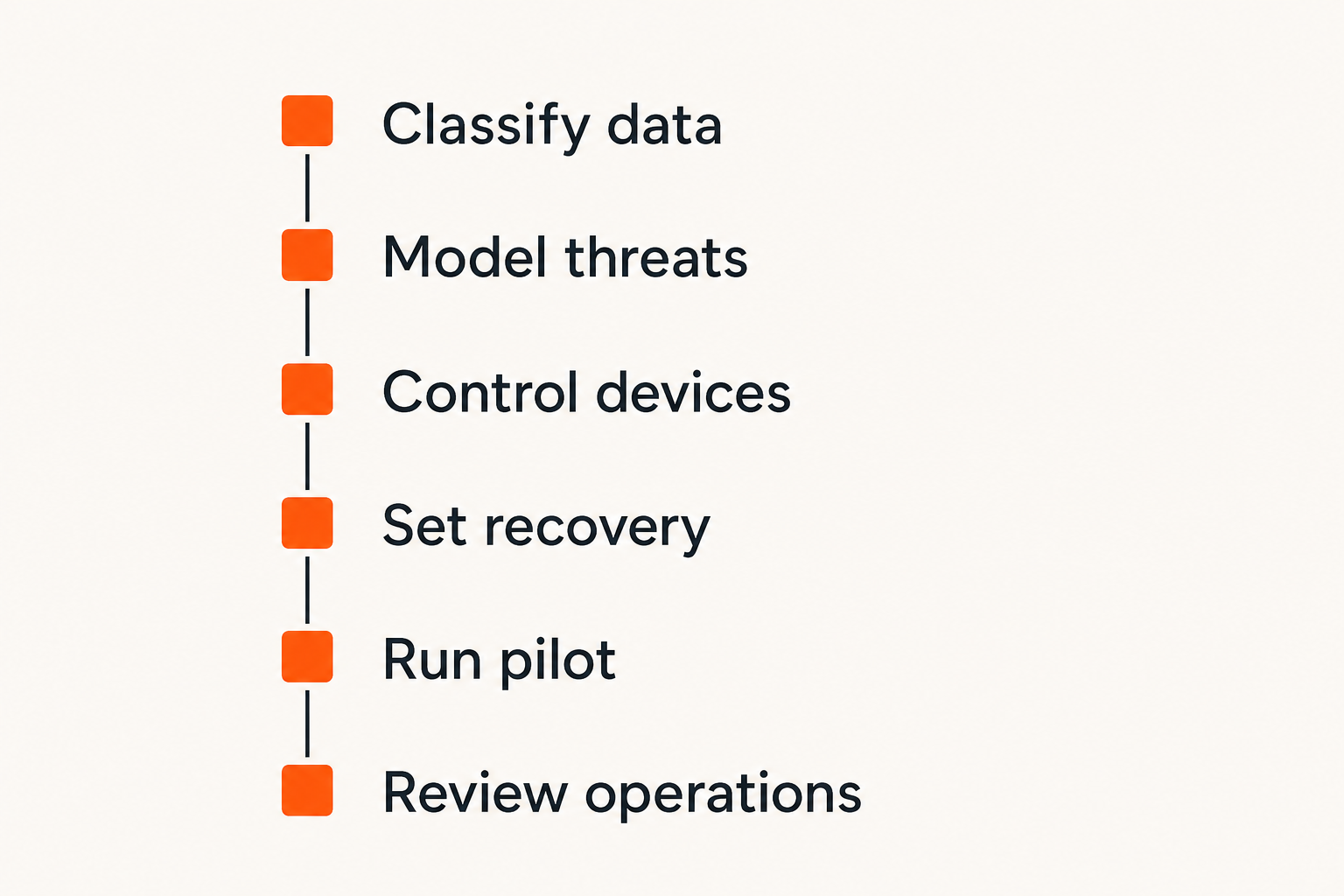
Buying a secure messenger without changing communication practices rarely fixes the underlying exposure. Use a controlled implementation sequence:
- Classify conversations. Identify which communications contain credentials, customer data, incident details, legal strategy, personal information, or long-lived secrets.
- Define the threat model. State which attackers, metadata, and compromise scenarios matter.
- Map devices and identities. Decide who may enroll endpoints and how participants verify them.
- Select recovery policy. Determine whether history can be restored and who controls the recovery secret.
- Pilot high-value workflows. Test a bounded team before moving the whole organization.
- Exercise membership changes. Add, remove, suspend, and recover users under realistic conditions.
- Train on boundary behavior. Cover exports, notifications, screenshots, link previews, and copied content.
- Review telemetry and response. Ensure operators can troubleshoot failures without reading conversations.
A pilot should include lost devices, offline participants, expired sessions, delayed messages, and an employee departure. Happy-path testing does not expose the hard problems.
Practical rule: Deploy encrypted messaging as an identity-and-device program, not as another chat application rollout.
Integrate without exporting plaintext
Bots and integrations frequently punch holes through an otherwise strong design. A bot that receives plaintext is effectively another conversation participant, even when the interface depicts it as a harmless automation.
List every integration and define its trust level. Where possible, use local actions, ciphertext-aware delivery hooks, or metadata-only events. If a service must process content, disclose that boundary and limit it to designated channels.
Webhook design should authenticate events, prevent replay, minimize payloads, and use idempotent processing. A delivery event might identify an opaque message reference and failure class without including the message body.
Related reading from our network: payment teams encounter a comparable handoff problem when content, trust, and system state cross service boundaries, as shown in this discussion of resilient crypto checkout architecture.
Measure security and operational health
Avoid metrics that require collecting sensitive content or durable relationship graphs. Useful operational measures include:
- Rate of failed device-key updates
- Number of stale or unverified devices
- Time between revocation and delivery cutoff
- Frequency of undecryptable-message errors
- Percentage of clients on supported protocol versions
- Recovery attempts and their outcomes
- Notification-preview policy adoption for managed devices
- Volume of fallback or legacy-protocol attempts
Aggregate where possible and apply short retention. A metric is not automatically safe merely because it appears on a dashboard.
The goal is to detect broken security state, not to reconstruct who said what to whom.
Know what breaks in practice
Security fails at the edges
Mature encryption can still be undermined by insecure randomness, exposed keys, weak update systems, malicious dependencies, vulnerable web clients, or verbose diagnostics. Browser-based clients deserve particular attention because downloaded code, extensions, and the browser runtime affect the trusted endpoint.
Attachments also create persistence outside the chat application. A document may be encrypted during delivery and then stored unencrypted in a downloads folder, synchronized to cloud storage, or opened by software that creates temporary copies.
The endpoint is where content must become readable. Endpoint hardening, patching, screen locking, storage encryption, and malware resistance remain part of messaging security.
Unusable controls create shadow workflows
If verification interrupts every conversation, users stop verifying. If recovery is impossible to understand, they copy sensitive material into email. If file limits are too restrictive, they upload documents to unmanaged sharing services.
What works is proportionate friction. Make routine secure behavior automatic, then introduce explicit confirmation for high-risk events such as a new device, changed identity key, recovery, or group membership transition.
What fails is hiding every state change to preserve a smooth interface. Users cannot respond to risks the product refuses to show. Warnings should explain the event, likely causes, and safe next action without demanding cryptographic expertise.
Incident response needs encrypted-messaging context
A response plan should distinguish account compromise, device compromise, server compromise, dependency compromise, and suspected protocol failure. Each requires different containment.
For a stolen device, revoke the endpoint, rotate affected group state, review recent enrollment events, and assess what plaintext was locally accessible. For a server breach, investigate key-directory tampering, malicious client delivery, metadata exposure, and ciphertext integrity. Do not assume that inaccessible message content means there is no incident.
Security operations also need a trusted channel for coordinating the incident. If the primary messaging system is suspect, responders need prearranged out-of-band verification and communication procedures.
Choose an end-to-end encrypted messaging platform
Where qrypt.chat fits
qrypt.chat is intended for people evaluating private communication, secure messaging, and practical digital security, including users considering post-quantum protection. The relevant fit is architectural: protecting message content at endpoints while treating identity, device state, and operational boundaries as part of the security model.
Do not select any platform solely because it uses the right terminology. Review how it handles enrollment, key changes, multi-device access, recovery, groups, notifications, metadata, and incident communication. Ask which guarantees are enforced cryptographically and which depend on policy.
A strong product fit exists when the service’s trust assumptions match the user’s threat model. A privacy-conscious individual may reject provider-readable recovery. A managed team may require rapid revocation and visible device inventories. Both are reasonable if the resulting boundaries are explicit.
Use a practical decision checklist
Before moving sensitive conversations, confirm the following:
- Message content is encrypted before it reaches the delivery service.
- Each authorized device has distinct, visible cryptographic state.
- New-device events are detectable by users or administrators.
- Contact or device verification is available for high-risk conversations.
- Removed devices stop receiving future messages.
- Group membership changes trigger appropriate key-state changes.
- Recovery behavior is documented, including who can restore history.
- Backups preserve the intended end-to-end boundary.
- Notifications, previews, exports, and attachments receive explicit treatment.
- Logs and support tools do not routinely collect plaintext.
- Protocol versions and downgrade behavior are controlled.
- Metadata collection and retention are understandable.
- There is a process for reporting and responding to vulnerabilities.
- Post-quantum claims cover protocol integration and migration, not only an algorithm name.
End-to-end encrypted messaging should reduce the number of parties users must trust with content. It cannot eliminate trust in endpoints, software delivery, identity decisions, or human behavior. The best architecture makes those remaining assumptions narrow, visible, and testable.
Try qrypt.chat
You are writing for people who care about private communication, secure messaging, and practical digital security. Evaluate end-to-end encrypted messaging with the full workflow in mind, then Try qrypt.chat.