
A message can be encrypted in transit and still be exposed where it matters: on an unlocked laptop, inside a cloud backup, through a compromised contact, or in metadata retained by the service. That is why choosing end-to-end encrypted messaging based on a lock icon is not enough.
Teams think the problem is selecting an app with strong encryption. The real problem is designing a communication workflow in which keys, devices, identities, recovery, group membership, and human behavior preserve the intended security boundary.
This matters more in 2026 because conversations increasingly move across phones, desktops, remote teams, contractors, automated notifications, and long-lived archives. Meanwhile, organizations are considering post-quantum migration without having solved basic endpoint ownership or account recovery.
The practical question is not simply, “Does this product use end-to-end encryption?” It is, “Under which conditions can someone other than the intended participants read the message, and what happens when those conditions change?” That changes the conversation from feature comparison to architecture and operations.
Table of contents
- End-to-end encrypted messaging is a system boundary
- Map the real trust boundary
- Keys, identity, and device enrollment
- Metadata remains an operational privacy problem
- Group messaging and file sharing require lifecycle controls
- Build an end-to-end encrypted messaging workflow
- What breaks in practice
- How to evaluate secure messaging in 2026
- Where qrypt.chat fits
End-to-end encrypted messaging is a system boundary
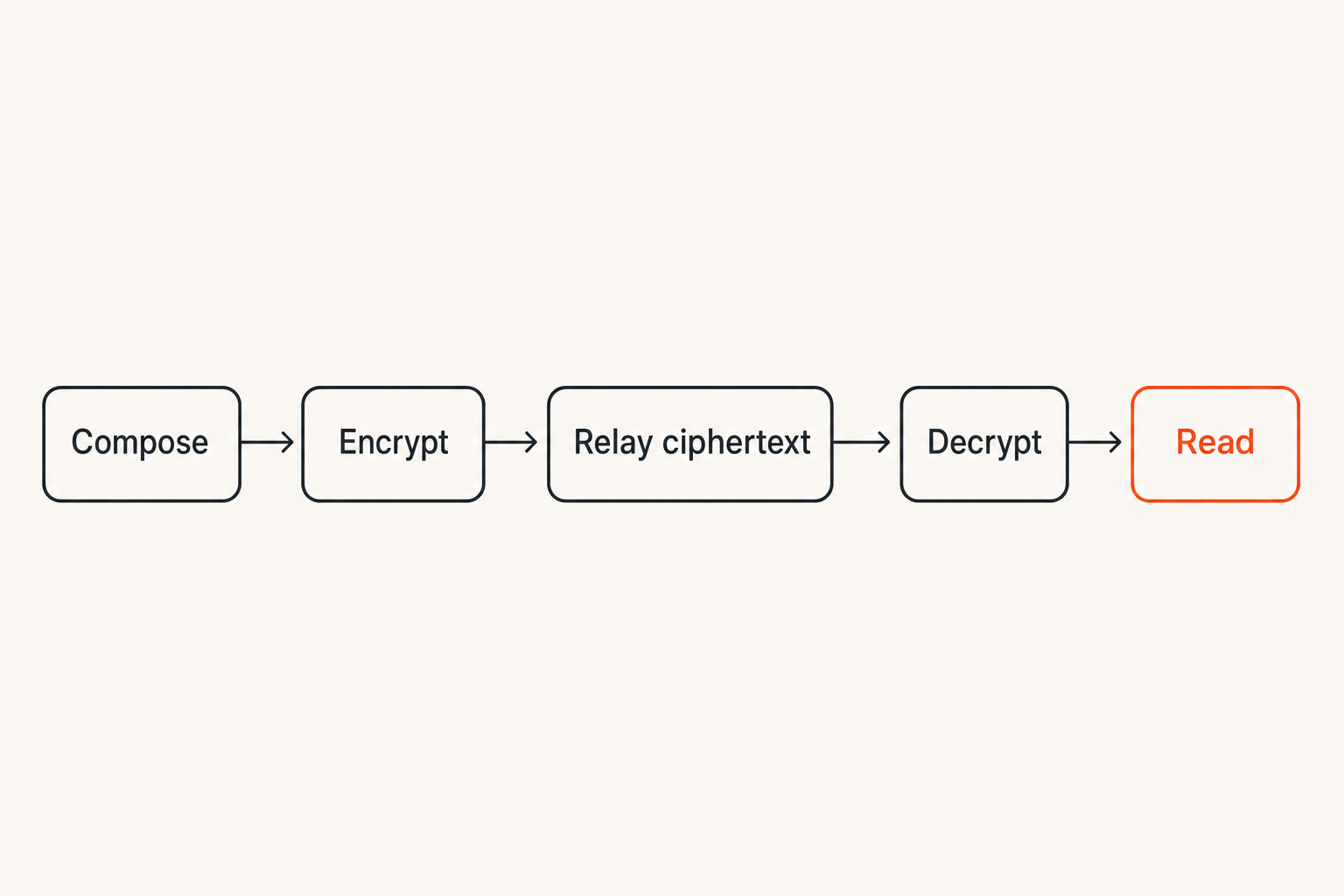
End-to-end encrypted messaging should create a cryptographic boundary around a conversation: a sender encrypts content for intended recipients, and intermediary infrastructure transports ciphertext without holding the keys needed to recover plaintext.
That definition is useful, but production systems are more complicated. People add devices, reset accounts, preview messages on lock screens, export files, invite colleagues, and lose phones. Each event can modify the effective boundary even if the underlying cipher remains sound.
A useful way to think about it is as a state machine, not a tunnel. Participants, authorized devices, keys, and message history all have state. Security depends on how the system moves between those states.
What end-to-end should mean
A credible design should make clear where keys originate, where encryption happens, which devices can decrypt, and whether the provider can silently add a recipient or replacement key. The server may handle routing, queues, encrypted attachments, abuse controls, and delivery receipts without receiving message plaintext.
That does not make the provider irrelevant. Its software distribution, directory service, enrollment flow, and update infrastructure may still influence which code runs and which public keys users trust. End-to-end encryption reduces provider access; it does not eliminate all provider-related risk.
Practical rule: Draw the path from keystroke to recipient screen. Mark every point where plaintext, keys, or trusted identity data can exist.
Encryption in transit is not enough
Transport Layer Security protects data moving between a client and server. It helps prevent network observers from casually reading traffic, but the service commonly terminates that protected connection. If messages are decrypted on the server, server operators, compromised administrative accounts, or application-layer intruders may be able to access them.
With end-to-end encryption, the service routes encrypted payloads that are intended to become plaintext only on participant endpoints. This distinction matters for legal exposure, infrastructure compromise, insider risk, and database theft.
The mistake teams make is treating these models as interchangeable because both display “encrypted.” Ask who controls decryption keys rather than whether encryption appears somewhere in the stack. For a deeper architecture baseline, see the earlier end-to-end encrypted messaging operations guide.
Map the real trust boundary
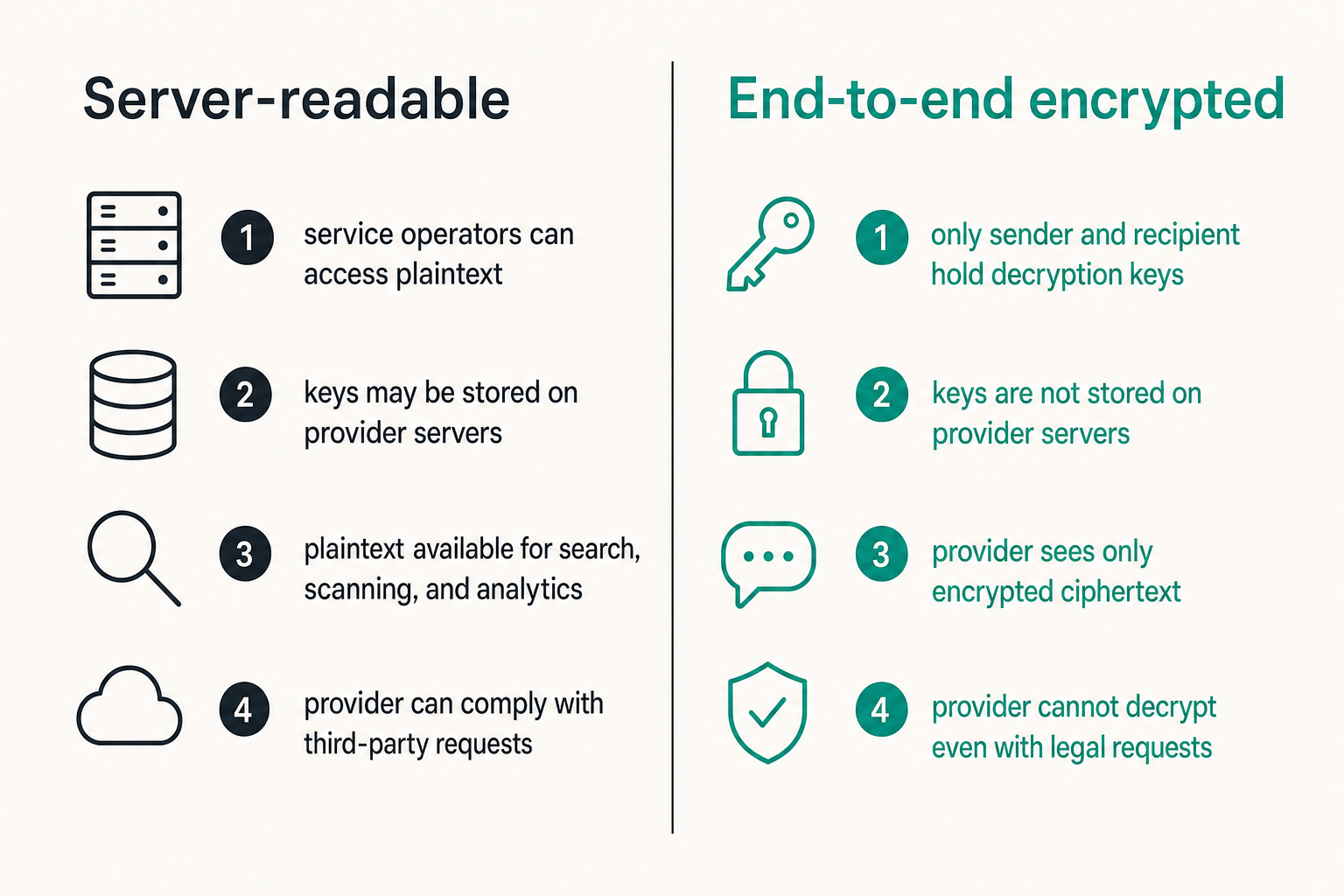
Strong protocols cannot compensate for an undefined threat model. A journalist protecting sources, a remote engineering team discussing credentials, and a family avoiding commercial profiling do not have identical risks. Their required controls, acceptable metadata, and recovery tradeoffs differ.
Start by naming plausible adversaries: network observers, service operators, device thieves, abusive insiders, compromised contacts, malware, or a party capable of storing ciphertext for future cryptanalysis. Then map which parts of the system each adversary can influence.
Identify every plaintext location
Plaintext may exist in more places than the conversation window:
- keyboard and clipboard buffers;
- notification previews and wearable devices;
- local message databases and search indexes;
- screenshots, exports, downloads, and temporary files;
- operating-system backups;
- recipient endpoints and forwarded copies;
- accessibility tools or endpoint monitoring software.
A provider can correctly claim that message content is end-to-end encrypted while an operating-system backup preserves readable history. That is not necessarily a protocol failure, but it is a workflow failure if users assume their archive has the same protection as transport.
Related reading from our network: the torrent download safety checklist addresses a similar principle in another context—private transport does not make downloaded content, local storage, or endpoint behavior automatically safe.
Separate provider trust from endpoint trust
Secure messaging changes where trust sits. It generally reduces the need to trust the provider with content, but increases the importance of endpoint security and identity verification.
| Layer | Weak model | Stronger model | Remaining risk |
|---|---|---|---|
| Transport | Plain or server-readable traffic | TLS plus end-to-end ciphertext | Traffic analysis |
| Keys | Provider-generated or recoverable | Generated and retained on endpoints | Endpoint compromise |
| Identity | Username accepted without verification | Verifiable keys or safety codes | Users skip checks |
| Storage | Plain cloud history | Encrypted local or synchronized history | Unlocked devices |
| Recovery | Provider restores everything | Explicit recovery secret or trusted-device approval | Secret loss or social engineering |
The stronger column is not automatically convenient. A system that cannot recover user-held keys may be unable to restore history after every device is lost. That is a real tradeoff, not a bug to hide in onboarding text.
Practical rule: If recovery can restore encrypted history, document exactly what secret enables it, who controls that secret, and how account takeover is prevented.
Keys, identity, and device enrollment
Most practical messaging failures are not caused by attackers breaking modern encryption algorithms. They happen when a valid key is associated with the wrong person, an unauthorized device is enrolled, or old access persists after a role changes.
Key generation and storage
Prefer designs in which private keys are generated on user-controlled endpoints and are not transmitted to the service in recoverable form. Hardware-backed operating-system storage can make key extraction harder, although its guarantees vary by device, platform, and unlock configuration.
Ask whether long-term identity keys are distinct from session keys. Modern messaging designs commonly rotate ephemeral material so compromise of one current state does not necessarily expose every previous message. Precise guarantees depend on the protocol, backup model, and whether old plaintext remains stored locally.
Key rotation also needs operational behavior. The application must know what to do when a device is replaced, a key changes unexpectedly, or a participant reinstalls the software. Silently accepting every new key improves convenience but weakens identity assurance.
Identity verification and key changes
Encryption answers, “Can someone without the key read this?” Identity verification answers, “Whose key is this?” Both are necessary for sensitive communication.
Applications may expose safety numbers, QR codes, fingerprint phrases, or verified device lists. These controls only help when key changes are visible and users know when verification is warranted. A remote team might verify executive, finance, administrator, and incident-response accounts through a separate channel, rather than requiring manual checks for every casual conversation.
Key transparency can make silent substitutions more detectable by recording identity-key associations in a verifiable structure. It is valuable, but it does not remove the need to secure enrollment and respond to warnings.
Multi-device access changes the model
Adding a desktop or tablet usually means adding another authorized decryption endpoint. The system must decide how that device receives current keys, whether it receives historical messages, and how existing participants learn about the change.
Useful controls include:
- approval from an already trusted device;
- an accurate list of enrolled devices;
- timestamps and recognizable device names;
- visible alerts for additions and removals;
- remote revocation;
- clear rules for history synchronization.
What breaks in practice is stale enrollment. A contractor’s old laptop, a recycled phone, or an abandoned browser session can remain an invisible participant unless device inventory is easy to review.
Practical rule: Treat every enrolled device as a conversation member, even when the interface shows only one human identity.
Metadata remains an operational privacy problem
End-to-end encryption can protect message bodies while leaving surrounding events observable. Depending on the architecture, a service may process account identifiers, IP addresses, device information, delivery timing, group state, contact-discovery queries, or abuse reports.
Metadata is not a reason to dismiss encrypted messaging. It is a reason to evaluate claims precisely. Protecting content is materially useful; claiming that content protection creates total anonymity is not.
Content secrecy does not hide communication patterns
An observer who cannot read a message may still infer that two accounts communicate frequently, that a team became active during an incident, or that a new device appeared in a sensitive group. Padding, batching, relays, private contact discovery, and short retention can reduce some exposure, but each adds cost or complexity.
The practical question is which metadata exists, where it is visible, how long it persists, and whether it can be linked to a durable identity. Read the service’s privacy disclosures with those questions in mind rather than looking only for a general promise not to sell data.
Retention and observability need limits
Operators still need enough visibility to detect delivery failures, control abuse, and maintain reliability. The mistake teams make is copying conventional application logging into a private messaging system. Payloads, tokens, contact identifiers, or attachment URLs can end up in logs that have broader access and longer retention than the messaging database.
Safer observability emphasizes aggregates and technical events: queue latency, failed ciphertext delivery, client version, rate-limit outcomes, and coarse error categories. Sensitive fields should be excluded, transformed, or retained only when justified.
Related reading from our network: network security monitoring integration shows why telemetry needs an explicit path into detection and response. Messaging operations face the same discipline, but must gather actionable signals without turning private conversations into monitoring data.
Group messaging and file sharing require lifecycle controls
A private one-to-one conversation is only the simplest case. Groups introduce membership changes, administrator privileges, concurrent updates, multiple devices per member, and expectations about old history. Attachments add storage, caching, malware, and downstream sharing.
Membership changes must change access
When a member joins, decide whether they can read earlier messages. When a member leaves, future messages must use cryptographic state they no longer possess. Removing a name from the interface without rotating relevant state is not meaningful revocation.
Group administrators also become security-sensitive identities. If one compromised administrator can add an attacker without prominent notice, the group’s confidentiality depends heavily on that account. High-risk groups may need multiple approvals or strict policies for membership changes.
No cryptographic mechanism can force a former member to forget messages already decrypted. Revocation protects future communication; it cannot retract screenshots, exports, or memorized information.
Encrypted files still escape through workflows
Attachments should be encrypted before upload, with decryption keys delivered through the protected conversation. Servers can store opaque encrypted objects, enforce quotas, and expire data without reading file content.
After download, however, the file enters the recipient’s environment. It may be indexed, copied to a shared folder, opened by a vulnerable application, or uploaded to another service. Teams handling sensitive files need rules for supported formats, local retention, external sharing, malware handling, and project closure.
For client work, the freelancing encrypted messaging workflow provides an adjacent example of how access, files, identities, and handoffs must be managed together rather than delegated to the chat interface.
Build an end-to-end encrypted messaging workflow
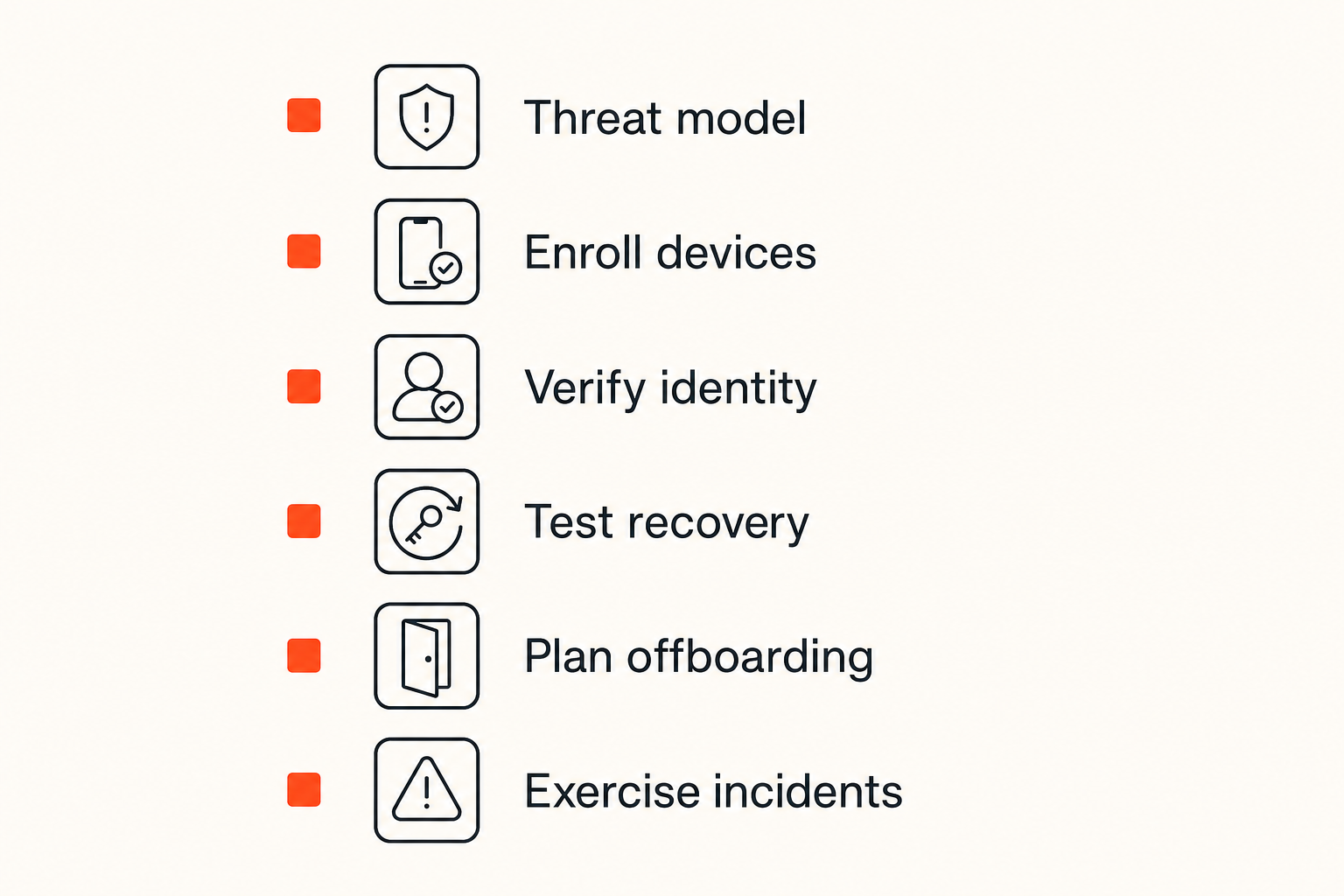
Deploying end-to-end encrypted messaging is an access-management project as much as a software rollout. The application provides primitives; the organization decides who enrolls, which devices are acceptable, when identity checks occur, and how departures are handled.
A practical implementation sequence
- Classify conversations. Identify routine, confidential, privileged, regulated, or incident-sensitive communication. Not every channel needs identical friction.
- Write the threat model. Name likely adversaries and consequences. Include device theft, account takeover, malicious insiders, and provider compromise.
- Map keys and plaintext. Record where keys are created, where history is stored, what backups contain, and what notifications reveal.
- Define enrollment. Decide how users establish identity, approve devices, and verify high-risk contacts.
- Set lifecycle rules. Specify group creation, administrator rights, guest access, offboarding, revocation, retention, and export policy.
- Test recovery. Lose a device deliberately. Confirm what returns, what does not, and which credentials an attacker would need.
- Exercise incidents. Simulate a stolen phone, compromised administrator, suspicious key change, and unavailable service.
- Review periodically. Recheck devices, group membership, client versions, recovery methods, and unresolved warnings.
This sequence avoids a common failure: buying a private messenger and discovering later that the organization cannot offboard users or recover from a lost executive phone.
Define ownership before deployment
Security owns the threat model, but not every operational decision. IT may manage endpoints, team leads may own group membership, legal may define retention, and individual users may control recovery secrets. Put those responsibilities in writing.
A small deployment still needs answers:
- Who approves a new device?
- Who investigates an unexpected key change?
- Who can create high-sensitivity groups?
- Who removes departed members?
- Who communicates during a service outage?
- Who decides whether message export is permitted?
If nobody owns a control, it will eventually become a support ticket handled under pressure.
Measure the workflow without reading messages
Private systems can still be operated with useful metrics. Track enrollment failures, outdated clients, unresolved device warnings, delivery reliability, revocation completion time, and recovery attempts. Use aggregates where possible and keep retention proportional to operational need.
Avoid vanity metrics such as total messages when they do not support a security or reliability decision. Every collected event creates another dataset that needs access controls, retention limits, and incident handling.
Related reading from our network: the analysis of crypto payment processor pricing makes an analogous operational point. The visible interface or transaction fee is not the whole system; support, reconciliation, failure handling, and ownership often determine the real cost.
What breaks in practice
Encryption can remain mathematically intact while the overall workflow fails. These failures are dangerous because users continue seeing familiar security indicators and assume the original boundary still applies.
Recovery quietly weakens the design
Password-reset flows are convenient, but a resettable account credential should not automatically reveal old encrypted history. If it does, another recoverable secret or provider-controlled capability may exist.
Recovery models include a user-held recovery code, encrypted backup protected by a separate passphrase, trusted-device approval, or deliberate loss of old history. Each model trades availability against resistance to account takeover.
What works is explicit separation: regaining an account, enrolling a new device, and decrypting historical data are treated as distinct actions. What fails is a support process that bypasses cryptographic intent because an urgent user cannot access a device.
Notifications and integrations leak context
Lock-screen previews can expose sender names and message text. Email bridges, ticketing integrations, bots, and AI assistants may receive plaintext even when the core service cannot. Once an integration reads a message, its storage and access model become part of the trust boundary.
Before enabling an integration, ask:
- Does it decrypt content on a participant device or external server?
- What content and metadata does it retain?
- Can it be added without every participant noticing?
- How is its access revoked?
- Does it train models or send data to another processor?
A bot should be presented as a group participant, not as invisible plumbing.
Users route around unusable controls
Security controls that make urgent work impossible encourage users to copy information into email, personal accounts, or unapproved tools. The answer is not removing every control. It is matching friction to risk and making the secure path operationally complete.
Provide supported desktop and mobile access, reliable file transfer, understandable verification, and a documented fallback for outages. Train users on a few high-value actions: reviewing devices, responding to key changes, limiting notification previews, and reporting lost endpoints.
Practical rule: A secure messaging policy is credible only if the approved workflow handles ordinary work, urgent work, recovery, and offboarding.
How to evaluate secure messaging in 2026
Marketing pages tend to collapse complex architectures into labels such as private, military-grade, zero-access, or quantum-safe. These terms are not substitutes for a documented protocol and operational model.
Use architecture questions instead of feature labels
Ask vendors or internal builders:
- Where are private keys generated and stored?
- Can the provider or an administrator add a device without visible notice?
- How are identity keys verified and changed?
- What does a newly added device receive?
- Can new group members access old history?
- What metadata is retained, and for how long?
- Are backups end-to-end encrypted with user-controlled secrets?
- How are attachments encrypted and expired?
- What happens after every trusted device is lost?
- How are protocol and client updates reviewed and distributed?
Answers should describe mechanisms and failure behavior. “We take privacy seriously” is not an architecture answer. The published qrypt.chat security information is the appropriate place to compare implementation claims with your own threat model.
Treat post-quantum readiness as migration work
Post-quantum cryptography addresses the risk that sufficiently capable future quantum computers could undermine widely used public-key algorithms. For long-lived secrets, an adversary may collect encrypted traffic now and attempt decryption later if the captured material depends on vulnerable key establishment.
But “quantum-resistant” should not end the evaluation. Ask which operations use post-quantum algorithms, whether the design is hybrid, how keys and ciphertext sizes affect clients, how algorithm agility works, and how implementations are updated if a scheme or library has problems.
Symmetric encryption and public-key establishment face different quantum considerations. Product claims should therefore identify the actual protocol components instead of implying that one label makes every layer future-proof.
The mistake teams make is prioritizing speculative future resistance while ignoring current device compromise, weak recovery, or silent key replacement. Post-quantum readiness is valuable when layered onto sound endpoint and identity operations—not used to distract from them.
Test failure conditions before adoption
A polished demo exercises the happy path. A useful evaluation exercises state changes:
- enroll a second device and inspect every alert;
- remove a group member and test future access;
- reset an account without trusted devices;
- restore from backup and identify the required secret;
- rotate a key unexpectedly;
- revoke an offline device;
- download an attachment and trace local copies;
- operate during a partial service outage.
Record the observed result, not the expected claim. If evaluators cannot explain why a device can read a message, the design is not yet understood well enough for sensitive use.
Where qrypt.chat fits
End-to-end encrypted messaging should reduce the number of parties able to access conversation content while keeping trust decisions understandable to users. qrypt.chat is relevant to people evaluating private communication and quantum-resistant encrypted messaging, but product fit still depends on the threat model and operating workflow.
Choose a product that matches the threat model
For an individual, the central concerns may be metadata minimization, simple device review, and safe recovery. A remote company may place more weight on membership lifecycle, cross-platform reliability, and contractor offboarding. Security teams may additionally require documented cryptographic choices and predictable incident behavior.
Do not adopt any messenger solely because its strongest feature sounds advanced. Verify that its key management, device model, privacy posture, recovery behavior, and post-quantum approach address the risks that matter to you.
Keep deployment decisions explicit
Even a strong platform cannot decide whether your team permits lock-screen previews, unmanaged laptops, permanent group history, or unreviewed integrations. Document those decisions and revisit them as participants, devices, and risks change.
Start with a small group, test device loss and membership changes, and establish a separate channel for verifying sensitive identities. That produces more confidence than a broad rollout based on interface familiarity.
End-to-end encrypted messaging works best when cryptography and operations reinforce each other. The protocol protects content in transit and at rest within its defined boundary; the workflow keeps that boundary aligned with the people and devices that should actually have access.
Try qrypt.chat
You are writing for people who care about private communication, secure messaging, and practical digital security. Try qrypt.chat.