
A confidential message can be mathematically protected and still become exposed through a synced notification, an unlocked laptop, a compromised participant, or a recovery process that quietly copies plaintext into the cloud. That is the uncomfortable reality of end-to-end encrypted messaging in 2026.
Teams think the problem is choosing an app with strong encryption. The real problem is operating a communication system across identities, devices, keys, backups, metadata, people, and incident response.
The lock icon is only the visible edge. What matters is who can decrypt a message, how new devices gain access, what the service learns, what happens when somebody leaves, and whether users can detect a change in trust. Those are architecture and workflow decisions, not feature-list details.
This guide explains how privacy-conscious users, remote teams, and security professionals can evaluate and operate encrypted chat without treating cryptography as magic.
Table of contents
- End-to-end encrypted messaging is a system boundary
- Start with a realistic threat model
- The key lifecycle determines the trust model
- Metadata remains part of the privacy problem
- Multi-device encrypted messaging is the hard part
- Recovery backups and retention need explicit policy
- Build an operational workflow around encrypted chat
- What breaks in end-to-end encrypted messaging
- Post-quantum security changes the planning horizon
- Choosing an encrypted messaging platform
End-to-end encrypted messaging is a system boundary
End-to-end encryption means message content is encrypted on a sender-controlled endpoint and is intended to become readable only on recipient-controlled endpoints. An intermediary may transport and store ciphertext, but it should not possess the ordinary capability to recover the plaintext.
That definition is useful, but production systems are more complicated. A conversation can involve multiple recipients, several devices per user, asynchronous delivery, attachments, message edits, reactions, contact discovery, and account recovery. Each function can widen the effective trust boundary.
What end-to-end actually promises
A sound design should protect message content from network observers and service infrastructure. If a messaging database, object store, or delivery queue is copied, an attacker should not receive a convenient archive of readable conversations.
The promise applies to content while it moves through and rests on infrastructure. It does not automatically protect content after a recipient views, exports, screenshots, or forwards it. Nor does it make a compromised endpoint trustworthy.
Practical rule: Treat end-to-end encryption as protection against intermediaries, not as protection against every action taken at either endpoint.
What the server can still control
Even without decryption keys, a server may control delivery, account lookup, device registration, group membership proposals, message ordering, and software distribution. A malicious or compromised service could withhold messages, replay stale state, attempt to enroll a device, or provide manipulated key information.
Protocols therefore need authentication and integrity, not just secrecy. Clients should reject altered ciphertext, expose meaningful key changes, and authenticate changes to sensitive conversation state. The QryptChat security overview is the appropriate place to inspect the platform's stated security model rather than inferring it from interface design.
Why transport encryption is not enough
TLS protects a connection between a device and a service. In a conventional chat architecture, the service terminates that connection, reads the message, and starts another encrypted connection toward the recipient. This is encryption in transit, but not end-to-end encryption.
| Architecture | Where plaintext exists | Server can routinely read content | Main trust assumption |
|---|---|---|---|
| Plain transport | Devices and network path | Yes | Almost none |
| TLS-only chat | Devices and application servers | Yes | Service and infrastructure remain trusted |
| End-to-end encrypted chat | Intended recipient devices | No | Endpoints, protocol, and key verification remain trusted |
| E2EE with plaintext cloud backup | Devices and backup service | Indirectly | Backup layer reintroduces content access |
The mistake teams make is evaluating only the transport path. The practical question is where plaintext can exist over the entire message lifecycle.
Start with a realistic threat model
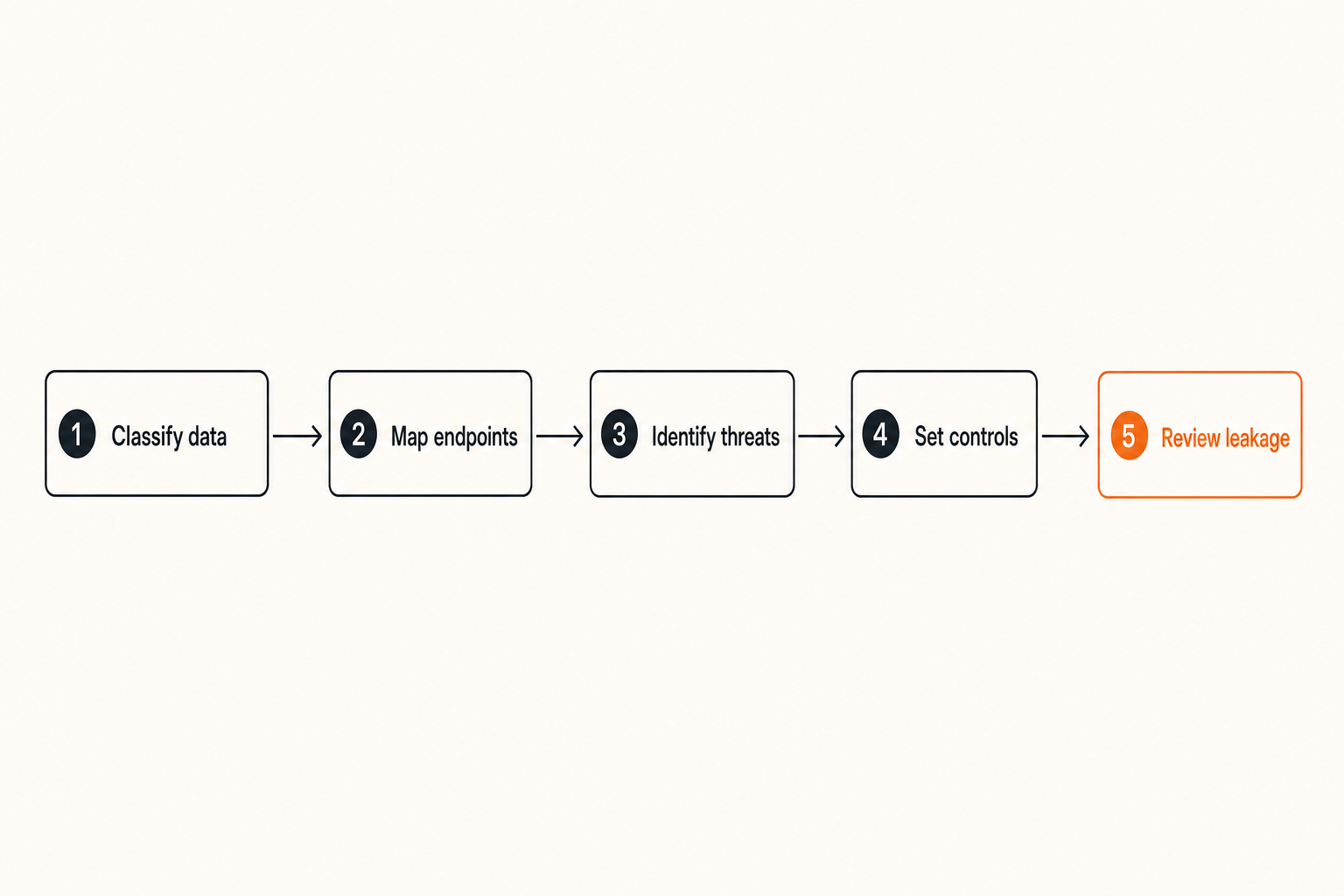
A threat model prevents two expensive mistakes: demanding controls that obstruct normal work without reducing relevant risk, and accepting convenient features that defeat the reason encrypted messaging was adopted.
Identify the information worth protecting
Start by listing communication classes rather than making a universal claim that every message is sensitive. Examples include credentials, customer information, legal strategy, source identities, product plans, security incidents, health information, and ordinary personal conversation.
Then map where each class enters and exits chat. A secret pasted from a password manager may later appear in a notification preview, screenshot, ticket, transcript export, or copied reply. Encryption during delivery protects only one part of that path.
A useful way to think about it is as a data-flow review:
- Who creates the information?
- Which participants need it?
- Which devices may display it?
- How long should it remain available?
- Can it move into another system?
- What happens when a participant leaves?
Separate routine privacy from targeted attack
Routine privacy may focus on reducing service-provider access, network surveillance, data brokerage, and exposure after an infrastructure breach. A targeted threat may include phishing, device malware, account takeover, coerced access, malicious insiders, or a patient observer correlating traffic.
The controls are not identical. Strong cryptography can substantially reduce infrastructure risk while doing little against an unlocked endpoint. High-risk users may need hardened devices, reduced notification content, verified contacts, separate identities, and disciplined in-person verification.
Teams in other technical domains face the same distinction between buying a control and operating one. Related reading from our network: detection engineering pricing as a workload and validation problem illustrates why nominal coverage is not operational coverage.
Define acceptable operational leakage
No useful communication system reveals literally nothing. Delivery requires some routing information. Abuse controls may need rate signals. Mobile notification services need enough information to wake an application. The issue is whether collection is bounded, documented, and proportionate.
Write down what leakage is acceptable before selecting a platform. Consider account identifiers, IP addresses, contact relationships, group membership, timestamps, device details, and retention periods.
Practical rule: If a team cannot state what metadata it accepts, it cannot meaningfully evaluate the privacy of a messaging service.
The key lifecycle determines the trust model
Encryption algorithms receive attention because they are easy to name. Key lifecycle decisions usually have more influence on day-to-day security: where keys originate, where they remain, how contacts authenticate them, and what happens after loss or compromise.
Key generation and storage
Private key material should be generated in a trustworthy client environment and should not be sent to the service in recoverable form. On supported devices, operating-system key stores or hardware-backed protection can make extraction harder. They do not make extraction impossible, especially on an already compromised endpoint.
Operators should determine whether key material is exportable, whether local databases are encrypted, and which device authentication state unlocks messaging. A four-digit device PIN and a strong messaging protocol do not average into strong security.
Contact verification and key changes
A server can distribute public keys, but users need a way to detect substitution. Verification may use safety numbers, QR codes, key fingerprints, trusted directories, or an authenticated organizational process.
Verification must also survive reality. Contacts replace phones. Employees reinstall applications. Teams add laptops. A warning that appears constantly will be ignored; a silent change removes the user's chance to notice an attack.
Good systems distinguish routine addition of an authenticated device from an unexplained identity reset. High-risk conversations should pause after surprising key changes until participants verify through an independent channel.
Rotation revocation and deletion
Rotation can limit the effect of future compromise, but it does not retroactively erase plaintext or every prior key. Forward secrecy aims to prevent a current key compromise from exposing all past traffic. Post-compromise security aims to restore protection after a compromise once honest key updates occur. Implementations differ, so these properties should be verified rather than assumed.
Revocation also needs a concrete meaning. Removing a device should stop future delivery and future key distribution. It cannot force the device to forget information it already decrypted.
Practical rule: Never describe device revocation as remote deletion of previously received content.
Metadata remains part of the privacy problem
Message content can be opaque while communication patterns remain revealing. Who spoke, when, from where, how often, and in which group may expose relationships or activity even when every message body is encrypted.
What encryption does not conceal
Depending on the architecture, a provider may observe account creation, login times, IP-derived location, device type, recipient routing, group size, message size, delivery status, and abuse reports. Some systems deliberately minimize or separate this information; others retain it for long periods.
Read privacy documentation with architectural questions in mind. The QryptChat privacy information can be evaluated by asking what is collected, why it is needed, where it is processed, and how long it remains—not merely whether content is encrypted.
Push notifications and traffic patterns
Mobile platforms often rely on third-party push infrastructure. A privacy-preserving design can send a minimal wake-up event and let the application retrieve ciphertext. A careless design may place sender names or message previews in notification payloads, creating another disclosure path.
Even minimal notifications can produce timing signals. Network observers may correlate bursts of traffic, and an operating system can display sensitive previews on a locked screen. Users and administrators should configure preview behavior based on their threat model.
Practical metadata minimization
Useful controls include:
- minimizing stored routing and delivery records;
- shortening log retention where operationally possible;
- avoiding plaintext content in telemetry and crash reports;
- using generic push payloads;
- separating abuse signals from conversation content;
- limiting contact uploads and supporting privacy-preserving discovery;
- documenting subprocessors and infrastructure boundaries.
Metadata minimization sometimes conflicts with troubleshooting and abuse prevention. That changes the conversation. The objective is not to pretend there is no tradeoff, but to collect the smallest useful signal under a defined retention policy.
Multi-device encrypted messaging is the hard part
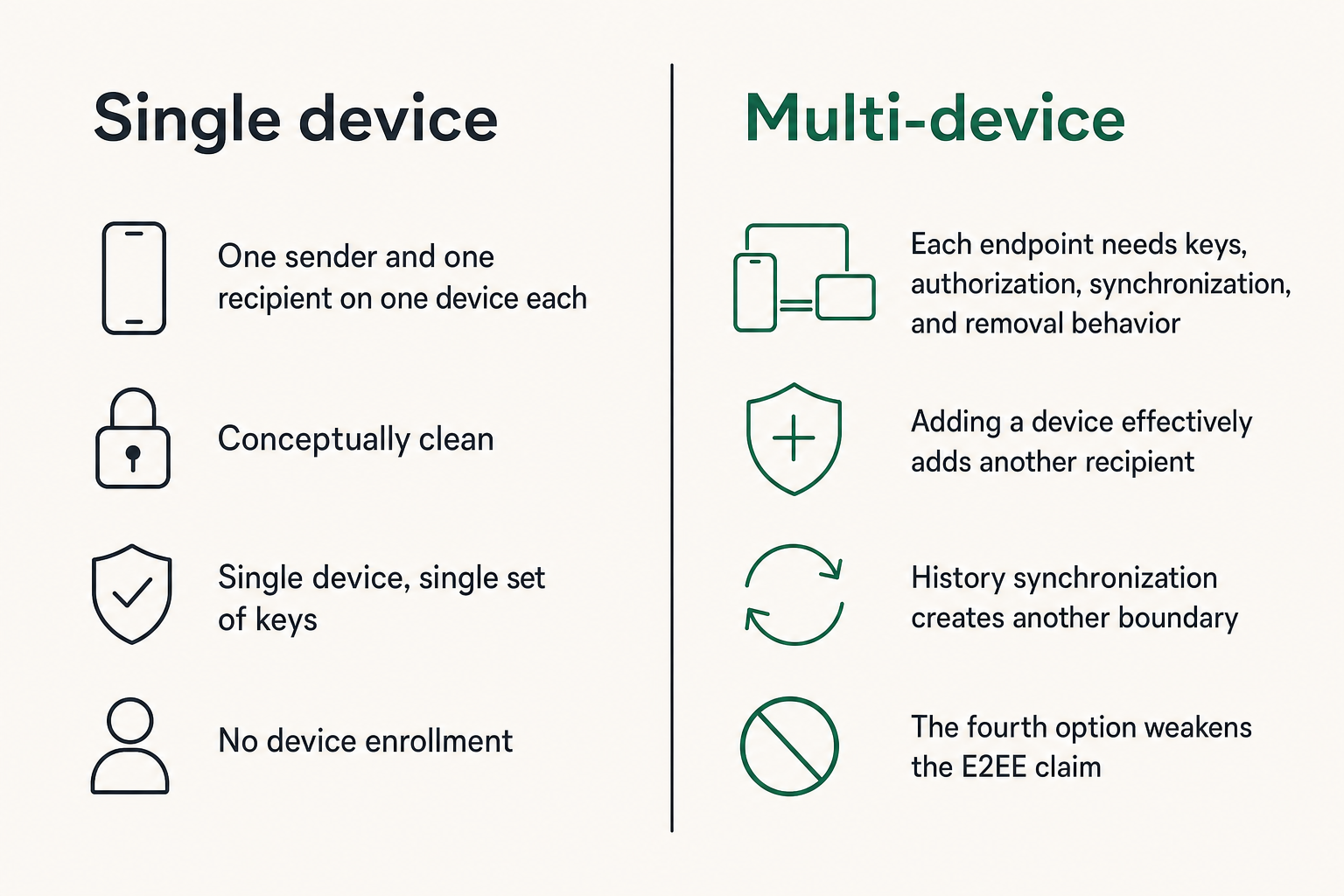
One sender and one recipient on one device each is conceptually clean. Production messaging is not. A single person may use a phone, browser, work laptop, and replacement device. Each endpoint needs keys, authorization, synchronization, and removal behavior.
Device enrollment changes trust
Adding a device effectively adds another recipient. If enrollment requires only account credentials, stolen credentials may be enough to join future conversations. Stronger designs authorize new devices from an existing trusted device, require additional authentication, and notify contacts or the account owner.
The interface should show an understandable device inventory with creation time, recent activity, and revocation controls. Unknown sessions should not be buried behind generic account settings.
History synchronization creates another boundary
Users expect a new laptop to display old conversations. That expectation creates a difficult choice:
- Do not synchronize old history.
- Transfer history from an existing trusted device.
- Store an end-to-end encrypted history archive.
- Let the server recover readable history.
The fourth option weakens the E2EE claim. The first is secure but inconvenient. Device-to-device transfer can work well but needs both devices available. An encrypted archive can preserve privacy if its recovery secret is unavailable to the provider and protected against weak guesses.
The detailed evaluation method in this architecture and operations guide to end-to-end encrypted messaging apps is useful when comparing how products handle devices, recovery, and deployment as one system.
Device removal must have consequences
After removal, a device should stop receiving new messages and group keys. Remaining participants may need a visible state update, especially if the removed endpoint belonged to a departed employee or was reported stolen.
What breaks in practice is assuming removal reverses prior disclosure. A former participant may retain screenshots, exports, attachment downloads, notification history, or a local database. Sensitive teams should combine technical revocation with retention rules, endpoint management, and offboarding procedures.
Recovery backups and retention need explicit policy
Convenient recovery often moves the decryption boundary. Before enabling any backup, identify who holds the recovery secret and whether the provider can reset access without an already trusted endpoint or user-held secret.
Recovery without silent decryption
Recovery approaches include a user-held recovery code, a key protected by a strong passphrase, social recovery, authorization from an existing device, or organization-controlled key escrow. Each addresses a different risk.
Escrow may be appropriate for regulated business records, but it means the escrow holder is another decryption endpoint. Consumer privacy systems may reasonably reject escrow. The correct choice depends on whether loss of access or unauthorized access is the dominant risk.
Avoid vague claims such as “zero knowledge” unless the workflow supports them. If support staff can restore message history after a user forgets every secret and loses every device, another recovery capability probably exists and should be understood.
Encrypted backups still need governance
An encrypted backup is not automatically safe. Its security depends on key entropy, key storage, cryptographic construction, metadata exposure, retention, and deletion. A backup protected by a guessable password can be attacked offline after theft.
Teams should specify:
- which conversations and attachments enter backups;
- who controls the backup key;
- whether old keys remain recoverable;
- when backups expire;
- whether deletion propagates;
- how restoration is tested;
- what audit evidence exists for business-managed recovery.
Disappearing messages are not remote erasure
Expiration reduces routine accumulation. It can lower exposure from later device loss and make chat less attractive as a permanent document repository. It cannot prevent screenshots, photography, copy-and-paste, modified clients, or prior exports.
Use disappearing messages as a retention control, not a trust substitute. Important records may belong in a governed system; highly sensitive secrets may not belong in chat at all.
Related reading from our network: privacy and reliability tradeoffs in live media alternatives addresses a different product category but demonstrates the same operator lesson: the visible client is only one layer of delivery, storage, and infrastructure behavior.
Build an operational workflow around encrypted chat
A secure messenger becomes useful when its deployment process makes safe behavior easier than unsafe behavior. Installation alone is not deployment.
A seven-step implementation sequence
- Classify conversations. Define which information may be discussed in chat and which must stay in password managers, case systems, or controlled repositories.
- Document the threat model. List relevant adversaries, trusted endpoints, accepted metadata, and consequences of account loss.
- Evaluate architecture. Review key generation, verification, multi-device enrollment, backups, logs, notifications, and deletion behavior.
- Configure endpoints. Require strong device locks, timely updates, restricted notification previews, and appropriate disk protection.
- Enroll and verify users. Confirm identity through an independent channel for sensitive groups and record who owns group administration.
- Run failure exercises. Test lost devices, forgotten recovery secrets, employee departures, suspicious key changes, and service interruption.
- Review periodically. Remove stale devices, revisit group membership, inspect policy exceptions, and update the threat model when workflows change.
Practical rule: Test recovery and revocation before sensitive conversations begin, not during the first real incident.
Assign ownership before deployment
Personal groups can rely on participants, but organizations need named owners. Security may define controls, IT may manage endpoints, legal may define retention, and team leads may control membership. Somebody must reconcile those responsibilities.
For client-facing or freelance work, separate projects and identities where practical. The same principles apply to contractors handling customer documents, credentials, and offboarding, as explained in this guide to freelancing encrypted messaging security architecture.
Ownership questions include:
- Who approves a new participant?
- Who reviews linked devices?
- Who removes departed users?
- Who handles legal preservation requirements?
- Who contacts participants after suspected compromise?
- Who decides when a conversation must move to another system?
Measure controls rather than message volume
Encrypted content limits centralized inspection by design. That means teams should not recreate surveillance merely to produce dashboards. Measure administrative control health instead.
Useful indicators may include the number of stale devices, unresolved identity changes, unowned groups, overdue client versions, recovery-test outcomes, and time required to revoke a lost endpoint. These metrics assess the system without reading conversations.
What breaks in end-to-end encrypted messaging
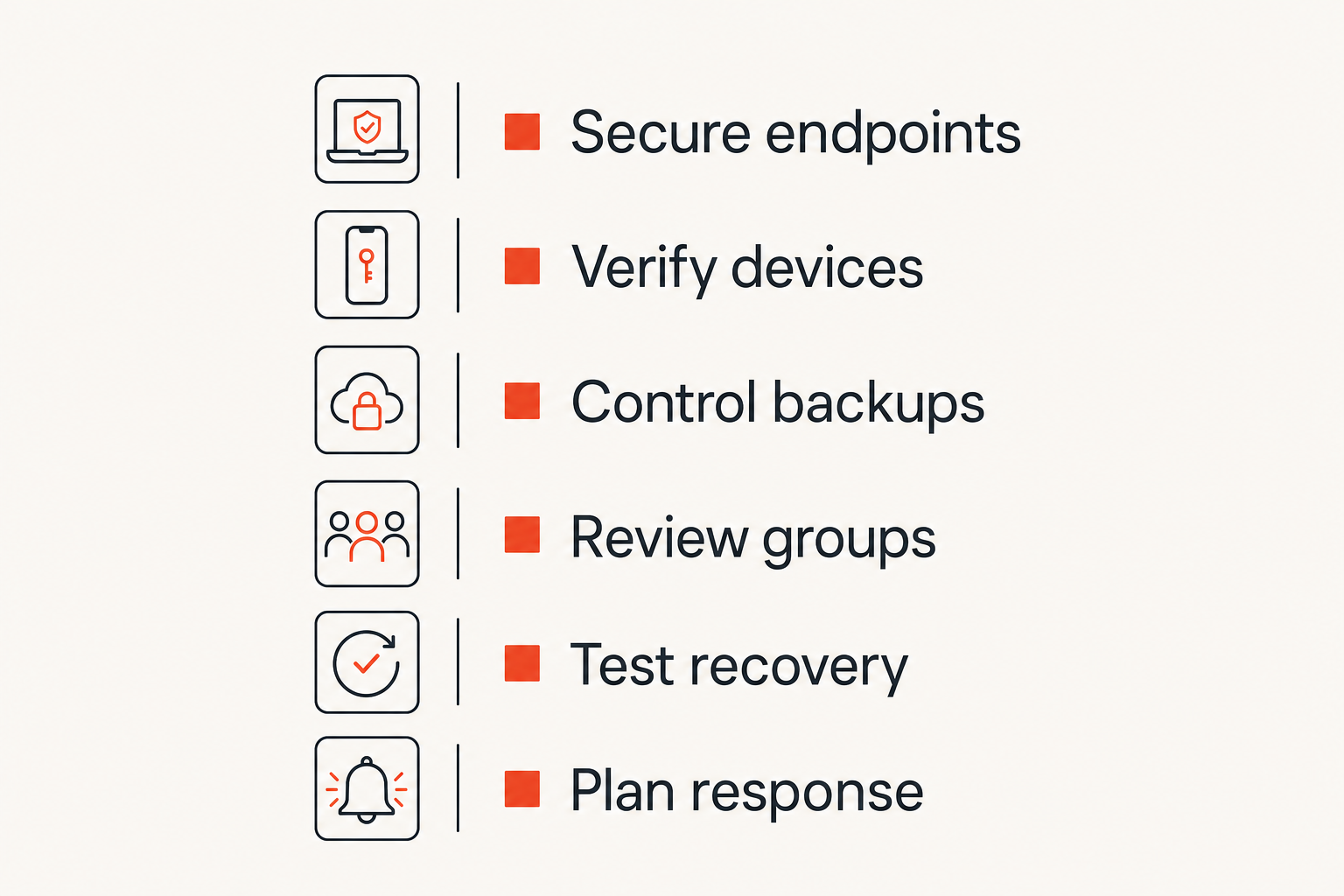
Most failures occur around the protocol rather than inside its core encryption primitive. The interface, operating system, recovery path, participant behavior, and administrative workflow create the practical attack surface.
What fails
Common failure modes include:
- Trusting a badge. “Encrypted” may refer only to TLS, storage encryption, or an optional mode.
- Ignoring endpoints. Malware, browser extensions, shared accounts, and unlocked screens expose plaintext after decryption.
- Automatic device enrollment. Stolen credentials quietly become a new endpoint.
- Unencrypted exports. A protected conversation becomes a plaintext transcript in email or cloud storage.
- Verbose logging. Message bodies, attachment URLs, tokens, or identifiers enter analytics and support systems.
- Permanent large groups. Membership drifts, former collaborators remain, and nobody owns review.
- Untested recovery. Users discover during an emergency that they either cannot recover or that recovery bypasses expected protections.
- Security-warning fatigue. Frequent unexplained alerts train users to approve every key change.
The mistake teams make is compensating for weak workflow with more policy text. If enrollment, verification, and removal are confusing, users will route around them.
What works
A resilient deployment uses layered controls:
- a protocol designed for authenticated end-to-end encryption;
- transparent device lists and meaningful change warnings;
- strong endpoint authentication and updates;
- minimal notification and telemetry content;
- explicit backup and retention choices;
- small, owned groups for sensitive work;
- independent verification for high-risk contacts;
- rehearsed loss and offboarding procedures.
Usability is part of the security boundary. A control that ordinary participants cannot interpret is unreliable under pressure.
Responding to a suspected compromise
When a device or account may be compromised:
- Preserve enough external evidence to understand timing without copying sensitive chat unnecessarily.
- Revoke the affected device or session from a known-good endpoint.
- Rotate account credentials and recovery secrets where relevant.
- Notify conversation participants through an independently verified channel.
- Re-establish trusted devices and verify identities again.
- Assume content displayed on the compromised endpoint may have been exposed.
- Review group membership, exports, linked desktop sessions, and notification surfaces.
- Record lessons and change the enrollment or recovery workflow that failed.
Do not promise that rotating keys makes already captured plaintext secret again. Incident communication should distinguish future protection from past exposure.
Post-quantum security changes the planning horizon
Quantum-resistant messaging is not a reason to discard current endpoint controls. It is a reason to examine whether long-lived confidential traffic could be captured today and attacked later, and whether the protocol can evolve without destabilizing identity and device workflows.
Harvest now decrypt later is a design concern
Some information loses value quickly; other information remains sensitive for years. Legal communications, personal identities, trade secrets, diplomatic material, and long-term strategic plans may warrant protection against future cryptanalytic capability.
The practical question is not whether a cryptographically relevant quantum computer exists today. It is whether an adversary can retain ciphertext until capabilities change and whether the protected information will still matter then.
Hybrid designs reduce transition risk
A hybrid construction combines established classical techniques with post-quantum mechanisms so that breaking one component is not sufficient to defeat the intended protection. This can reduce dependence on the maturity of a single new algorithm, although correct composition remains a serious engineering task.
Migration also affects message sizes, handshake behavior, CPU and memory use, library support, version negotiation, and compatibility with older clients. Protocol agility should not permit silent downgrade to weaker modes.
Post-quantum claims still require scrutiny
“Quantum-safe” is not a complete architecture description. Evaluators should ask:
- Which operation uses post-quantum cryptography?
- Is the design hybrid or exclusively post-quantum?
- How are identity keys authenticated?
- Are group messages and attachments covered?
- Can old clients force downgrade behavior?
- How are algorithm and library updates deployed?
- Does recovery preserve the same protection level?
A post-quantum key exchange does not secure a compromised phone, conceal all metadata, or prevent a recipient from exporting plaintext. It addresses a specific cryptographic risk inside a larger communication system.
Related reading from our network: connecting technical architecture to buyer trust and settlement workflows concerns a different market, but its useful parallel is that a front-end promise is only credible when the underlying operational chain supports it.
Choosing an encrypted messaging platform
Platform selection should produce an explicit decision record, not a vague conclusion that one product “feels private.” Compare systems against the threat model and test important workflows on real devices.
Questions to ask before adoption
Use these questions during evaluation:
| Area | Question | Warning sign |
|---|---|---|
| Keys | Where are private keys generated and stored? | Provider can routinely retrieve them |
| Identity | How are contacts and devices verified? | Key changes are silent or incomprehensible |
| Devices | How is a new endpoint authorized? | Password-only enrollment without notice |
| History | How does old history reach a new device? | Server can return readable archives |
| Metadata | What routing and activity data is retained? | Undefined collection or retention |
| Backups | Who possesses the recovery capability? | Encryption claim excludes default backups |
| Groups | How are membership changes authenticated? | No clear owner or change visibility |
| Updates | How are protocol changes and downgrades handled? | Indefinite legacy support without boundaries |
| Incidents | Can users revoke devices and re-verify trust? | Support intervention is the only option |
Run a small pilot. Add and remove devices, restore an account, inspect notification behavior, export data, revoke a member, and observe what other participants see. Documentation matters, but workflow behavior reveals whether the system communicates trust changes effectively.
Where qrypt.chat fits
qrypt.chat is relevant to readers assessing private communication and quantum-resistant encrypted messaging. The useful product-fit question is not whether the service uses modern terminology. It is whether its cryptographic approach, device behavior, privacy boundaries, and user workflows fit the reader's threat model.
Evaluate qrypt.chat using the same standard applied throughout this guide: inspect how endpoints establish trust, understand what infrastructure can observe, configure devices carefully, and maintain realistic expectations about recipient behavior. Strong end-to-end encrypted messaging works best when the protocol and the operating workflow reinforce each other.
Try qrypt.chat
You are writing for people who care about private communication, secure messaging, and practical digital security. Explore Try qrypt.chat to assess end-to-end encrypted messaging for your own communication model.