End-to-end encrypted messaging sounds simple until you have to rely on it during real work.
A founder needs to discuss payroll. A journalist needs to protect a source. A remote team needs to share incident details before the public knows anything happened. Everyone assumes the encrypted chat app is the answer. Then someone adds a second device, loses a phone, screenshots a thread, exports a backup, or invites the wrong contractor.
Teams think the problem is choosing the most private app. The real problem is building a communication workflow where encryption, identity, device trust, metadata exposure, retention, and human behavior all line up.
That changes the conversation. End-to-end encrypted messaging is not a badge on a product page. It is an operating model for private communication.
Table of contents
- What end-to-end encrypted messaging actually protects
- End-to-end encrypted messaging architecture is a workflow decision
- Identity and key trust are where private chats get fragile
- Metadata is the part most users underestimate
- Device security decides whether encryption holds
- Backups, exports, and retention are privacy decisions
- Team use requires policy, not just an app
- Implementation workflow for secure private communication
- Failure modes that break end-to-end encrypted messaging
- How qrypt.chat fits private communication workflows
What end-to-end encrypted messaging actually protects
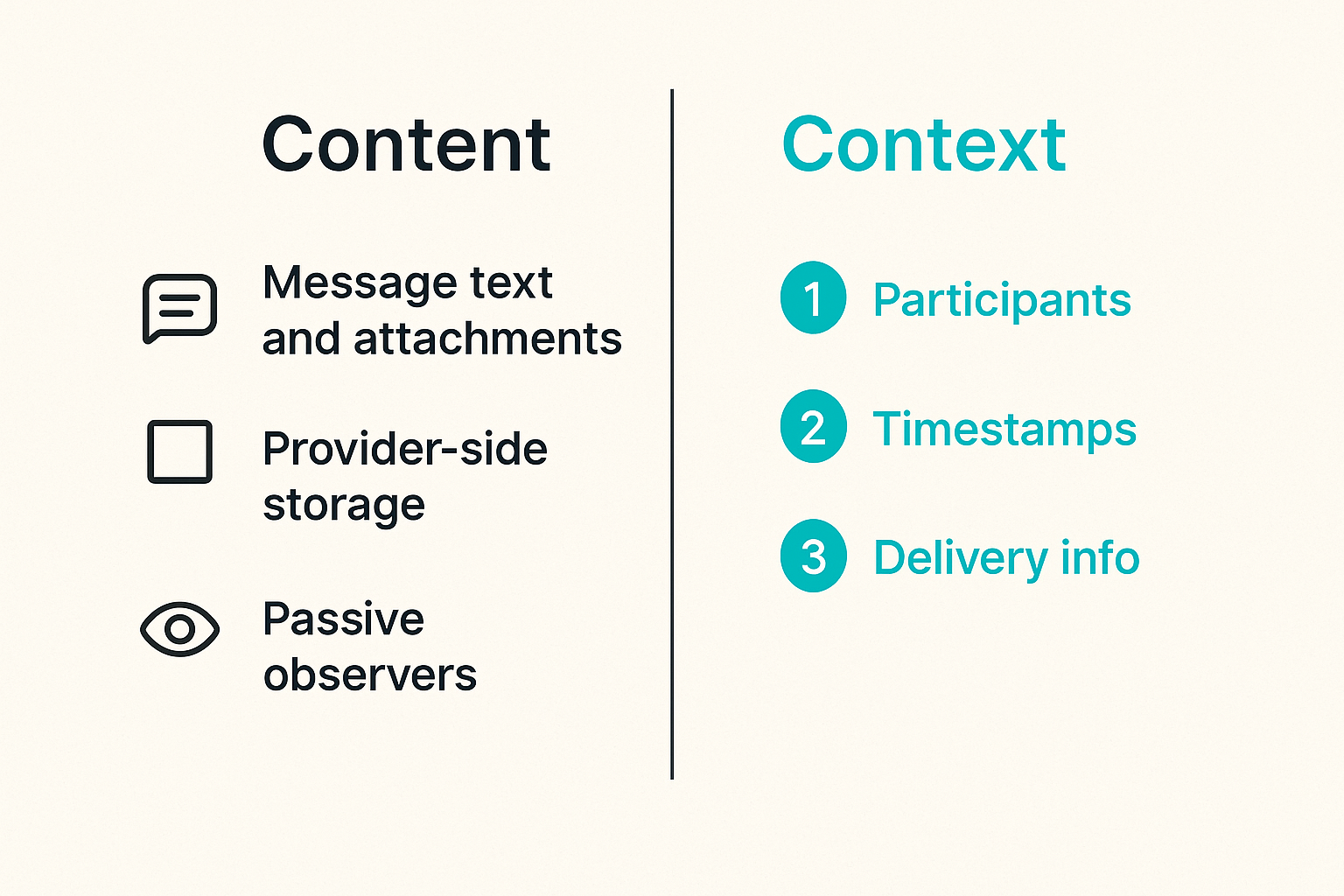
End-to-end encrypted messaging protects message content from being readable by the service provider, network operators, and other intermediaries while messages travel between participants. In plain terms: the sender encrypts, the recipient decrypts, and the server should not have the keys required to read the content.
That is the core promise. It is important. It is also narrower than many people assume.
The mistake teams make is treating end-to-end encryption as a complete privacy system. It is not. It is one control inside a larger communication architecture.
The useful security boundary
A useful way to think about it is this: end-to-end encryption moves trust away from the transport layer and toward the endpoints.
Without it, the server is a high-value content repository. With it, the server can route messages without reading the message body. That is a major architectural improvement, especially for private conversations, legal communications, sensitive business discussions, and security incidents.
But the boundary is specific. E2EE generally protects:
- Message text and attachments in transit
- Message content stored on the provider side, if implemented correctly
- Content from passive network observers
- Content from many routine provider-side failures
It does not automatically protect every part of the conversation lifecycle.
Practical rule: Treat end-to-end encryption as content protection, not total communication invisibility.
What encryption does not hide
What breaks in practice is the assumption that encrypted content means private context. The message body may be unreadable, while other signals remain visible or recoverable.
Depending on the system, exposed or partially exposed data can include:
- Who registered an account
- Which devices are linked
- When users are online
- Which accounts communicate
- Message sizes and delivery timing
- Group membership changes
- Push notification metadata
- IP address and network information
- Backup locations
- Local device copies
This does not mean encrypted messaging is weak. It means the practical question is broader: what information do you need protected, from whom, and for how long?
End-to-end encrypted messaging architecture is a workflow decision
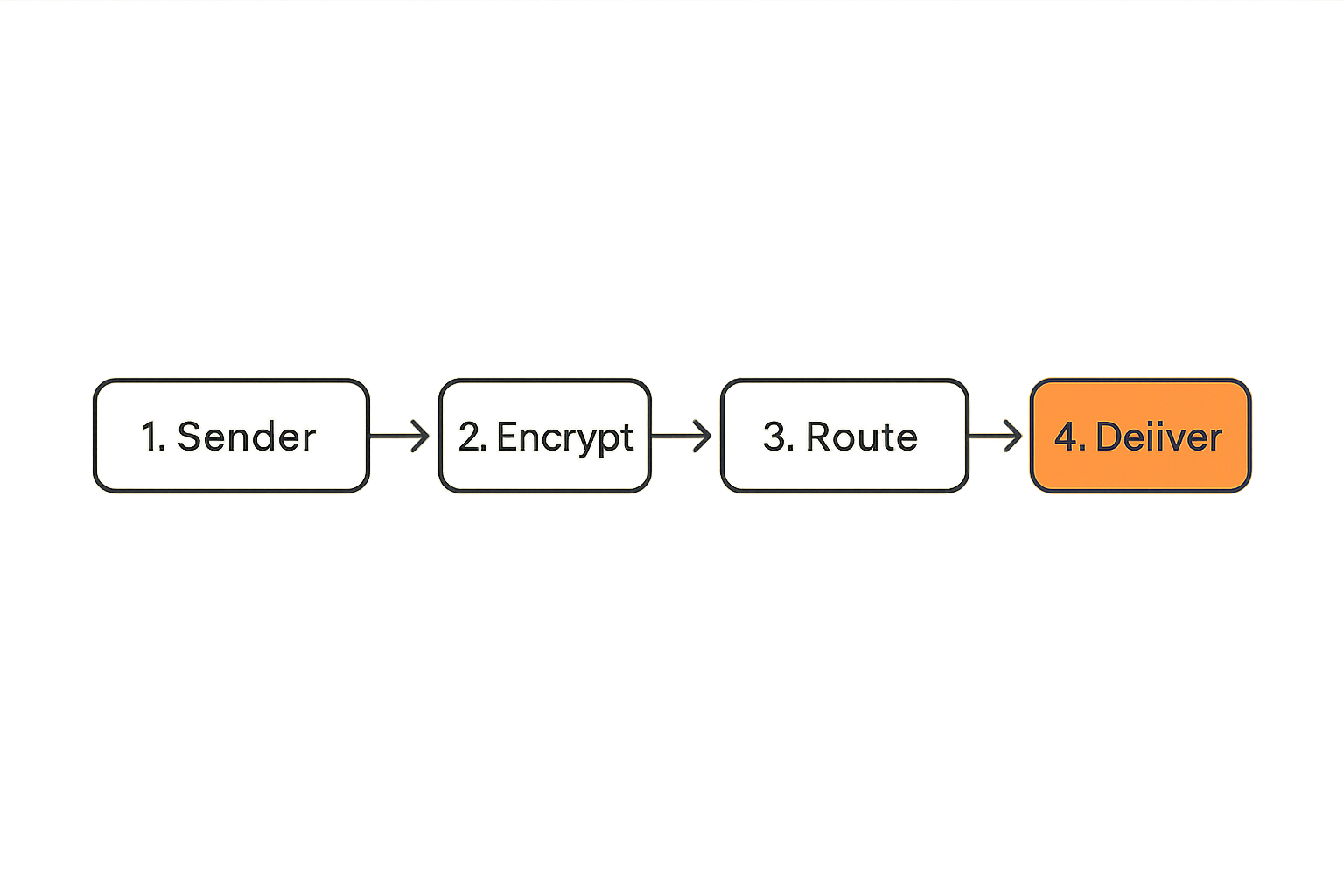
End-to-end encrypted messaging architecture is less about a single algorithm and more about the path a conversation takes across users, devices, servers, recovery flows, and support processes.
For a casual one-to-one chat, the workflow may be simple. For a remote team, nonprofit, newsroom, security group, or privacy-conscious business, the workflow becomes more complex quickly.
Related reading from our network: teams working on protocol-heavy systems face similar tradeoffs between specs, contracts, and operational behavior in Synonyms of Standards in AI Agent Systems.
Devices are part of the system
Every private message eventually becomes plaintext on a device. That device may be a phone, laptop, tablet, browser session, or linked desktop app. If the endpoint is compromised, unlocked, shared, unmanaged, or backed up carelessly, strong cryptography upstream cannot save the workflow.
This is why device rules matter:
- Require screen locks
- Keep operating systems patched
- Avoid shared accounts
- Remove unused linked devices
- Use hardware-backed protection where available
- Separate personal and high-risk work conversations
A secure messaging workflow should define which devices are allowed to participate. Otherwise the weakest device becomes the real security boundary.
The server is still operationally important
Some users hear end-to-end encryption and assume the server no longer matters. That is wrong.
The server may still handle account registration, message queues, contact discovery, push notifications, spam controls, abuse reports, group coordination, and delivery state. Even if it cannot read message content, it can influence availability, metadata exposure, and user experience.
A well-designed private messaging service should minimize what the server can know while still making the product usable. That balance is hard. Too much central visibility creates privacy risk. Too little operational design creates reliability and recovery failures.
For readers comparing platforms, the public qrypt.chat security overview is the right kind of place to look first: not for slogans, but for how the service describes its security model and boundaries.
Identity and key trust are where private chats get fragile
Encryption depends on keys. Keys depend on identity. Identity depends on a user understanding who they are actually talking to.
That sounds obvious until an app hides the complexity so well that users never verify anything. Convenience is useful. Invisible trust is dangerous.
Account identity is not cryptographic identity
An account name, phone number, email address, or username is not the same thing as a verified cryptographic identity. It may help users find each other, but it does not automatically prove that the right encryption keys are attached to the right person.
The risk is impersonation or silent account takeover. If an attacker can register, recover, or substitute a device under a familiar identity, users may continue chatting as if nothing changed.
Good systems make key trust visible without making users do cryptography homework. They provide safety numbers, key verification, device lists, change alerts, or other mechanisms that let users confirm identity when risk is high.
Key changes need a human workflow
Key changes happen for legitimate reasons. People get new phones. Apps reinstall. Devices break. Accounts migrate. The problem is not that keys change. The problem is when key changes are ignored.
Practical rule: A key change should trigger a question, not panic. Verify before sharing sensitive new information.
For a high-trust group, define a simple verification workflow:
- Key change appears.
- User pauses sensitive conversation.
- User verifies through a second channel.
- Group confirms the change.
- Conversation resumes.
The second channel does not need to be dramatic. It can be a voice call, in-person confirmation, or pre-agreed recovery phrase. The important point is that the team knows what to do before a risky moment.
Metadata is the part most users underestimate
Metadata is not a footnote. In many investigations, disputes, or threat scenarios, metadata can be highly revealing even when message content remains encrypted.
Who talked to whom, when, how often, from where, and in what group can expose sensitive relationships. For some users, that relationship graph is more dangerous than the text itself.
Related reading from our network: people building home media and network setups run into adjacent privacy tradeoffs around traffic, devices, and visibility in Information Technology for Cord Cutters.
The message body is not the whole story
Consider a simple case: a whistleblower messages a journalist. The content is encrypted. But if the service retains account identifiers, connection times, IP addresses, device fingerprints, or repeated contact patterns, the relationship may still be inferred.
The same applies to businesses. An encrypted chat between executives during a deal may hide text while still revealing timing and participants. In incident response, the existence of a private group may itself be sensitive.
This is why privacy reviews should ask practical metadata questions:
- What account data is required?
- Are phone numbers or emails exposed?
- How are contacts discovered?
- What logs are retained?
- What push notification data exists?
- How are groups represented server-side?
- What happens when a user deletes an account?
Reducing metadata is different from eliminating it
No serious operator should promise that all metadata disappears in every real-world messaging system. Networks need to route packets. Apps need to deliver notifications. Abuse controls often require some operational signal.
The better question is: what metadata is collected, how long is it retained, who can access it, and can the system function with less?
Comparison matters here:
| Design choice | Privacy impact | Operational tradeoff |
|---|---|---|
| Phone-number identity | Higher linkability | Easier contact discovery |
| Username identity | Lower direct exposure | Requires user education |
| Persistent server logs | Higher investigation surface | Easier debugging |
| Minimal logging | Lower retained metadata | Harder support and abuse analysis |
| Cloud message history | Higher recovery convenience | More retention risk |
| Local-only history | Lower server exposure | More user responsibility |
The mistake teams make is pretending these tradeoffs do not exist. They do. The mature approach is to choose deliberately.
Device security decides whether encryption holds
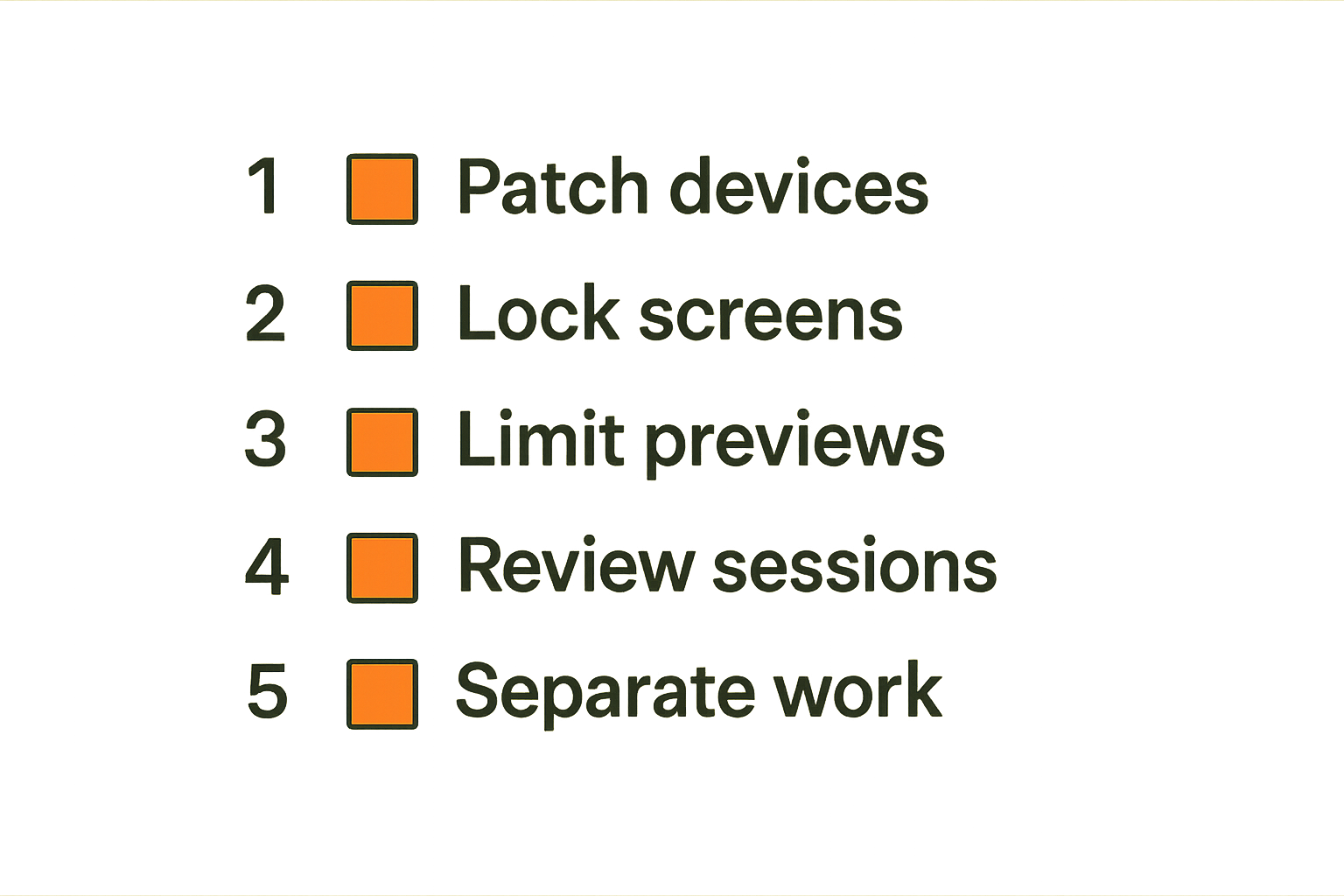
The endpoint is where encrypted messaging becomes human-readable. That makes device security part of the private messaging architecture, not an optional personal preference.
A user with an infected laptop can leak conversations. A phone without a lock screen can expose threads. A shared browser profile can turn private chat into office gossip.
Compromised endpoints beat strong cryptography
If malware can read the screen, capture keystrokes, scrape local storage, or access screenshots, end-to-end encryption has already done its job and lost the next battle. The message was protected in transit. It was not protected after decryption.
For high-risk users, device hygiene should include:
- Updated operating system and browser
- App updates enabled
- Strong device passcode
- Biometric unlock with a fallback policy
- Full-disk encryption
- Limited notification previews
- No sideloaded unknown apps
- Separate devices or profiles for sensitive work
Practical rule: If the device is not trusted, the chat is not trusted.
Multi-device access needs rules
Multi-device messaging is convenient and often necessary. It is also one of the easiest places to accidentally widen the attack surface.
Each linked device is another place where plaintext may appear. Each old laptop, forgotten browser session, or unused tablet becomes a privacy liability.
A practical multi-device policy should answer:
- Who can add a device?
- Are device additions visible to other participants?
- How often should users review linked devices?
- What happens when a contractor leaves?
- Are shared family computers allowed?
- Are mobile notifications allowed on locked screens?
For remote teams, this is not bureaucracy. It is access control.
Backups, exports, and retention are privacy decisions
Backups are where many private messaging workflows quietly fail.
Users want recovery. Operators want fewer support tickets. Teams want searchable history. Legal teams may want retention. Privacy-minded users want messages gone. These goals conflict.
Cloud backups can undo private messaging
A chat can be end-to-end encrypted in the app and then copied into a less protected cloud backup. That backup may be protected by a different account, different policy, different jurisdiction, and different recovery process.
The practical question is not whether backups are good or bad. It is whether backup security matches conversation sensitivity.
Ask:
- Are backups encrypted before leaving the device?
- Who controls the backup key?
- Can the provider restore message content?
- Are attachments included?
- Are deleted messages removed from backups?
- Can users disable backups for sensitive chats?
The qrypt.chat privacy page is relevant here because privacy is not just encryption design; it is also what data a service says it collects, uses, retains, and discloses.
Retention should match the risk
Retention is a business decision with security consequences. Keeping everything forever helps search and continuity. It also increases damage when devices are compromised, accounts are taken over, or legal demands arrive.
For most users and teams, retention should be tiered:
- Low-risk coordination: keep as needed
- Routine business chat: retain for a defined period
- Sensitive personal data: minimize retention
- Incident response: preserve only what policy requires
- Source protection or high-risk work: use short retention and strict device rules
A disappearing message timer is not a complete compliance system. It is a privacy control. Use it where reduced local history is valuable, and do not pretend it solves screenshots, exports, or compromised endpoints.
Team use requires policy, not just an app
Private messaging for teams fails when nobody owns the workflow.
Someone creates a group. Someone invites people. A contractor joins. An employee leaves. A sensitive decision gets made in a thread nobody can later find. A device is lost. Nobody knows whether the person still has access.
That is not an encryption failure. It is an operations failure.
Who owns the room matters
Every sensitive group should have an owner. The owner does not need to read everyone’s messages or act as a surveillance function. The owner is responsible for membership, purpose, and lifecycle.
Define:
- Why the group exists
- Who belongs in it
- Who can invite others
- What information can be shared
- What retention setting applies
- When the group should be archived or deleted
This matters more than most teams expect. Private rooms become risky when they outlive their purpose.
Onboarding and offboarding need to be explicit
Secure messaging onboarding should include verification and device expectations. Offboarding should remove access and confirm old devices are no longer participating.
A simple team policy can be enough:
- Add user only after identity is verified.
- Confirm the correct account or key.
- Explain device and backup expectations.
- Add the user to the minimum necessary groups.
- Review access when their role changes.
- Remove the user immediately when access is no longer needed.
Related reading from our network: independent workers face similar workflow discipline problems around proof, delivery, and client communication in How to Find Freelance Work With No Experience.
Implementation workflow for secure private communication
The practical question is how to deploy end-to-end encrypted messaging without creating a fragile mess of private rooms, unmanaged devices, and unclear expectations.
Start small. Define the threat model. Then build rules that real people can follow.
A practical rollout sequence
Use this sequence for a privacy-conscious team, small organization, or high-risk project:
- Classify conversations. Separate routine coordination, sensitive business, personal data, incident response, and high-risk communications.
- Choose the messaging system. Evaluate encryption model, identity, key verification, metadata posture, device support, backup behavior, and retention controls.
- Define account identity. Decide whether users should use phone numbers, emails, usernames, or dedicated identities.
- Set device requirements. Require lock screens, updates, limited notifications, and review of linked devices.
- Create group rules. Assign owners, restrict invites, define purpose, and set retention expectations.
- Train for key changes. Make verification normal before sensitive information is shared.
- Document backup policy. Decide what can be backed up, where, and under whose control.
- Run access reviews. Periodically remove stale users, stale devices, and stale groups.
- Practice incident response. Know what to do after a lost phone, suspected compromise, or wrong invite.
This is not heavy process. It is basic operational hygiene.
What works and what fails
| Area | What works | What fails |
|---|---|---|
| Identity | Verify high-risk contacts | Trust display names blindly |
| Devices | Review linked devices | Let old sessions accumulate |
| Backups | Match backup policy to sensitivity | Assume encrypted app means encrypted backup |
| Groups | Assign owners and purpose | Create permanent rooms for temporary work |
| Retention | Keep less by default for sensitive work | Keep everything because search is convenient |
| Training | Teach key-change behavior | Ignore warnings until an incident |
The pattern is consistent. Private communication improves when the workflow is explicit and boring. It fails when teams rely on good intentions.
Failure modes that break end-to-end encrypted messaging
End-to-end encrypted messaging can fail socially, operationally, and technically. The cryptography may be sound while the workflow leaks information.
That distinction matters. If you diagnose every leak as a crypto problem, you will buy the wrong solution.
The screenshot and forwarding problem
Once a recipient can read a message, they can copy it, photograph it, summarize it, forward it, or show it to someone else. Encryption cannot stop a trusted participant from becoming an untrusted participant.
This matters for teams that use private chat to discuss confidential plans. If the group includes someone who should not have access, encryption protects the message from outsiders while delivering it directly to the wrong insider.
Mitigations are procedural:
- Limit sensitive groups to need-to-know members
- Use shorter retention for high-risk conversations
- Avoid oversharing attachments
- Mark especially sensitive context clearly
- Move extremely sensitive topics to stronger workflows
The support and recovery problem
Recovery is hard in private systems. Users forget passwords, lose phones, reinstall apps, and expect support to fix everything.
But if a provider can always restore message content, the provider may have access that weakens the privacy model. If the provider cannot restore anything, users need to understand their responsibility.
There is no magic answer. The right design depends on the threat model. What matters is honesty. Users should know whether lost keys mean lost history, whether backups exist, and whether support can access content.
We covered related architectural tradeoffs in more depth in End-to-End Encrypted Messaging in 2026: The Practical Architecture Behind Private Chat, especially around identity, devices, metadata, and recovery.
How qrypt.chat fits private communication workflows
End-to-end encrypted messaging in 2026 is not about chasing the most dramatic security claim. It is about choosing tools and workflows that reduce unnecessary trust.
For privacy-conscious users, security professionals, remote teams, and encrypted chat users, the right question is not simply: is this chat encrypted? The better question is: does this system support the way we actually need to communicate privately?
Product fit for privacy-conscious users
qrypt.chat is built for people who care about private communication, secure messaging, and practical digital security. That means the product conversation should be architectural:
- How are messages protected between participants?
- What identity and device assumptions exist?
- What metadata is minimized or retained?
- How do users reason about trust?
- What happens when devices change?
- How does the workflow support real private conversations?
No messaging product removes the need for judgment. But a good encrypted messaging tool should make safer behavior easier, make risky events visible, and avoid turning the server into a content warehouse.
That is the standard worth applying to end-to-end encrypted messaging.
Try qrypt.chat
qrypt.chat is for people who care about private communication, secure messaging, and practical digital security. If you are evaluating end-to-end encrypted messaging for yourself or your team, Try qrypt.chat.