
A team adopts end to end encrypted messaging, moves sensitive conversations into it, and assumes the security problem is solved. Six months later, a former contractor still has an authorized device, employees are approving unexplained key changes, and confidential files are sitting in unencrypted exports.
The messages may be encrypted correctly. The workflow is not secure.
Teams think the problem is choosing an app with strong encryption. The real problem is designing a communication system around identities, devices, keys, metadata, recovery, retention, and human behavior. In 2026, that distinction matters because conversations move across phones, laptops, browser sessions, bots, backups, and increasingly distributed teams.
The practical question is not simply whether a messenger uses encryption. It is whether the complete system preserves confidentiality when devices change, people leave, accounts are recovered, groups grow, and something eventually goes wrong.
Table of contents
- End to end encrypted messaging is a system boundary
- Start with a threat model
- Understand the messaging architecture
- Control keys devices and verification
- Design groups attachments and history carefully
- Reduce metadata without pretending it disappears
- Build an operational deployment workflow
- Recognize common failure modes
- Evaluate encrypted messaging products
- Where qrypt.chat fits
End to end encrypted messaging is a system boundary
End-to-end encryption means plaintext is intended to be available only at authorized endpoints. An intermediary may carry ciphertext, queue it, and synchronize it, but should not hold the keys needed to read the underlying message.
That definition is useful, but incomplete for an operator. An endpoint might be a well-maintained phone protected by hardware-backed credentials. It might also be an abandoned browser session on a shared computer. Both can be legitimate cryptographic endpoints while presenting very different operational risk.
A useful way to think about end to end encrypted messaging is as a boundary: plaintext exists inside authorized clients, while infrastructure outside those clients should handle encrypted data. Every feature that crosses that boundary deserves scrutiny.
What E2EE actually guarantees
A sound design can protect message content from network observers, hosting providers, compromised routers, and infrastructure operators who lack endpoint keys. It can also provide integrity checks that make undetected message alteration difficult.
Those guarantees depend on correct protocol design, implementation, key authentication, random number generation, and endpoint behavior. Transport Layer Security still matters because it protects connection metadata and reduces interference, but TLS alone is not end-to-end encryption. If a server terminates TLS and receives plaintext, the service remains able to read the conversation.
Practical rule: Ask where plaintext can exist, not merely where encryption is enabled.
What remains outside the encrypted channel
E2EE does not automatically protect a message displayed on an unlocked screen, copied into another application, captured by malware, included in a notification preview, or exported by an authorized participant. It also does not guarantee anonymity or hide every interaction pattern.
The server may still need enough information to route messages, prevent abuse, rate-limit clients, and deliver push notifications. Operating systems may learn that an application received traffic. Participants can retain screenshots. Workplace device-management software may inspect endpoints, depending on its privileges.
That changes the conversation. Security review must cover the entire path from composition to deletion, not only the ciphertext crossing the network.
Start with a threat model
A messenger cannot protect equally against every adversary while remaining usable. Before comparing protocols or features, document the information being protected, the people allowed to access it, and the failures that would create material harm.
A personal conversation, an incident-response room, and a client project may all need encryption, but they do not have identical identity, retention, or recovery requirements.
Decide who should not be trusted
List relevant parties explicitly: internet providers, hosting operators, application administrators, former employees, device thieves, malicious insiders, compromised contacts, and legal or coercive adversaries. Then specify what each party can observe or control.
For a remote team, a practical threat model might require that infrastructure administrators cannot read messages, a stolen locked phone can be revoked, and removed members cannot receive future group traffic. It might accept that active participants can copy text because preventing that completely is unrealistic.
The mistake teams make is writing “protect confidential messages” without naming the trust boundary. That phrase cannot guide a decision about cloud backups, account recovery, or browser access.
Separate likely threats from dramatic threats
Prioritize account takeover, phishing, lost devices, stale sessions, malicious attachments, and accidental disclosure. These common operational problems frequently matter more than exotic cryptanalytic attacks.
Long-lived confidential data also creates a forward-looking concern: an attacker may capture encrypted traffic now and attempt to decrypt it later if cryptographic capabilities change. Post-quantum design can be relevant here, but it does not compensate for weak device security or unverified identities.
Related reading from our network: teams operating complex research infrastructure face a similar need to separate data, compute, identity, and operator trust in this cloud architecture analysis.
Understand the messaging architecture
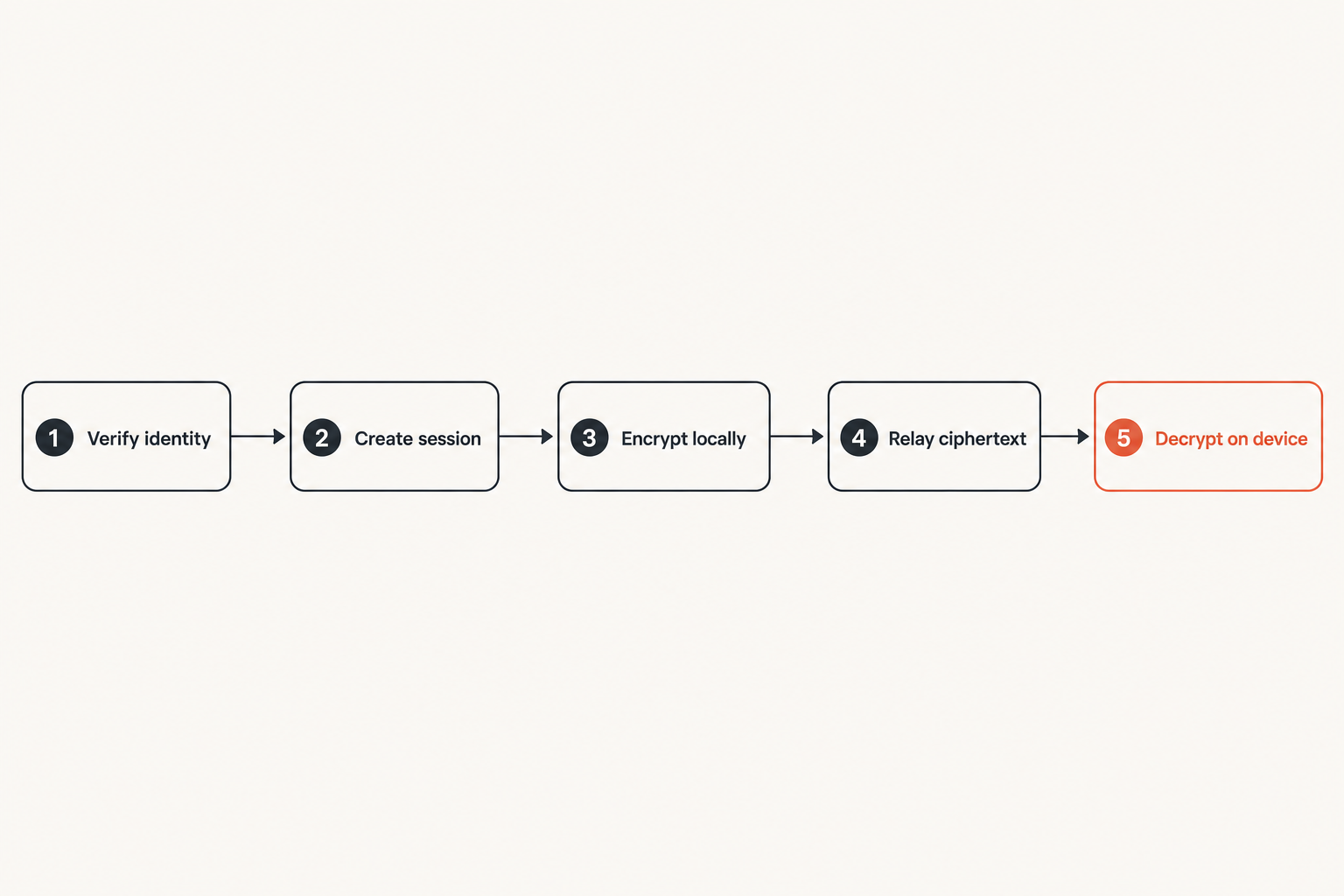
Secure messaging is a coordinated protocol, not a lock icon attached to a chat interface. A robust architecture must establish identity, negotiate secrets, encrypt messages, handle asynchronous delivery, rotate keys, and reconcile state across devices.
The detailed design varies by protocol. The review method should not: trace keys and plaintext through each component, then test what happens when state changes.
Identity sessions and transport
Users need stable identity material or a trustworthy way to bind changing cryptographic keys to an account. Devices commonly hold their own keys so a user can participate from several endpoints without sharing one private key everywhere.
Session establishment may combine long-term identity keys, pre-published material for asynchronous contact, and short-lived secrets. Well-designed protocols also rotate message keys so compromising one current key does not necessarily reveal the entire conversation history.
The service still needs a transport layer for mailbox queues, message acknowledgements, and device fan-out. It should be able to perform those functions without decrypting content. For a deeper architecture review spanning devices, recovery, metadata, and groups, see this end-to-end encrypted messaging operations guide.
Message state is part of the protocol
Messages are not always sent once and immediately received. Phones sleep, laptops go offline, recipients add devices, and networks retry requests. The protocol needs identifiers and state transitions that prevent a retry from creating duplicate or inconsistent events.
A minimal delivery model might include:
created -> encrypted -> queued -> delivered -> acknowledged
                           |             |
                           +-> expired   +-> locally deleted
Receipts should reference opaque message identifiers rather than repeat sensitive content. Clients need rules for out-of-order messages and replayed envelopes. A “delete” event also needs precise semantics: local deletion, synchronized deletion, or a request that other authorized clients remove their copies. It cannot guarantee that a recipient never preserved the plaintext.
Control keys devices and verification
Cryptographic security eventually becomes device administration. If a user has four authorized endpoints, the effective account boundary includes all four. If an attacker enrolls a fifth endpoint through weak recovery, the encryption may faithfully deliver future plaintext to the attacker.
Treat every device as a security principal
Each device should have a visible identity, enrollment time, last activity, and revocation path. Users need to recognize their own device list. Administrators may need aggregate posture and offboarding controls without gaining access to message content.
A sound lifecycle covers:
- Enrollment using an existing trusted device or another strong authorization path.
- Explicit naming so users can distinguish a work laptop from an old browser.
- Key storage using platform protections where available.
- Revocation that prevents new message delivery to the removed device.
- Re-encryption or session updates after membership changes.
- Secure local deletion during logout and offboarding.
Practical rule: A device that cannot be identified and revoked should not be trusted with durable confidential access.
Make verification and key changes usable
Verification allows participants to confirm that cryptographic identities match the people they intended to contact. This may use fingerprints, safety numbers, QR codes, or a verified organizational directory.
What breaks in practice is alert fatigue. If routine reinstalls generate vague warnings, users learn to approve every key change. Good clients explain what changed, which device is affected, whether prior verification still applies, and what action is appropriate.
High-risk conversations should have stronger procedures. Two incident responders might verify through a separate authenticated call. A company could bind employee keys to an internal directory. No interface can make verification useful if the organization has not decided when it is required.
Design groups attachments and history carefully
A one-to-one encrypted exchange is only the beginning. Group conversations introduce changing membership, multiple devices per member, concurrent updates, and different expectations about historical access.
Group membership is an authorization system
The application must authenticate additions and removals, distribute new group state, and stop removed devices from receiving future content. Participants should be able to see who changed membership and when.
Teams need an explicit history policy. Should a newly added employee see messages sent before joining? Should a removed member retain content already received? Cryptography can enforce some future-access rules, but it cannot remotely erase every plaintext copy from a previously authorized device.
For business use, define group owners, approval rules, guest expiration, and offboarding responsibilities. A contractor should not remain in a project channel because everyone assumed somebody else would remove them.
Attachments backups and history need separate policies
Attachments should normally be encrypted on the sending client using fresh content keys. The server can store encrypted blobs while the encrypted message carries the information needed by recipients to retrieve and decrypt them. Download URLs should be scoped, difficult to guess, and short-lived where practical.
Backups are a separate trust boundary. A cloud backup containing plaintext or recoverable keys can negate the protection of the messaging protocol. Ask whether backups are end-to-end encrypted, which secret unlocks them, whether the provider can reset that secret, and how deletion works.
Local search indexes, thumbnails, temporary files, notification text, and operating-system logs also deserve review. The visible chat may disappear while derived copies remain.
Practical rule: Apply the same confidentiality policy to attachments, previews, exports, indexes, and backups as to message text.
Reduce metadata without pretending it disappears
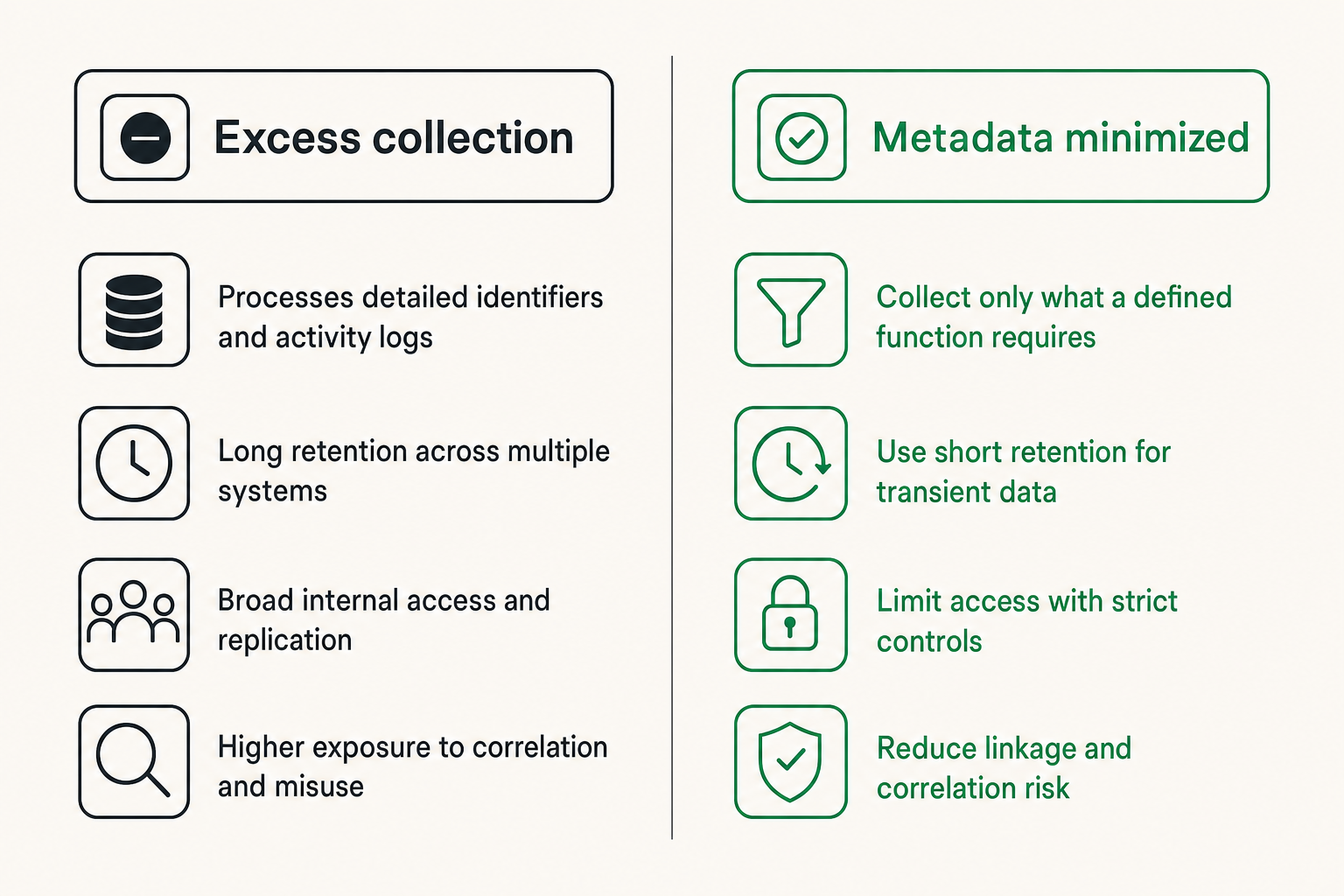
Encryption can conceal content while communication patterns remain observable. Depending on the architecture, a service may process account identifiers, device tokens, timestamps, IP addresses, recipient routing information, group relationships, message sizes, and delivery status.
Claims that a system stores “no metadata” are rarely useful without a field-level explanation. The better objective is metadata minimization backed by retention and access controls.
Map the metadata your system creates
Create a data-flow inventory covering registration, contact discovery, message routing, push delivery, abuse prevention, diagnostics, and customer support. For each field, record its purpose, storage location, retention period, and who can query it.
For example, an encrypted envelope might expose operational fields while keeping content opaque:
{
  "envelope_id": "opaque-id",
  "recipient_device": "routing-token",
  "created_at": "coarse-time",
  "expires_at": "expiry-time",
  "ciphertext": "encrypted-bytes"
}
Even these fields can become sensitive in aggregate. Exact timestamps and stable routing tokens may reveal recurring relationships. Logs may duplicate them into systems with broader access than the primary message store.
Minimize collection retention and exposure
Collect only what a defined function requires. Use short retention for transient delivery records, restrict diagnostic logs, separate abuse signals from message content, and avoid stable identifiers where rotating tokens will work.
Privacy documentation should match production behavior. Review the provider's privacy practices, but also validate client telemetry, crash reporting, support procedures, and subprocessors during a serious assessment.
Related reading from our network: even consumer streaming workflows expose privacy and reliability tradeoffs across providers, networks, and devices, as this guide to cord-cutting websites illustrates.
Build an operational deployment workflow
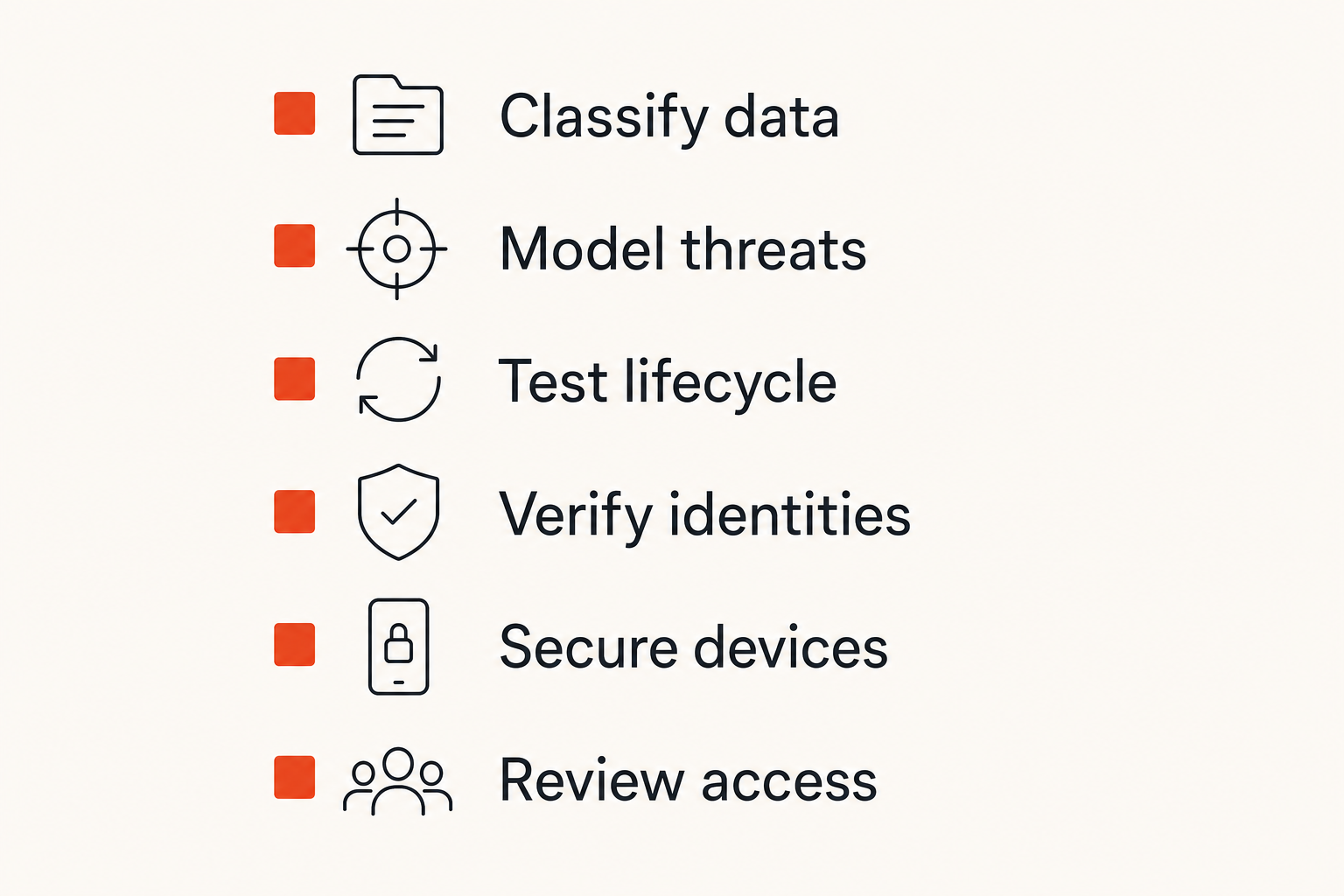
Choosing a secure messenger is a deployment project, not a checkbox. Teams need channel policies, identity procedures, device rules, user education, and an exit path for legacy communication.
Roll out secure messaging in controlled stages
A practical implementation sequence is:
- Classify conversations. Identify which messages, files, and groups require protected channels and which systems must never receive them.
- Model threats. Name adversaries, trusted endpoints, retention requirements, and realistic failure scenarios.
- Pilot the lifecycle. Enroll several users, add second devices, replace a phone, remove a member, recover an account, and export or delete data.
- Define verification rules. Specify when users must verify identity changes and how they should do so out of band.
- Configure endpoints. Require supported operating systems, screen locks, prompt security updates, and restrained notification previews.
- Migrate active groups. Recreate membership deliberately instead of copying stale directories without review.
- Train for exceptions. Give users a clear procedure for lost devices, suspicious key changes, phishing, and accidental disclosure.
- Review continuously. Audit authorized devices, guest membership, retention settings, and protocol changes on a regular schedule.
The rollout should have an owner. Without one, security assumes IT handles offboarding, IT assumes group administrators handle it, and users keep stale access.
Integrate without breaking the trust boundary
Bots, archiving tools, ticketing connectors, AI assistants, and compliance exports can become additional plaintext endpoints. That may be an accepted business decision, but it must be described honestly and limited technically.
Prefer integrations that run on controlled endpoints, receive only selected conversations, and have explicit identities visible to participants. Avoid invisible server-side processing that changes the trust model while the interface continues to imply exclusive participant access.
Screen sharing is another common escape path: a secure message can be exposed during debugging or a remote meeting. Related reading from our network: this screen-sharing development workflow provides adjacent guidance on designing collaborative sessions and handoffs deliberately.
Recognize common failure modes
Encrypted messaging implementations usually fail at boundaries and transitions, not while two stable devices exchange ordinary text. Enrollment, recovery, device replacement, group changes, exports, and support requests deserve the most testing.
What fails in production
| Failure mode | What breaks | Better control |
|---|---|---|
| Weak device enrollment | An attacker becomes an authorized endpoint | Existing-device approval or strong identity proofing |
| Ignored key warnings | Users continue after an unexplained identity change | Specific alerts with verification guidance |
| Stale group membership | Former staff receive future messages | Automated offboarding plus visible membership review |
| Plaintext notification previews | Locked screens reveal sensitive content | Configurable redaction by default |
| Unencrypted exports | Protected history moves into ordinary storage | Encrypted export with clear warnings and access controls |
| Indefinite server queues | Undelivered ciphertext and metadata accumulate | Expiration rules and deletion verification |
| Overpowered integrations | Bots silently become universal readers | Scoped access and participant-visible identities |
The mistake teams make is testing the happy path repeatedly. Sending and receiving a message proves very little about account recovery, asynchronous state, or revocation.
Recovery and support can bypass encryption
Recovery creates a difficult tradeoff. If the provider can restore every key after a user forgets all secrets, the provider or recovery mechanism may possess a path to protected content. If recovery is entirely user-controlled, losing all trusted devices and recovery material may make history permanently inaccessible.
Neither outcome is automatically wrong. It must be explicit. Teams should distinguish account recovery from message-history recovery: regaining an identifier does not have to restore old encryption keys.
Support staff also need constrained tools. They may need to inspect delivery status, application version, and anonymized errors without seeing contacts or plaintext. Procedures should prevent a support agent from silently enrolling a replacement device or disabling verification controls.
Practical rule: Test recovery as if the requester is an attacker who knows the user's email address and personal details.
Evaluate encrypted messaging products
Product pages tend to compress a complicated trust model into phrases such as “military-grade,” “zero knowledge,” or “quantum secure.” Those labels are not enough to approve a communication system.
Turn requirements into evidence
Request concrete answers about protocol design, implementation review, key storage, multi-device enrollment, identity verification, metadata retention, backups, group updates, and incident handling. The provider's security documentation should explain boundaries and controls rather than rely only on algorithm names.
A useful evaluation table includes the requirement, expected behavior, available evidence, test result, owner, and unresolved risk. This prevents procurement from treating every feature checkmark as equivalent.
Ask especially difficult questions:
- Can the service add a device without an existing trusted endpoint knowing?
- What happens to sessions when a member is removed?
- Can the provider decrypt backups or reset their protection?
- Which identifiers and timestamps are retained, and for how long?
- Are browser clients protected against compromised delivery infrastructure?
- How are cryptographic updates versioned and rolled back safely?
- What does post-quantum support protect today, and what remains classical?
Test the lifecycle rather than the demo
Run a controlled exercise with realistic users and devices. Enroll a new phone, lose the old one, change a key, add an external guest, revoke a laptop, leave messages undelivered, and attempt recovery. Observe both security behavior and whether users understand it.
Also test network interruption, clock drift, duplicate delivery, older client versions, large attachments, and concurrent group changes. A protocol may be sound while the surrounding state machine produces confusing or unsafe outcomes.
Record which failures are blocked, which produce warnings, and which depend on policy. The practical question is whether ordinary users can maintain the intended trust boundary under pressure.
Where qrypt.chat fits
End to end encrypted messaging is strongest when cryptography, device behavior, and operational expectations agree. qrypt.chat is relevant to users and teams that want private communication while also considering how encrypted systems should adapt to future cryptographic risk.
Use post-quantum readiness as an architectural question
Post-quantum cryptography should be evaluated as part of protocol architecture, not as a slogan. Ask where post-quantum mechanisms are used, whether they protect initial key establishment or ongoing sessions, how they combine with established cryptography, and how larger keys or ciphertexts affect performance.
Migration capability matters because cryptographic recommendations evolve. Protocol version negotiation, authenticated updates, algorithm agility, downgrade resistance, and compatibility testing are operational requirements. A modern primitive inserted into an opaque or poorly managed system does not solve compromised endpoints, metadata exposure, or weak recovery.
Plan migration around people and devices
A migration should start with a small set of high-value conversations. Define participants, verify devices, agree on backup and recovery behavior, and establish what users should do when identity state changes. Expand only after testing offboarding and replacement-device workflows.
For remote teams, keep administrative authority narrow and separate it from content access where possible. For individuals, review linked devices periodically and protect the operating system account underneath the messenger. In both cases, the goal is the same: preserve a comprehensible trust boundary.
End to end encrypted messaging is not secure because a lock icon appears beside a conversation. It is secure when keys, endpoints, membership, metadata, recovery, and user actions continue to enforce the intended boundary throughout the communication lifecycle.
Try qrypt.chat
You are writing for people who care about private communication, secure messaging, and practical digital security. Try qrypt.chat.