
A sensitive project starts in Signal. The team sees encrypted messages, disappearing timers, and reassuring lock indicators. Three months later, nobody knows which devices remain linked, whether a departing contractor retained files, or whether anyone verified the identity behind the account used for an urgent approval.
Signal encrypted messaging solved the transport problem. It did not solve the operating model.
Teams think the problem is choosing an encrypted chat app. The real problem is controlling identity, endpoints, metadata, message retention, and human behavior across the full communication lifecycle. Encryption matters, but it sits inside a larger system that includes compromised phones, notification previews, social engineering, screenshots, exports, backups, and account recovery.
That changes the conversation. The practical question is not simply whether Signal is secure. It is whether your use of Signal matches your threat model and whether your workflow preserves the protections the protocol provides.
This guide treats Signal encrypted messaging as an architecture and operations decision. It explains what the system protects, what remains exposed, what breaks in practice, and how individuals and teams can build a defensible secure messaging workflow in 2026.
Table of contents
- Signal encrypted messaging is an architecture, not an icon
- What Signal encrypted messaging protects
- Identity and verification are the trust layer
- Device security defines the practical boundary
- Build a repeatable secure messaging workflow
- Metadata and privacy still require attention
- Groups make encrypted messaging harder
- Retention, disappearing messages, and recovery
- Common Signal encrypted messaging failure modes
- Post-quantum readiness and long-term confidentiality
- Where qrypt.chat fits in the messaging architecture
Signal encrypted messaging is an architecture, not an icon
Separate the app, protocol, and operational promise
People often use “Signal” to mean three related but different things: the Signal application, cryptographic protocol designs associated with Signal, and a general promise of private communication. Those layers should not be treated as interchangeable.
The application includes account setup, contact discovery, group behavior, linked devices, local storage, notifications, calls, and user-interface decisions. The cryptographic layer protects message content as it travels between endpoints. Your operational layer determines who may participate, which devices are acceptable, how identities are verified, and when information should be deleted or recorded elsewhere.
A strong protocol cannot compensate for an unlocked laptop displaying message previews in a shared office. Likewise, a disciplined team cannot repair a service that can read message plaintext on its servers. Secure communication needs both sound cryptography and sound operation.
Start with a concrete threat model
A threat model identifies the information being protected, likely adversaries, acceptable inconvenience, and consequences of failure. A journalist protecting a source has different requirements from a remote product team discussing an unreleased feature.
Consider at least these adversaries:
- A network observer monitoring traffic patterns.
- A service operator or infrastructure provider.
- A thief with temporary or permanent access to a device.
- Malware running under the user's account.
- An impersonator taking over or recreating an identity.
- A legitimate participant who later misuses information.
- A legal or administrative process directed at stored records.
The mistake teams make is declaring every conversation “high security” without deciding what controls that label requires. The result is inconsistent behavior and warning fatigue.
Decide what success means
Success might mean preventing the service from reading content, limiting historical exposure after device theft, verifying a small number of high-risk contacts, or keeping confidential strategy off corporate email. Write that objective down.
Practical rule: Define the adversary and the protected information before selecting secure messaging controls.
A useful architectural baseline is available in this end-to-end encrypted messaging operations guide, which covers keys, devices, metadata, recovery, and group governance beyond any single application.
What Signal encrypted messaging protects
Protection in transit
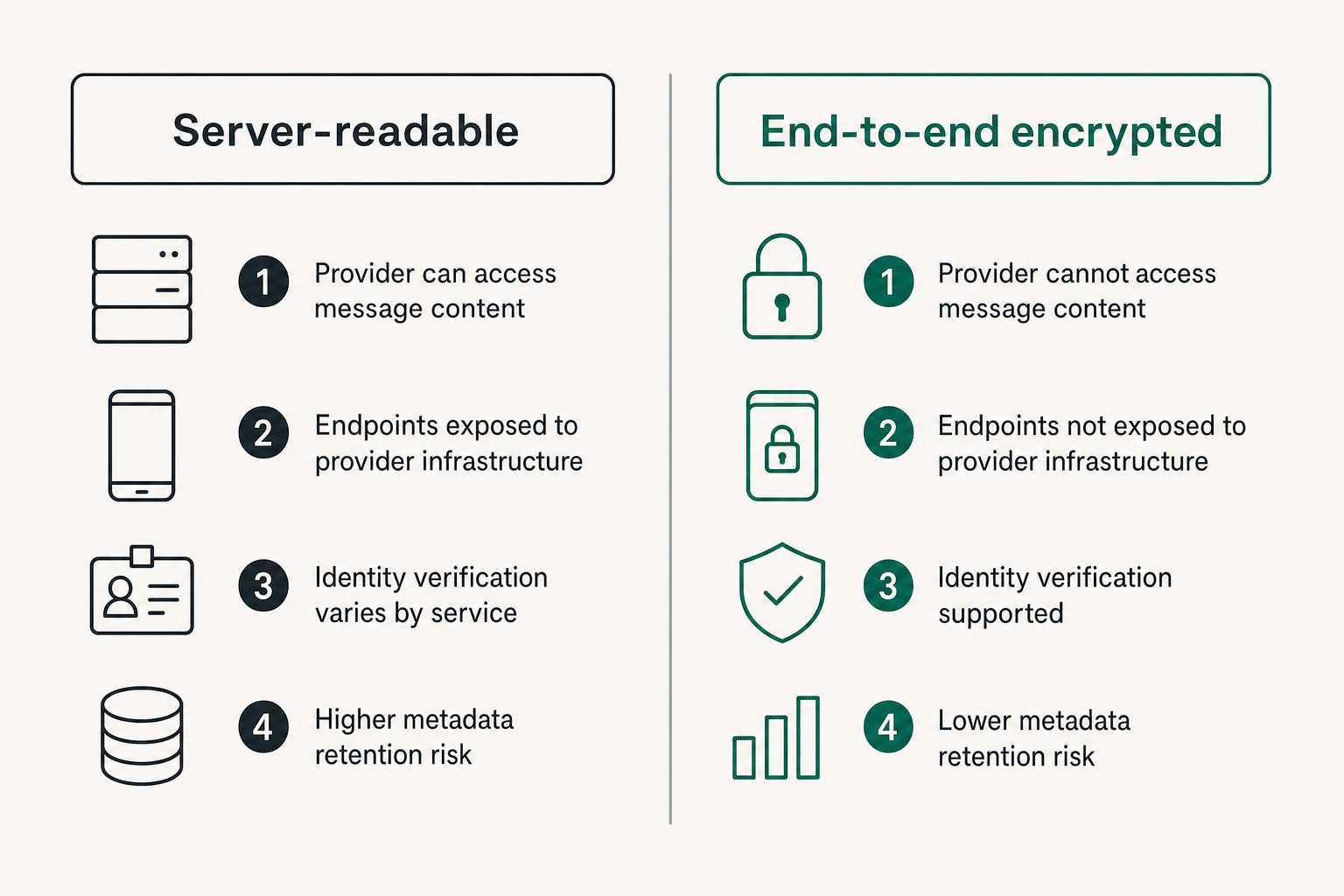
Signal encrypted messaging is designed so message content is encrypted on the sender's device and decrypted on recipient devices. The service relays ciphertext rather than receiving ordinary message plaintext. This meaningfully changes the trust boundary: compromising a relay server should not automatically reveal readable conversation history.
This protection can cover text, voice calls, video calls, and supported attachments, subject to the implementation and client versions in use. It also helps on untrusted networks because readable content is not dependent solely on transport encryption between the device and server.
That is materially stronger than a system where the provider decrypts messages in its own infrastructure, even if that provider stores them encrypted afterward.
Forward secrecy and changing keys
Modern secure messaging does not normally protect an entire relationship with one permanent encryption key. Session state advances as messages are exchanged. This is intended to limit the amount of historical content exposed if particular key material is compromised.
The exact protocol details matter to cryptographers, but operators should understand the practical consequence: current endpoint state, identity keys, session establishment, and device additions all affect trust. Key evolution reduces blast radius; it does not make endpoint compromise harmless.
A useful comparison is:
| Architecture | Provider can normally read content | Compromised endpoint can expose content | Identity verification needed | Metadata risk remains |
|---|---|---|---|---|
| Server-readable chat | Yes | Yes | Sometimes | Yes |
| End-to-end encrypted chat | No by design | Yes | Yes | Yes |
| Encrypted chat with disciplined operations | No by design | Reduced, not eliminated | Explicitly managed | Reduced, not eliminated |
What end-to-end encryption does not cover
End-to-end encryption does not stop a recipient from copying a message. It cannot prevent a camera from photographing a screen. It does not remove plaintext from a compromised endpoint or guarantee that a contact is the person you intended to reach.
It also does not make all surrounding data invisible. Depending on system design and observable network activity, timing, IP addresses, account identifiers, device behavior, and communication relationships may reveal useful information without exposing message text.
Related reading from our network: SOC teams face a similar distinction between collecting signals and operating a defensible response workflow in this guide to threat detection alternatives. The shared lesson is that technical capability is only useful when ownership and response are explicit.
Identity and verification are the trust layer
Account discovery is not identity proof
Finding an account associated with a familiar number, username, profile, or invitation does not prove that the expected person controls it. Discovery answers “which account should the client contact?” Verification answers “is this account cryptographically connected to the person I trust?”
An attacker may exploit a compromised device, account-registration weakness, social engineering, or a convincing duplicate profile. The encrypted channel can work perfectly while securely delivering information to the wrong person.
Use safety-number verification selectively
Signal provides a mechanism for comparing cryptographic identity information between participants. Verification is most valuable for high-impact relationships: sources, administrators, executives, financial approvers, incident commanders, and people exchanging long-lived secrets.
Compare verification information through an independent channel. In person is ideal when practical. A known voice call or previously trusted channel may be appropriate depending on the threat model. Comparing a code inside the same potentially compromised conversation proves very little.
Verification does not have to become ceremony for every casual chat. Prioritize contacts where impersonation would create serious harm.
Handle identity changes as events
A changed identity may have an innocent cause, such as a new phone or reinstallation. It can also indicate that the trusted endpoint relationship changed. Treat the notification as an event requiring context rather than a nuisance to dismiss.
For sensitive conversations:
- Pause disclosure.
- Ask whether the person changed devices or reinstalled the app.
- Confirm through an independent route.
- Reverify identity information.
- Record the decision if the conversation supports business authorization.
Practical rule: An encrypted conversation is only as trustworthy as the process used to bind its keys to a real person.
Device security defines the practical boundary
Treat every linked device as an endpoint
A phone may be secure while a linked desktop remains logged in on an unmanaged home computer. Every linked device receiving plaintext is part of the encryption boundary, including devices used rarely.
Review linked devices periodically and after travel, loss, repair, role changes, or suspicious activity. Remove entries that are unfamiliar or no longer needed. Require supported operating systems, timely security updates, device encryption, strong local authentication, and automatic locking.
For teams, decide whether personal devices are acceptable. If they are, state minimum controls instead of relying on an ambiguous bring-your-own-device policy.
Control notifications, files, and screenshots
Notification previews can expose content on lock screens, watches, desktop banners, presentation displays, and vehicle interfaces. Disable previews for sensitive applications or configure them to show only that a message arrived.
Attachments create another copy as soon as users download, open, export, or forward them. The receiving application may cache a file. A desktop search index, photo library, cloud-sync tool, or document editor may create additional plaintext copies outside the encrypted messenger.
Screenshots and screen recording remain human and operating-system risks. Application restrictions may discourage casual capture, but they are not a reliable confidentiality boundary across all devices.
Plan for loss, theft, and departure
Before an incident, configure short lock timeouts, strong device credentials, storage encryption, remote management where appropriate, and a documented response route. After loss or theft, revoke linked sessions, protect the underlying mobile or account identity, and assess what recent content was locally accessible.
When somebody leaves a team, remove them from groups and rotate any secrets shared in chat. Removing a participant does not erase prior messages, files, screenshots, or credentials from their devices.
Related reading from our network: distributed computing operators encounter the same need to define job state, retries, and ownership instead of trusting the interface alone; this cloud computing service architecture provides an adjacent workflow example.
Build a repeatable secure messaging workflow
Classify the conversation before it starts
Not every message deserves identical handling. A simple classification model is easier to apply than a large policy document:
- Routine: ordinary coordination with low impact if disclosed.
- Sensitive: internal plans, personal information, customer context, or security discussions.
- Restricted: credentials, source identities, legal strategy, incident access, or decisions with severe consequences.
The classification should determine participant verification, acceptable devices, retention, and whether messaging is appropriate at all. Some secrets belong in a password manager, access-control system, or purpose-built file exchange rather than chat.
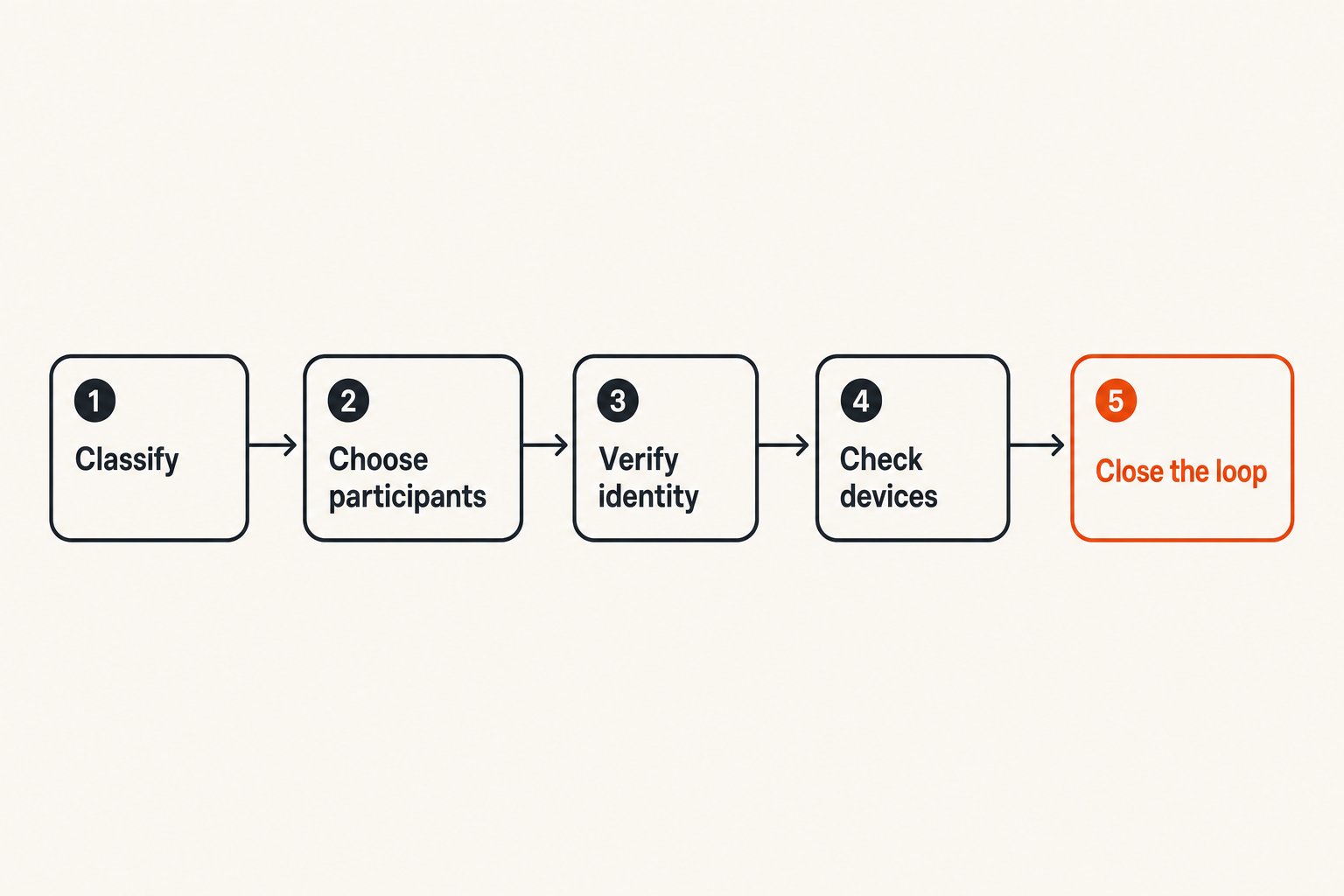
Follow a seven-step operating sequence
A workable Signal encrypted messaging workflow looks like this:
- Classify the content. Decide the likely harm from disclosure, alteration, impersonation, or loss.
- Choose participants. Include only people who need the information or decision.
- Confirm identity. Verify high-risk contacts independently before sharing restricted material.
- Inspect endpoints. Check linked devices and update clients before critical work.
- Set retention. Select a disappearing-message timer or durable-record path that fits the purpose.
- Communicate and confirm. Separate contextual discussion from explicit approval, especially during incidents or financial actions.
- Close the loop. Remove temporary participants, rotate exposed secrets, and transfer necessary records to the correct system.
The workflow is intentionally short. Controls that require a specialist for every conversation will be bypassed.
Move durable records out deliberately
Chat is useful for rapid coordination, but it is a weak source of truth for many business decisions. If an approval, incident timeline, design decision, or contractual instruction must be retained, move the final record into an authorized system.
Do not solve this by automatically exporting every encrypted conversation. That recreates a large central archive and may undermine the reason for using end-to-end encryption. Export the minimum required conclusion with context, ownership, and access controls.
Practical rule: Use encrypted chat for communication; use an approved system of record for facts that must remain durable.
Metadata and privacy still require attention
Understand what observers can infer
Message content is only one category of information. An observer may care that two people communicated at a particular time, that a device connected from a location, or that activity increased immediately before a public event.
Signal has implemented mechanisms intended to minimize data available to its service and reduce sender exposure in some delivery scenarios. Those protections matter, but metadata resistance is not the same as complete network anonymity. Internet providers, device platforms, notification infrastructure, malware, and traffic observers occupy different positions in the system.
The practical question is which observer you need to resist and which metadata that observer can access.
Reduce unnecessary exposure
Basic operational measures include:
- Avoid using revealing group names or profile details.
- Limit group membership and unnecessary contact discovery.
- Disable message previews on locked or shared screens.
- Keep sensitive communications separate from public identities where the product and threat model support it.
- Avoid discussing high-risk matters from monitored workplace or travel environments.
- Consider whether traffic-level anonymity requires tools beyond encrypted messaging.
Review the provider's published privacy terms and data handling when evaluating any alternative. Architecture claims should be checked against what the service says it collects, retains, and processes.
Do not confuse anonymity with confidentiality
Confidentiality protects content from unauthorized readers. Anonymity conceals who is communicating. Pseudonymity uses an identifier that may not directly reveal a civil identity. These properties overlap, but none automatically provides the others.
A user may have strongly encrypted messages while remaining identifiable through a phone number, payment trail, IP address, contact graph, or device account. Conversely, an anonymous communication path can still carry unencrypted content.
This distinction matters for researchers, activists, sources, and incident responders. If identity exposure is the primary threat, encrypted messaging is one component of the design rather than the whole design.
Groups make encrypted messaging harder
Membership is a security control
One-to-one verification does not scale automatically to a large group. Every added participant increases the number of endpoints, identities, notification surfaces, and people able to retain information.
Before adding someone, ask whether they need historical context, current discussion, or only the final decision. Create smaller purpose-specific groups rather than one permanent room containing every contractor, adviser, and former employee.
Sensitive groups should announce membership changes clearly. Participants must notice when somebody joins, leaves, replaces a device, or changes identity state.
Assign an owner and review cadence
Every operational group needs an owner. The owner should know why the group exists, who belongs, what information is acceptable, and when the group should be archived or abandoned.
Review high-risk groups after project milestones and personnel changes. A monthly review may fit an active incident or executive channel, while event-specific groups should be closed as soon as the event ends. The cadence matters less than having a trigger and named responsibility.
A practical review checks:
- Current members and their roles.
- Unexpected administrators or linked identities.
- Whether the group still has a valid purpose.
- Whether retention settings remain suitable.
- Whether shared secrets need rotation.
Separate discussion from authorization
An encrypted message saying “go ahead” may be authentic to an account but still lack sufficient business context. High-impact actions need explicit authorization semantics: what is approved, by whom, for how long, and subject to which limits.
For payments, access grants, production changes, or emergency data release, require a second channel or formal approval system. Signal can carry discussion and an alert, but it should not silently become the entire authorization plane.
The mistake teams make is assuming confidentiality implies process integrity. It does not. A private instruction can still be ambiguous, coerced, outdated, or sent from a compromised endpoint.
Retention, disappearing messages, and recovery
Timers are exposure controls, not guarantees
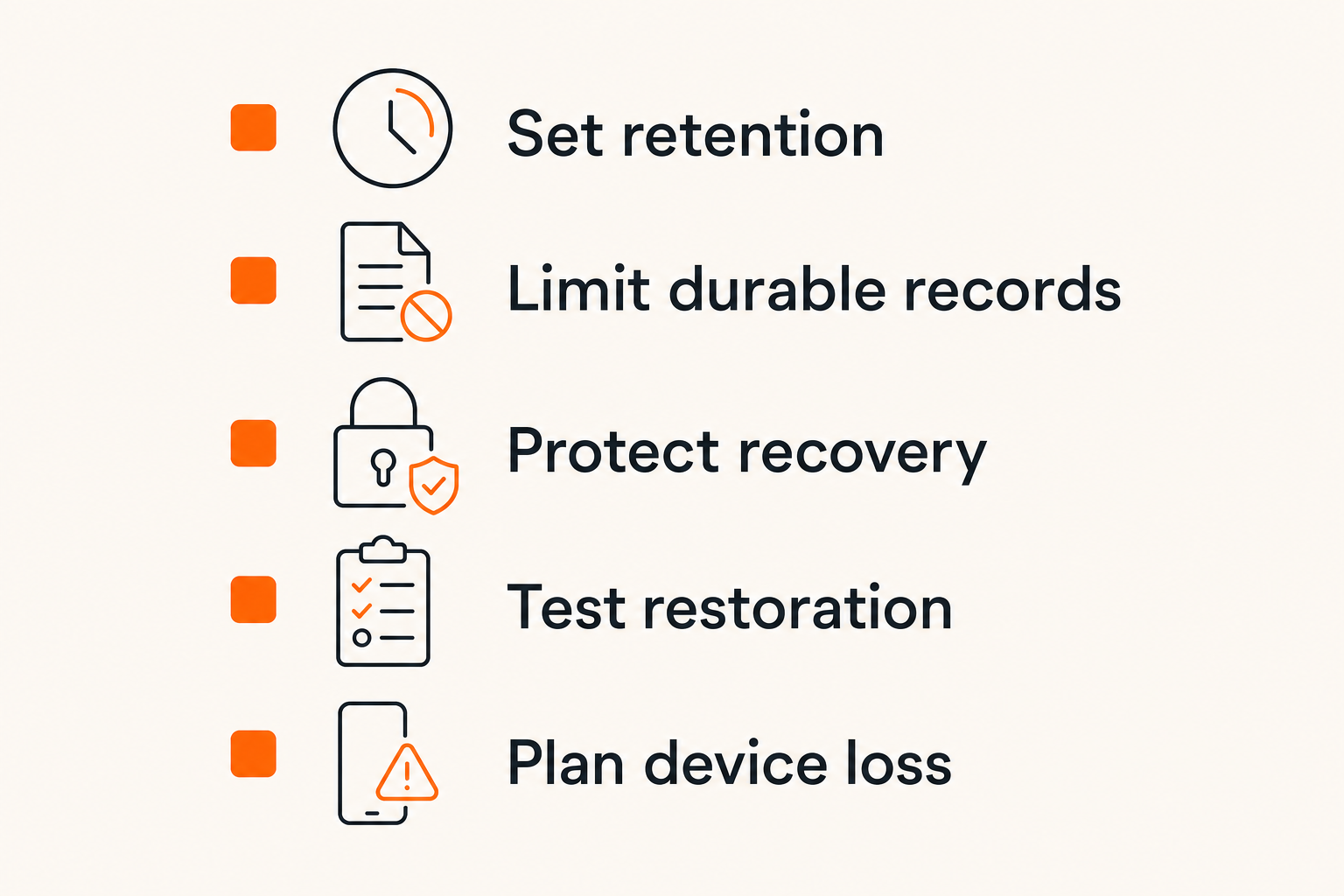
Disappearing messages reduce routine accumulation on participating devices. They can limit how much historical context remains available after casual inspection or later device compromise. That is useful.
They do not guarantee deletion from every possible location. A recipient can copy text, photograph the screen, save an attachment, quote information elsewhere, or capture it with malware. Devices that are offline may also process state changes differently from what users intuitively expect.
Treat timers as data-minimization controls, not remote erasure technology.
Recovery can weaken or destroy the workflow
Recovery creates a tension. Users want to regain conversations after replacing a device, but any mechanism that restores readable history may create another key, archive, credential, or storage location requiring protection.
At the opposite extreme, no recovery can cause operational loss when a device fails. Teams may respond by taking unsafe screenshots or forwarding messages to email “just in case.” A secure design must account for both confidentiality and availability.
Document what can be restored, from where, with which secret, and under whose control. Test the process using non-sensitive data before depending on it. Never assume a device backup preserves the same security properties as the messaging protocol.
Choose retention by conversation class
A practical retention model might be:
| Conversation class | Typical handling | Durable record approach |
|---|---|---|
| Routine coordination | Moderate timer or standard history | Usually none |
| Sensitive project work | Shorter timer and limited group | Record final decisions only |
| Restricted exchange | Minimal history and verified participants | Store required artifact in a dedicated secure system |
| Formal authorization | Chat provides context, not sole approval | Preserve authorization in the official system |
There is no universally correct timer. An extremely short timer can damage incident response by deleting needed context. Unlimited history expands the impact of endpoint compromise. Choose based on purpose rather than copying a fashionable setting.
Related reading from our network: even consumer streaming workflows must balance privacy, reliability, and operating cost rather than ranking interfaces alone, as shown in this guide to cord cutting websites. The stakes differ, but the architecture-versus-interface distinction is similar.
Common Signal encrypted messaging failure modes
What fails in individual use
The most common failures occur around the encryption rather than inside it:
- Trusting a profile or familiar identifier without verification.
- Leaving message previews visible on a locked screen.
- Linking a desktop and forgetting it exists.
- Downloading attachments into automatically synchronized folders.
- Keeping sensitive history indefinitely without a reason.
- Sending passwords or recovery codes that should be stored in a password manager.
- Treating disappearing messages as proof that no copy survives.
- Ignoring identity-change notifications during urgent conversations.
Urgency amplifies these errors. Attackers do not need to break cryptography if they can persuade someone to skip verification.
What fails in team use
Teams add governance problems. Groups outlive projects, former members retain history, nobody owns membership reviews, and chat becomes an unofficial approval system. Personal devices may have inconsistent updates, local authentication, backups, or malware protection.
Compliance can also collide with privacy. An organization may require retention, legal hold, access review, or administrative recovery that a consumer-oriented encrypted messenger was not designed to provide. Secretly working around those requirements with screenshots and manual exports produces the worst of both systems.
What breaks in practice is the gap between the application's trust model and the organization's operating model. Security teams should identify that gap before deployment rather than after an incident.
What works instead
What works is usually unglamorous:
- A written threat model no longer than one page.
- A small set of conversation classes.
- Verification for high-impact contacts.
- Supported, encrypted, locked, and reviewed endpoints.
- Named owners for sensitive groups.
- Clear retention and offboarding triggers.
- A separate system for durable approvals and secrets.
- Periodic drills for device loss and identity changes.
This is also why encryption claims should be evaluated against implementation details. QryptChat publishes a dedicated overview of its security architecture, giving evaluators a starting point for asking about cryptography, trust boundaries, and post-quantum design.
Post-quantum readiness and long-term confidentiality
Focus on harvest-now-decrypt-later risk
Quantum computing risk is often framed as an immediate ability to read every encrypted message. The more practical concern for long-lived secrets is harvest now, decrypt later: an adversary records encrypted traffic today and retains it in the hope that future capabilities expose the key agreement or related cryptography.
This matters most when information must remain confidential for many years. Source identities, medical context, strategic plans, government information, and high-value intellectual property may retain value long after the conversation ends.
Signal has publicly evolved its protocol designs to incorporate post-quantum protections in session establishment. Operators should still verify current documentation and deployed client behavior because cryptographic migrations continue over time.
Evaluate the whole cryptographic lifecycle
Post-quantum readiness is not a single algorithm badge. Evaluate:
- How identity and initial sessions are established.
- Whether classical and post-quantum mechanisms are combined.
- How sessions update after initial contact.
- What happens when participants use outdated clients.
- How linked devices receive trust and keys.
- Whether stored data and attachments receive suitable protection.
- How implementations are reviewed, patched, and migrated.
Hybrid designs can reduce dependence on one new primitive by combining it with established cryptography. They also add implementation complexity, message-size overhead, compatibility requirements, and migration work.
Avoid quantum-resistant marketing shortcuts
A provider can describe one component as quantum resistant while leaving identity, storage, backups, or endpoint compromise unaddressed. That may still represent progress, but it is not a complete security argument.
Ask for protocol specificity, implementation scope, downgrade behavior, client compatibility, and independent analysis where available. Avoid claims of absolute or permanent security. Cryptographic assurance is always conditional on assumptions, implementation quality, endpoint integrity, and future review.
Practical rule: Treat post-quantum protection as a migration property across the messaging lifecycle, not as a label attached to one algorithm.
Where qrypt.chat fits in the messaging architecture
Assess alternatives against the same model
Signal encrypted messaging provides a useful benchmark because it forces evaluators to think about end-to-end encryption, identity keys, device state, metadata minimization, and key evolution. An alternative should be assessed against the same architecture rather than against surface features such as themes, reactions, or file-size limits.
For qrypt.chat, the relevant product-fit question is whether you need private communication with explicit attention to post-quantum cryptography and long-term confidentiality. That does not remove the need for device security, identity verification, group ownership, and retention discipline. No messaging product can do those jobs entirely on behalf of its users.
Before adopting any platform, run a small operational test:
- Establish a conversation on clean, supported devices.
- Verify participant identity through another channel.
- Add and remove a linked endpoint.
- Observe warnings after an identity or device change.
- Test attachment handling and notification privacy.
- Simulate a lost device and participant departure.
- Confirm what metadata, history, and recovery material remain.
The result should be a documented workflow, not merely a successful message exchange. That is the standard privacy-conscious users and security teams should apply to Signal encrypted messaging and every competing secure messenger.
Try qrypt.chat
You are writing for people who care about private communication, secure messaging, and practical digital security. Explore a post-quantum-focused approach to encrypted chat at Try qrypt.chat.