
A sensitive message is encrypted in transit, yet someone still reads it from an unlocked laptop. A team verifies a contact once, then ignores a device-change warning six months later. An executive uses disappearing messages, but a recipient screenshots the conversation and forwards it.
That is the operational reality of Signal encrypted messaging in 2026. The cryptography can be strong while the communication workflow remains exposed.
Teams think the problem is choosing an encrypted app. The real problem is controlling the full path between human intent, identity, endpoints, message delivery, retention, and response when something changes.
Signal is an important part of that architecture, but the UI is not the security boundary. The practical question is whether your devices, verification habits, group administration, recovery process, and user behavior preserve the guarantees that encryption provides.
Table of contents
- Start with the threat model, not the app
- How Signal encrypted messaging protects a conversation
- Identity verification is a workflow
- Endpoint security determines the real boundary
- Build a Signal encrypted messaging workflow for teams
- Metadata, contacts, and group privacy
- Disappearing messages, screenshots, and retention
- Common failure modes and what works instead
- Post-quantum security and long-term confidentiality
- Choosing where Signal fits in your communication stack
- A practical deployment checklist
Start with the threat model, not the app
Define what must remain private
Before discussing encryption, identify the information at risk. Message text is only one category. A useful inventory includes attachments, contact identities, group membership, communication timing, device history, message retention, and the fact that two people communicated at all.
A journalist protecting a source has different requirements from a remote engineering team discussing an unreleased product. The journalist may prioritize identity separation and resistance to targeted device searches. The engineering team may prioritize controlled membership, offboarding, and preventing confidential decisions from becoming permanent chat history.
Write down the consequences of exposure. If the answer is merely “inconvenient,” ordinary controls may be enough. If exposure could cause physical harm, regulatory problems, commercial loss, or source identification, the workflow needs stronger verification and endpoint controls.
Name the adversary and its capabilities
“Private” has no meaning without an adversary. Consider whether you are defending against network observers, a messaging provider, opportunistic thieves, abusive insiders, targeted malware, account takeover, legal demands, or a recipient who may intentionally disclose content.
Encryption is effective against some of these threats and irrelevant against others. It can stop a Wi-Fi observer from reading message content. It cannot stop an authorized recipient from photographing the screen with another device.
Practical rule: Define the adversary before selecting the control. A control without a named threat becomes security theater.
Separate content secrecy from operational privacy
Content secrecy asks whether an intermediary can read the message. Operational privacy asks who can infer relationships, timing, location, membership, or activity from the surrounding system.
Signal encrypted messaging is primarily evaluated for strong content protection, but a serious assessment must include account registration, contact discovery, push notifications, linked devices, IP visibility, local address books, and human behavior. Some details change as applications evolve, so confirm the current implementation rather than relying on an old setup guide.
For a deeper architecture-oriented treatment, our earlier Signal encrypted messaging analysis separates protocol guarantees from device and workflow assumptions.
How Signal encrypted messaging protects a conversation
End-to-end encryption and session keys
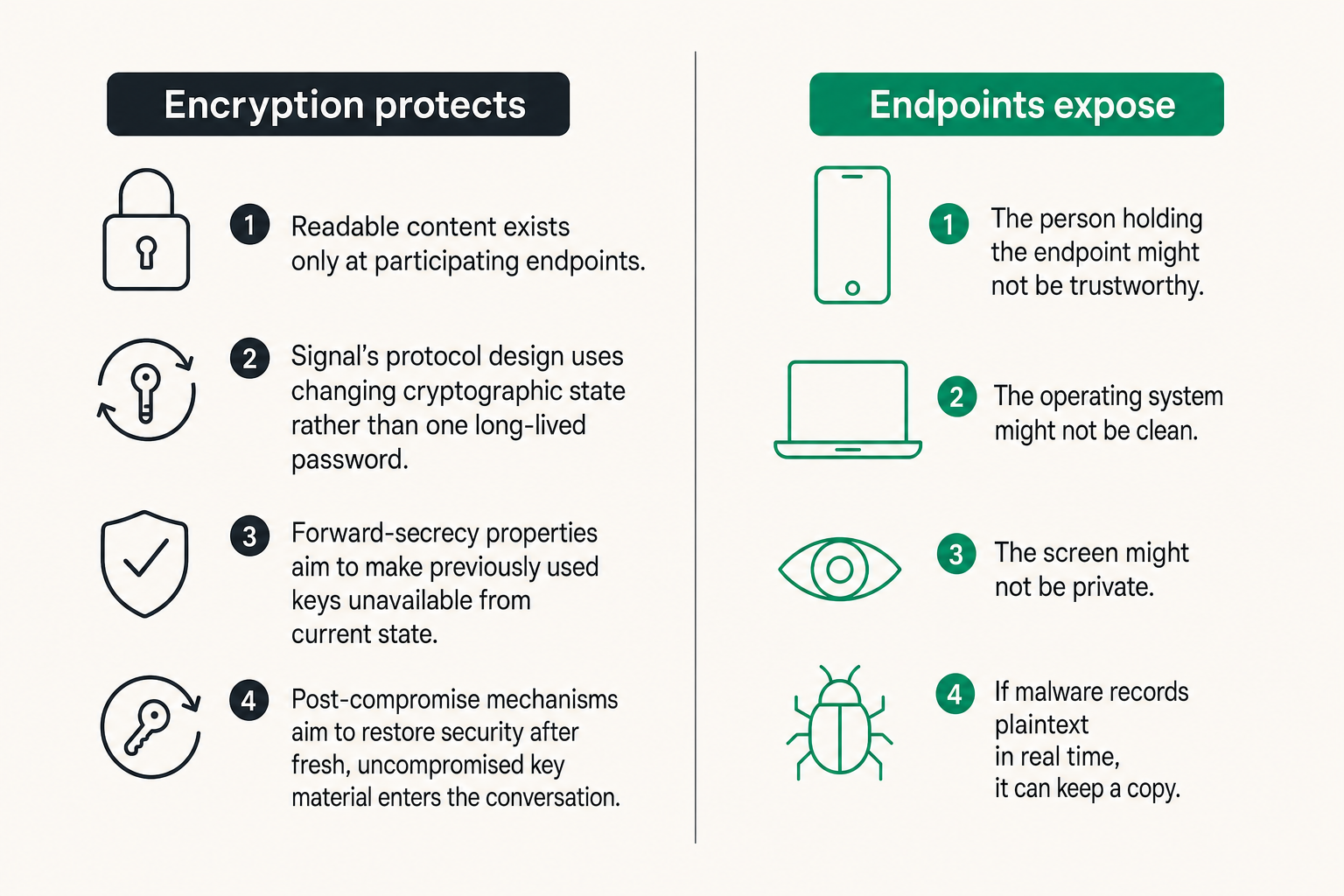
In an end-to-end encrypted system, readable content should exist only at participating endpoints. The service transports ciphertext rather than holding the keys needed to decrypt ordinary conversation content.
Signal’s protocol design uses changing cryptographic state rather than treating one long-lived password as the key for every message. That distinction matters. A static-key design creates a large blast radius: obtain the key once and a broad history may become vulnerable. A ratcheting protocol continually derives new state as participants exchange messages.
The mistake teams make is translating “end-to-end encrypted” into “safe under every condition.” The guarantee applies to a defined protocol path between endpoints. It does not attest that the person holding the endpoint is trustworthy, that the operating system is clean, or that the screen is private.
Forward secrecy and recovery after compromise
Modern secure messaging aims to limit the damage caused by key compromise. Forward-secrecy properties are intended to make previously used keys unavailable from current state. Post-compromise mechanisms aim to restore security after fresh, uncompromised key material enters the conversation.
These are valuable properties, but they are not magic rollback functions. If malware records plaintext as the user types, key evolution cannot erase the captured text. If a recipient exported an attachment, later session recovery does not retrieve it.
A useful way to think about it is containment: protocol design can narrow cryptographic exposure, while endpoint response must remove the cause of compromise.
What the server can and cannot protect
A server can facilitate registration, key distribution, queued delivery, spam controls, and group operations without necessarily possessing readable message content. That reduces the amount of trust placed in the service operator.
However, the service still participates in availability and routing. It can experience outages, apply rate limits, block accounts, or become a source of observable connection data. Mobile push infrastructure and network providers may also observe some activity even when they cannot read messages.
| Security question | Encryption helps | Encryption does not solve alone |
|---|---|---|
| Can a network observer read content? | Strongly reduces that risk | Endpoint capture remains possible |
| Can the provider read ordinary messages? | Designed to prevent this | Implementation and endpoint trust still matter |
| Is the contact the intended person? | Supports verification | Users must perform verification |
| Can a stolen unlocked phone reveal chats? | Not while content is only in transit | Local access controls are required |
| Can a recipient leak content? | No | Requires trust, policy, and minimization |
| Will service always be available? | No | Requires contingency planning |
That changes the conversation from “Is Signal secure?” to “Which failure domains does Signal remove, and which remain ours?”
Identity verification is a workflow
When safety-number verification matters
Encryption to an unknown key is confidential but not necessarily authenticated to the intended human. Safety numbers or comparable fingerprints let participants compare cryptographic identity information through another trusted path.
Verification is most important for high-impact conversations, first contact with a sensitive source, executive requests, privileged access coordination, and any situation where impersonation would be costly. Verifying every casual contact may create fatigue, so apply stronger ceremony according to risk.
Practical rule: Verification effort should rise with the consequence of impersonation, not with the volume of messages.
Choose an independent verification channel
Do not verify a suspicious identity entirely inside the channel you suspect may be compromised. Compare the safety number in person, over a known telephone number, during a trusted video call, or through another previously authenticated system.
The second channel does not need to be technologically elaborate. It needs to be independent enough that one attacker is unlikely to control both paths. Teams should document approved verification methods instead of expecting users to improvise during an incident.
For high-risk roles, use a short script: state both names, confirm the communication purpose, compare the complete verification value, record that verification occurred, and define when it must be repeated.
Treat identity changes as events
A changed identity can be benign. Someone may replace a phone, reinstall the application, or reset their account. It can also indicate an account transition that deserves investigation.
What breaks in practice is alert normalization. Users see enough routine changes that they automatically continue. A better workflow assigns meaning to the event:
- Pause sensitive discussion.
- Contact the person through an independent route.
- Confirm whether a legitimate device or account change occurred.
- Reverify before sending new confidential material.
- Escalate unexplained changes to the security owner.
The workflow should be quick enough that users follow it. A policy requiring a ticket, three approvals, and a scheduled meeting for every phone replacement will be bypassed.
Endpoint security determines the real boundary
Secure phones and linked desktops
A conversation is only as private as its least controlled endpoint. Phones should use strong device authentication, current operating-system updates, automatic locking, and encryption supported by the platform. Rooted or jailbroken devices add uncertainty because normal application isolation may no longer hold.
Linked desktops deserve equal attention. A carefully secured phone does not compensate for an unmanaged laptop with a shared login, persistent notification previews, browser-stealing malware, or unattended physical access. Inventory every linked device and remove sessions that are no longer required.
Security teams should inspect the application’s current linked-device behavior during deployment. Do not assume old devices disappear automatically or that offboarding one account removes every local copy.
Control notifications and local exposure
Lock-screen notifications can disclose names, message fragments, group titles, and communication timing. Screen recording, accessibility services, clipboard managers, cloud photo uploads, and desktop search indexing may create additional plaintext paths.
Use notification settings that hide sensitive previews. For higher-risk deployments, review operating-system backups, local media saving, screenshot behavior, and whether attachments are copied into general-purpose folders.
The QryptChat privacy approach is relevant here because meaningful privacy requires clarity about what information a service and its surrounding systems process, not only a claim that message bodies are encrypted.
Plan for loss, theft, and malware
Teams need a response sequence before a device goes missing:
- Report the event through a known channel.
- Determine whether the device was locked and when it was last controlled.
- Remove or invalidate linked access where the product allows it.
- Notify sensitive groups without reposting confidential context.
- Reverify identities after account or device recovery.
- Investigate malware or credential theft rather than treating replacement as sufficient.
Remote wipe can help, but it is not guaranteed if the device remains offline or has been modified. The defensible strategy combines local lock controls, limited retention, rapid reporting, and session review.
Related reading from our network: teams connecting engineering telemetry to response face the same ownership problem in CI/CD security threat detection—a signal only helps when someone knows how to investigate and act on it.
Build a Signal encrypted messaging workflow for teams
Classify conversations before choosing controls
Not every conversation needs the same treatment. A lightweight classification model is easier to follow than a long policy:
- Routine: scheduling, public information, and low-impact coordination.
- Confidential: internal plans, customer context, and nonpublic operations.
- Restricted: credentials, sensitive identities, incident details, legal strategy, or information with serious exposure consequences.
- Record-controlled: decisions or instructions that must be retained in an approved system.
Signal may fit routine, confidential, or restricted communication depending on the threat model. Record-controlled material often needs to move into a governed case, document, or ticket system. Secure chat and records management are different requirements.
Implement a repeatable secure-chat sequence
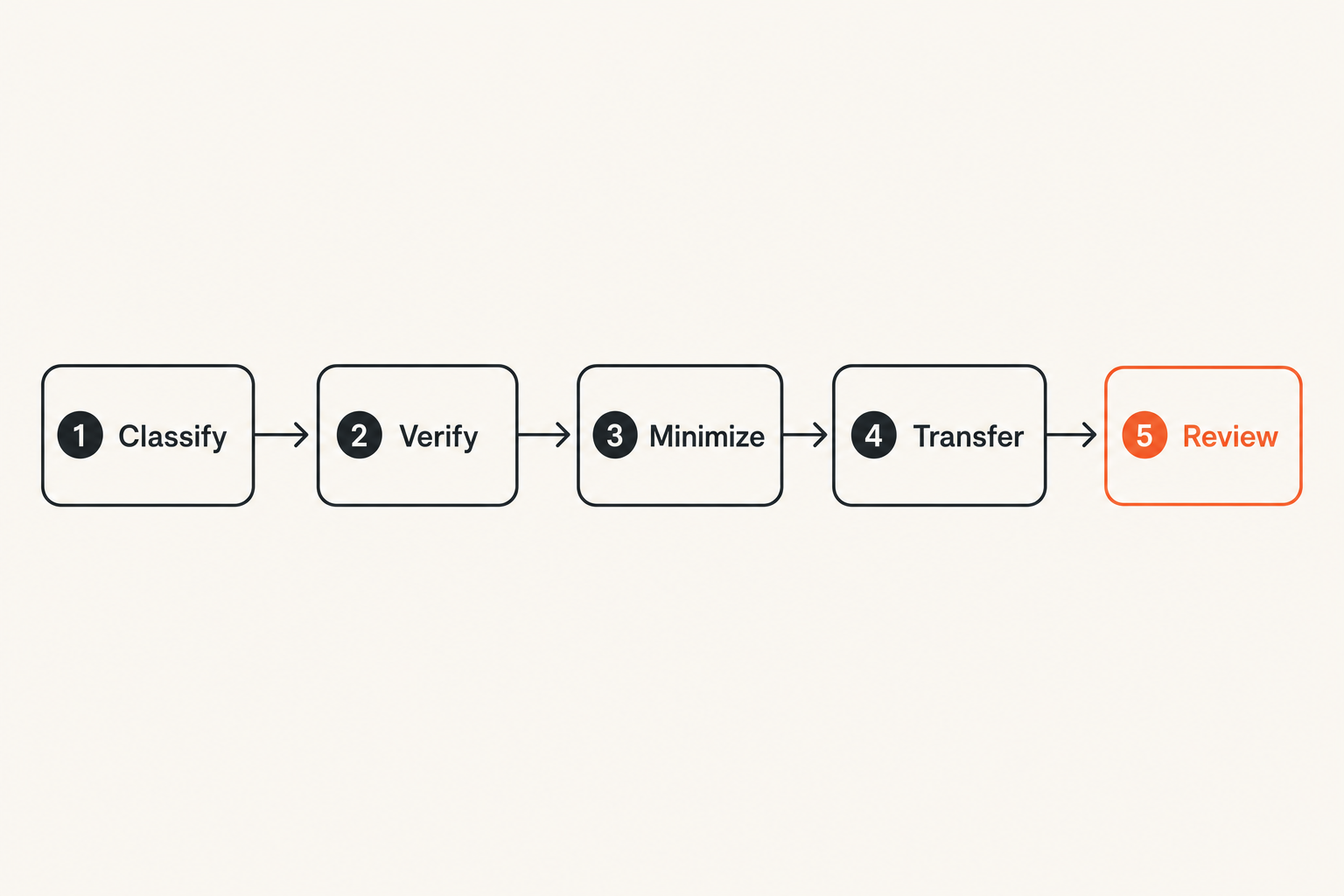
A practical team workflow should be explicit:
- Classify: Decide the sensitivity and retention requirement.
- Select: Confirm that encrypted chat is an approved channel for that class.
- Verify: Authenticate participants when impersonation would matter.
- Minimize: Share only the information required for the immediate task.
- Expire: Apply a suitable disappearing-message period where appropriate.
- Transfer: Move durable decisions into the authorized system of record.
- Review: Recheck membership, linked devices, and identity-change events.
This is intentionally simple. Workflow complexity creates shadow processes, particularly during incidents when people are tired and moving quickly.
Practical rule: Secure messaging should reduce plaintext exposure without becoming the only place where operational truth exists.
Assign ownership for groups and incidents
Every sensitive group should have an owner responsible for membership, purpose, and periodic review. Define who can add members, what happens when a contractor leaves, and how participants report a suspicious identity change or lost device.
Group names also deserve care. A title visible in notifications can disclose a project, customer, medical issue, or source relationship. Use neutral names when the label itself creates risk.
Decentralized teams encounter similar control problems across chat, jobs, artifacts, and identity. Related reading from our network: this analysis of cloud collaboration tools for decentralized teams shows why ownership and failure handling matter more than a polished interface.
Metadata, contacts, and group privacy
Understand what encryption does not hide
Message encryption does not make communication invisible. Depending on architecture and settings, observable data can include network connections, IP addresses, registration events, push timing, device information, contact-discovery interactions, and local address-book entries.
Not every observer sees every element. The mobile carrier, application service, push provider, recipient, and organization managing the device occupy different positions. Map visibility by actor instead of grouping all metadata into one vague category.
For especially sensitive use, consider whether a network observer knowing that Signal is being used is itself consequential. Network-level privacy tools may reduce some exposure, but they introduce new providers and availability tradeoffs. Test them rather than assuming layering always improves security.
Reduce unnecessary identity linkage
Use the least identifying account and profile information compatible with the relationship and current product behavior. Features such as usernames can reduce routine phone-number sharing, but they should not be confused with total anonymity. Registration requirements, prior contact exchange, device data, or participant knowledge may still create links.
Avoid uploading broad contact datasets from shared or role-based devices without understanding the discovery mechanism. Keep personal and high-risk professional identities separated when cross-linking them would cause harm.
The goal is not theatrical anonymity. It is minimizing unnecessary correlation while retaining enough identity assurance to avoid talking securely to the wrong person.
Limit group membership exposure
A group can reveal a relationship graph to every participant. Adding one untrusted member changes the confidentiality boundary for future messages and may expose the identities of existing members.
Before adding someone, confirm their need to know and communicate the change. For highly sensitive work, use smaller task-specific groups rather than a permanent room containing everyone. Review inactive participants, former employees, vendors, and linked devices regularly.
Membership review is particularly important after organizational changes. Offboarding from corporate identity systems may not automatically remove a person from an independently managed messaging group.
Disappearing messages, screenshots, and retention
Use expiration as minimization, not erasure
Disappearing messages reduce the amount of conversation left on participating devices after a chosen period. That is useful data minimization. It is not guaranteed erasure from human memory, screenshots, cameras, notification logs, quoted text, malware captures, or files saved elsewhere.
The mistake teams make is promising deniability or deletion that the system cannot enforce against recipients. Explain expiration accurately: it reduces routine persistence and some later exposure, but it does not recall information already received.
Choose the timer based on workflow. A timer that expires before another time zone can respond causes repeated messages and screenshots. A timer measured in months may offer little practical minimization.
Match retention to the business process
Short-lived incident coordination may justify brief retention once facts are transferred to a case system. A negotiation subject to formal recordkeeping may require approved retention outside chat. Personal safety planning may need rapid expiration, but participants must understand the risk of an abusive person controlling an endpoint.
Ask three questions:
- How long is the content operationally useful?
- Does law, contract, or policy require a durable record?
- What is the consequence if a device is searched or compromised later?
The answer should determine where the conversation occurs and what gets transferred, not merely which timer looks safest.
Keep records out of informal chat
Encrypted messaging often becomes a de facto database because it is convenient. That creates poor searchability, unclear authority, and dependence on individual devices. Important approvals, incident conclusions, customer commitments, and access changes should be captured in the designated system of record.
Do not solve this by copying entire sensitive transcripts into a less secure platform. Extract the minimum necessary decision, redact irrelevant personal information, and apply the destination system’s access controls.
This is fundamentally a governance workflow. Related reading from our network: editorial teams evaluating AI content software and workflow control face an adjacent issue—tools are safe and useful only when review, ownership, and durable records are designed around them.
Common failure modes and what works instead
Controls that fail in production
Many messaging deployments fail predictably:
- Declaring an app “approved” without defining approved uses.
- Treating installation as proof that users understand verification.
- Allowing unmanaged desktops to become permanent linked endpoints.
- Using one large group for every sensitive project.
- Ignoring identity-change notifications because most are benign.
- Setting aggressive expiration that drives screenshots and copying.
- Assuming endpoint malware is solved by transport encryption.
- Leaving former staff in independently administered groups.
- Storing credentials, recovery codes, and durable approvals in chat.
What breaks in practice is not usually the cryptographic primitive. It is the handoff between the product and the organization: nobody owns membership, alerts have no response path, and users invent workarounds when policy conflicts with the job.
Controls that survive normal use
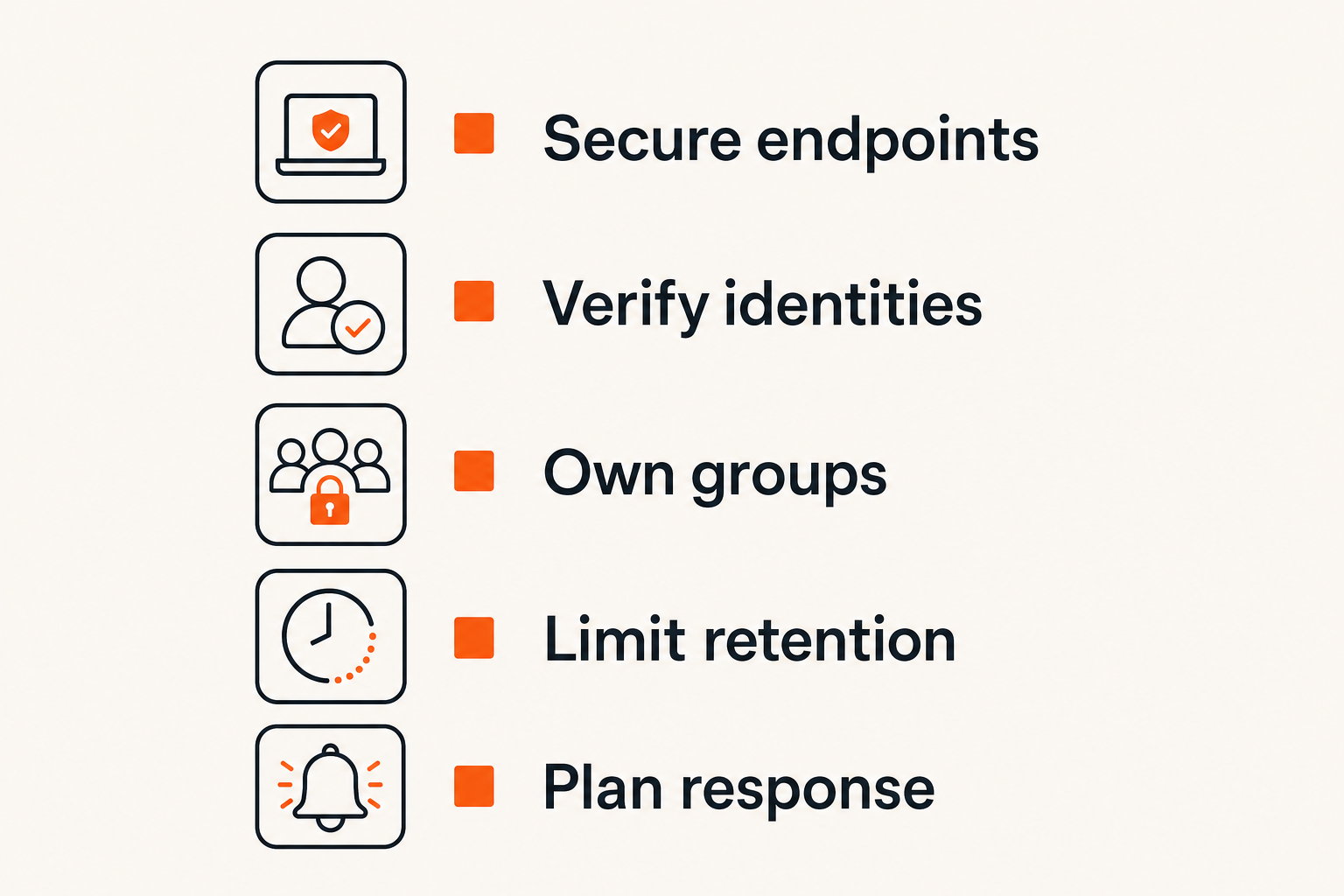
What works is narrower and more repeatable:
- A small set of communication classes.
- Clear rules for when verification is mandatory.
- Managed, updated endpoints for professional use.
- Neutral group names and limited membership.
- A fast lost-device reporting path.
- Expiration periods matched to actual response times.
- A separate governed location for durable decisions.
- Regular review of linked devices and high-risk groups.
These controls survive because they correspond to concrete moments in the workflow. “Maintain privacy” is abstract. “Reverify before discussing the incident after a device change” is actionable.
Measure behavior instead of installation
An organization should not claim success because everyone installed Signal. Useful review questions include:
- Can users explain what encryption does not protect?
- Do high-risk contacts complete independent verification?
- Are lost devices reported quickly?
- Are inactive group members removed?
- Are linked devices still authorized?
- Do durable decisions reach the system of record?
- Are identity changes investigated before sensitive conversation resumes?
Avoid collecting more message metadata than necessary to prove compliance. Training exercises, device-management posture, group-owner attestations, and incident reviews may provide assurance without centralizing private conversation content.
Post-quantum security and long-term confidentiality
Distinguish current protection from future risk
Some information only needs secrecy for a few days. Other information—source identities, health records, intellectual property, diplomatic material, or strategic plans—may remain sensitive for decades. An adversary could collect encrypted traffic now and attempt decryption later if cryptographic advances make that feasible.
Post-quantum readiness addresses part of that long-term risk. Messaging protocols have begun incorporating post-quantum components, but feature names and deployment details can change. Review current technical documentation and determine which stages use post-quantum algorithms: initial agreement, ongoing ratcheting, identity authentication, backups, or only selected paths.
Do not reduce the assessment to a “quantum-safe” badge.
Evaluate the complete cryptographic lifecycle
A hybrid design may combine established classical algorithms with post-quantum mechanisms so that breaking one family is insufficient to recover a key. The exact guarantee depends on composition, implementation, updates, and the protocol stage being protected.
Long-term confidentiality also depends on endpoints and retained copies. Post-quantum key agreement does not help if plaintext is stored in an unencrypted export, synchronized to an exposed desktop, or captured by malware.
The QryptChat security overview provides the relevant starting point for evaluating how post-quantum protection fits into an end-to-end encrypted messaging system rather than treating it as an isolated algorithm.
Ask vendors operational questions
Security professionals should ask:
- Which protocol stages use post-quantum cryptography?
- Is the design hybrid, and what happens if one component fails?
- How are identities authenticated across device changes?
- What metadata is retained and for how long?
- How are linked devices authorized and removed?
- What is the update path for algorithm or implementation changes?
- Can users verify contacts independently?
- How are security reports received and handled?
Good answers define boundaries and residual risks. Absolute claims deserve skepticism because messaging security always includes devices, users, availability, and implementation.
Choosing where Signal fits in your communication stack
Use a decision matrix instead of a feature list
Signal is often a strong choice for private interpersonal communication, but product fit depends on the operating environment.
| Requirement | Signal may fit well | Additional system may be needed |
|---|---|---|
| Private one-to-one chat | Yes, with endpoint discipline | High-assurance identity governance |
| Small sensitive groups | Yes, with active ownership | Automated enterprise lifecycle controls |
| Durable business records | Limited by design and workflow | Records or case-management platform |
| Anonymous communication | Reduces some exposure | Stronger identity and network separation |
| Long-term cryptographic resilience | Review current protocol state | Explicit post-quantum architecture assessment |
| Emergency coordination | Useful if available | Out-of-band contingency channel |
The correct answer may be multiple channels with clear boundaries. One product rarely optimizes privacy, retention, enterprise administration, anonymity, interoperability, and availability simultaneously.
Define boundaries with email and collaboration tools
Write down what belongs in each channel. For example, encrypted chat can handle time-sensitive confidential coordination; a ticket system can store approved incident findings; email can carry low-sensitivity external scheduling; a password manager can share credentials.
Users need a transfer rule when a conversation changes category. If a routine chat becomes a security incident, participants should know whether to create a case, establish a verified restricted group, or move to another approved system.
Contingency planning also matters. Maintain an independent way to reach key participants during an outage, account lockout, phone loss, or regional network disruption. Do not place the recovery instructions solely inside the unavailable channel.
Where qrypt.chat fits
qrypt.chat is relevant when users are evaluating private communication with explicit attention to end-to-end encryption and post-quantum cryptography. The useful comparison is architectural: identity establishment, key evolution, metadata exposure, endpoint behavior, device transitions, and long-term confidentiality.
This is not an argument to replace every communication system with one messenger. It is an invitation to compare designs against the information lifetime and adversary you actually face.
Signal provides a mature reference point for encrypted chat. qrypt.chat adds another option for people who want post-quantum considerations to be a first-class part of the evaluation. Test both against real workflows, including contact verification, device loss, group changes, and recovery—not only successful message delivery.
A practical deployment checklist
Baseline controls for individuals and teams
Use this minimum baseline before trusting Signal encrypted messaging with sensitive work:
- Define the protected information and expected adversary.
- Secure every participating phone and linked computer.
- Hide sensitive notification previews.
- Verify high-impact contacts through an independent channel.
- Pause after unexplained identity changes.
- Minimize group size and assign an owner.
- Select expiration based on operational need.
- Move required records into an approved system.
- Document the lost-device response path.
- Review membership and linked devices periodically.
- Maintain an independent contingency channel.
- Reassess cryptographic claims when protocols or products change.
Practical rule: If you cannot explain who owns verification, membership, retention, and incident response, you do not yet have a secure messaging system—you have an encrypted application.
Review the system when conditions change
A threat model is not permanent. Revisit it when a user changes roles, a team enters a higher-risk region, a device becomes unmanaged, a project becomes public, a platform changes registration behavior, or new cryptographic guidance appears.
Run short scenario tests. Ask what the team would do if an executive’s identity changed during an urgent request, a contractor retained a linked laptop, or an outage occurred during an incident. These exercises expose unclear ownership without requiring access to private message content.
Signal encrypted messaging works best when its protocol protections are supported by verified identities, hardened endpoints, limited retention, and realistic response procedures. That is the difference between having encryption and operating private communication.
Try qrypt.chat
You are writing for people who care about private communication, secure messaging, and practical digital security. Try qrypt.chat and evaluate encrypted messaging against your own threat model, devices, and long-term confidentiality requirements.