
A confidential conversation can be strongly encrypted and still fail in ordinary ways. A participant approves the wrong linked device. A disappearing message gets copied into a ticket. A phone number exposes an identity relationship. A departing contractor remains in a group for another week.
That is the practical problem with signal encrypted messaging in 2026. The cryptography is important, but most real exposure happens around the encrypted channel: endpoints, identities, notifications, membership, retention, and human behavior.
Teams think the problem is choosing an encrypted app. The real problem is operating a private communication system across people and devices that change over time. That changes the conversation from “Is Signal secure?” to “Which risks does Signal control, which risks remain ours, and how will we manage them?”
This guide treats Signal as part of a security architecture rather than a privacy badge. For a broader feature-level introduction, our earlier Signal encrypted messaging guide covers keys, devices, backups, metadata, and verification in more detail.
Table of contents
- Signal encrypted messaging is a system, not an app
- Start with a threat model
- How Signal encrypted messaging moves trust
- Identity and device verification
- Metadata, groups, and retention
- Build a team communication workflow
- What works and what fails in practice
- A practical Signal rollout sequence
- Post-quantum security and long-lived secrets
- Where qrypt.chat fits
Signal encrypted messaging is a system, not an app
Separate protocol security from operational security
Signal provides end-to-end encryption for conversations, calls, and supported message content. In normal use, message plaintext is intended to be available to conversation endpoints rather than the delivery service. The protocol also uses ratcheting mechanisms so that communication does not depend on one static session key forever.
That is protocol security. Operational security asks different questions:
- Was the correct person added to the conversation?
- Is every linked endpoint still under that person's control?
- Can lock-screen previews reveal content?
- Will media be exported into an unencrypted photo library?
- What happens when a user loses a device?
- Who removes a contractor from shared groups?
- Can the organization satisfy a legitimate retention obligation?
The mistake teams make is treating a strong protocol as evidence that all of these questions have been answered. It is not. Signal can substantially reduce interception and provider-access risks while leaving endpoint compromise, social engineering, physical coercion, screenshots, and participant misconduct in scope.
Practical rule: Treat end-to-end encryption as protection for data in transit between trusted endpoints, not proof that the endpoints or participants are trustworthy.
Define the communication boundary
Before adopting Signal, draw the boundary around the workflow. List who communicates, which devices they use, what information moves, and where that information goes afterward.
For a remote incident-response team, the boundary might include employee phones, linked desktops, a critical-response group, screenshots from monitoring systems, and follow-up records in a case platform. If a screenshot leaves Signal and enters a broadly accessible ticket, the private messenger protected only one segment of its lifecycle.
A useful boundary statement is short:
Signal is approved for time-sensitive internal coordination.
Final decisions move to the authorized system of record.
Secrets, recovery codes, and unredacted customer exports are prohibited.
Critical groups have a named owner and quarterly membership review.
The practical question is not whether Signal can carry a file. It is whether sending that file creates an unmanaged copy on devices you do not fully control.
Start with a threat model
Identify the adversary and consequence
“Private” means little without identifying private from whom. A journalist protecting a source, a family avoiding advertising surveillance, and a company coordinating a security incident have different adversaries and failure costs.
Start with plausible threats rather than cinematic ones:
- A network operator attempts to inspect message content.
- A service provider receives a legal demand.
- A thief obtains an unlocked or weakly protected phone.
- A former team member retains a linked desktop.
- A contact is impersonated during urgent outreach.
- Malware reads messages after decryption.
- A participant deliberately exports or photographs content.
- Future cryptanalytic capability targets captured traffic.
Then write the consequence: embarrassment, physical danger, account takeover, contractual exposure, or loss of customer trust. Severity determines whether Signal is sufficient, whether additional controls are needed, or whether the conversation should not happen digitally at all.
Map threats to controls
Not every privacy feature addresses every threat. The following matrix prevents category errors:
| Threat | Relevant control | Residual risk |
|---|---|---|
| Network interception | End-to-end encryption | Traffic patterns and compromised endpoints |
| Contact impersonation | Safety-number verification | Weak out-of-band verification |
| Stolen locked phone | Strong device lock, app controls, remote action | Notification previews and unlocked sessions |
| Old linked desktop | Device review and revocation | Delayed detection |
| Excess retention | Disappearing messages and deletion policy | Screenshots, exports, recipient copies |
| Provider data request | Data minimization and encrypted content | Some account and delivery metadata may remain |
| Malicious participant | Membership discipline and need-to-know groups | Authorized recipients can disclose content |
This table also shows why “military-grade encryption” language is unhelpful. It describes no operating decision. A control is useful only when connected to a threat, an owner, and a failure response.
Decide what Signal should not carry
A secure channel is not automatically the right repository. Passwords, seed phrases, long-lived private keys, identity documents, regulated records, and large customer datasets often require access logs, structured revocation, field-level controls, or formal retention that a messenger is not designed to provide.
Use a password manager for shared credentials, an approved file system for durable records, and a case-management platform for evidence that needs chain-of-custody controls. Signal can coordinate the work without becoming the permanent database for the work.
Practical rule: If information must be searched, audited, retained, approved, or revoked as a business record, store it in the system designed for that lifecycle.
How Signal encrypted messaging moves trust
Content encryption is the strong center
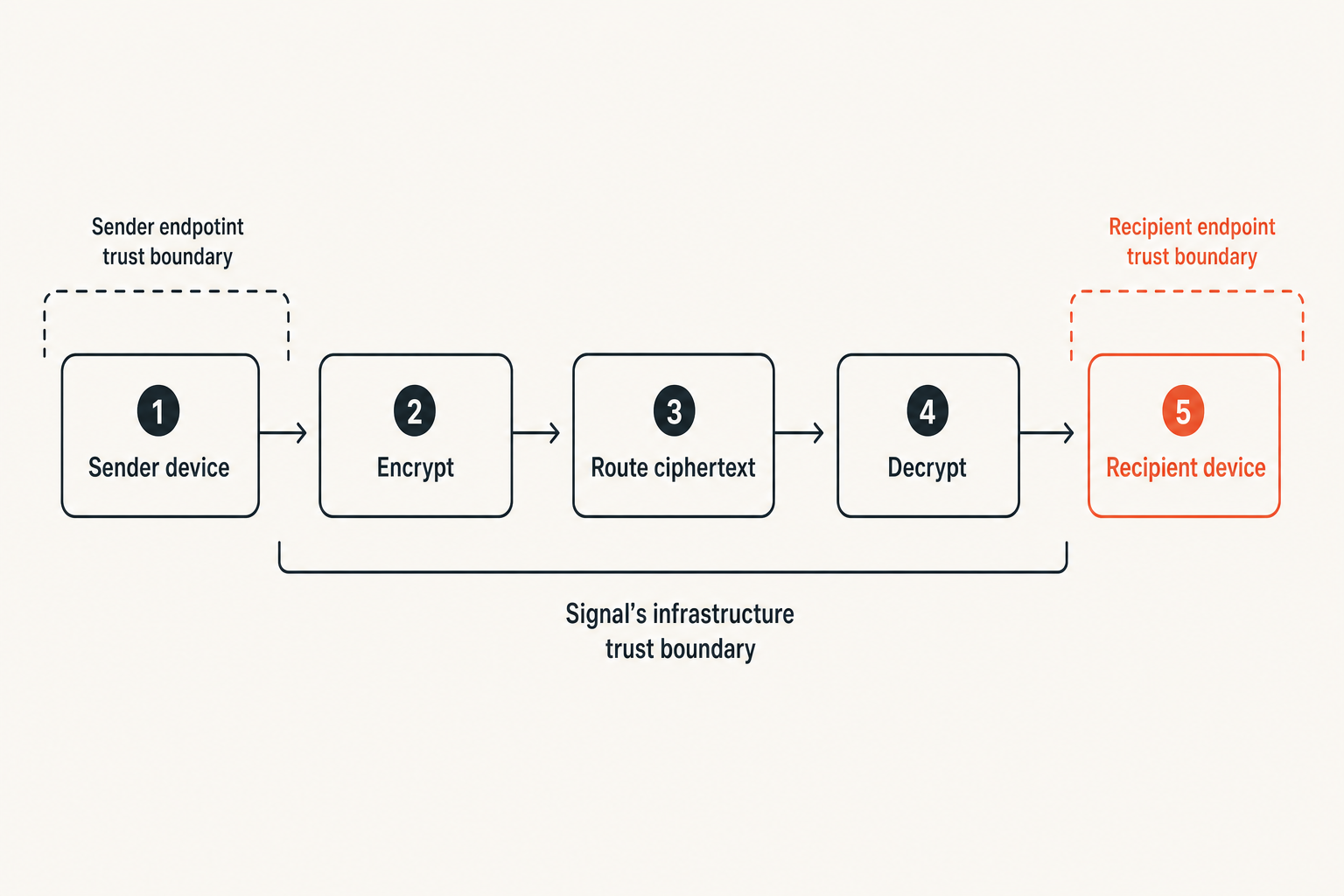
A simplified Signal message path looks like this:
- The sender's client establishes or updates cryptographic session state.
- The sender's device encrypts the message for the intended recipient endpoints.
- Signal's infrastructure routes ciphertext and handles delivery state.
- An authorized recipient endpoint receives and decrypts the content.
- Each endpoint applies local retention, notification, and storage behavior.
The service does not need message plaintext to route encrypted content. That materially changes the breach model compared with a conventional platform that stores readable conversations centrally.
However, simplified diagrams can hide the trust transfer. Removing the provider from the plaintext path increases the importance of client software, update integrity, device state, identity verification, and endpoint access. Encryption does not eliminate trust; it redistributes it.
Endpoints become the security perimeter
Once a message is decrypted, operating-system controls matter more than protocol marketing. Screen capture, accessibility services, keyboard software, notification synchronization, backups, desktop malware, and physical access can all expose readable content.
For higher-risk use, establish a device baseline:
- Supported operating-system versions with timely security updates
- Strong passcode or password rather than a simple swipe pattern
- Full-device encryption enabled where applicable
- Restricted lock-screen previews
- Reviewed biometric settings and coercion implications
- Minimal sideloaded software and unnecessary accessibility permissions
- A process for reporting loss, theft, and suspected compromise
- Routine review of linked Signal devices
Security professionals should resist building a policy that only hardened-device specialists can follow. If the baseline causes routine workarounds, the theoretical control will not survive production.
Delivery and recovery still need state
Messaging systems need queues, registration state, addressing, abuse controls, and retry behavior. End-to-end encryption minimizes what infrastructure can read; it does not make infrastructure stateless or immune to denial of service.
Recovery is similarly nuanced. Signal's backup and transfer capabilities can vary by platform, application version, and deployment stage. Any available encrypted backup should be treated as a separate security object with its own recovery secret, retention period, and loss scenario. Do not assume that installing Signal on a replacement phone will reproduce every conversation.
Test device migration before an emergency. Document what returns, what does not, and who is authorized to assist. A recovery method that nobody has rehearsed is not yet an operational control.
Identity and device verification
Usernames reduce exposure but do not prove identity
Signal usernames can help people initiate contact without broadly disclosing a phone number. That is useful data minimization, especially for public-facing users. Registration and account behavior may still involve a phone number, depending on current product requirements, and existing contacts may already know it.
More importantly, a username is an address, not proof of a real-world identity. An attacker can send a convincing handle through a compromised email account or social profile. For sensitive contact initiation, verify through an independent channel that was already trusted.
Examples include an in-person exchange, a known telephone call, an established corporate directory, or a signed public statement. Avoid “verification” through the same account that delivered the new Signal details; that merely repeats the original trust failure.
Safety numbers need an operating procedure
Safety numbers help participants verify that they are communicating with the expected endpoints. The feature matters most when the consequence of impersonation is high, but teams often either ignore it or demand verification for every casual exchange. Both approaches fail.
Use risk-based verification:
- Verify executives, administrators, journalists, sources, and incident leads before sensitive exchanges.
- Re-verify when identity or key-change warnings appear unexpectedly.
- Pause high-impact requests until verification is complete.
- Use a separate trusted channel for comparison.
- Record that verification occurred, but do not copy sensitive conversation content into the record.
Practical rule: Verification should be mandatory before irreversible actions such as transferring funds, disclosing credentials, changing access, or identifying a protected person.
A voice call within an unverified channel is not always independent verification. For high-risk actions, use a previously known number or another established route.
Linked devices require inventory
Desktop linking improves usability but expands the endpoint set. A forgotten laptop, shared workstation, or persistent desktop session can defeat careful phone security.
Users should review linked devices on a schedule and after travel, repair, device disposal, role changes, or suspicious activity. Organizations should define whether linking is permitted on personal computers and whether local disk encryption is required.
Device inventory does not need to become bureaucratic. A lightweight record can capture the user, device class, ownership, approval date, and review date without storing cryptographic secrets. The important point is ownership: someone must notice when an endpoint no longer belongs.
Metadata, groups, and retention
Encryption does not erase every relationship signal
Signal is designed to minimize accessible data and includes mechanisms intended to reduce sender information exposed during delivery. Still, any real-time communication service needs enough operational context to register accounts, route traffic, control abuse, and deliver messages.
Network observers may also infer timing, connection endpoints, IP information, or usage patterns under some conditions. A VPN can change which network party sees an originating address, but it transfers trust to another provider and does not make traffic invisible. Tor and similar systems introduce different usability and reliability tradeoffs.
The useful question is not “Does metadata exist?” It is “Which metadata could each party observe, how sensitive is it, and what additional control changes the risk?” Related reading from our network: privacy and reliability tradeoffs in cord-cutting workflows shows a similar pattern—changing delivery services does not remove the need to evaluate network visibility and operating reliability.
Group membership is an access-control problem
Encrypted group conversations are shared trust domains. Every legitimate member can read received content and may be able to preserve it outside the application. As groups grow, the chance of stale membership and accidental disclosure increases.
Use separate groups for separate purposes. A company-wide room, an incident command group, and a legal-response group should not collapse into one convenient channel. Review membership against role and current need, not social familiarity.
Group owners should handle:
- Approval of new members
- Verification requirements for sensitive groups
- Removal after departure or role change
- Periodic membership review
- Naming conventions that prevent misposting
- Escalation after a suspicious identity change
What breaks in practice is offboarding. Directory access may be removed immediately while independently managed messaging groups remain untouched. Include Signal groups in departure and contractor-completion checklists.
Disappearing messages are retention controls
Disappearing messages reduce routine accumulation on participating devices. They are useful hygiene, not remote destruction. A recipient can take a screenshot, copy text, export a file, photograph the screen, or preserve content using another compromised endpoint.
Choose timers by workflow. Fast-moving coordination may justify a shorter duration; decisions that need formal documentation should be moved into an authorized record before chat copies expire. Do not use disappearing messages to evade legitimate legal, safety, or contractual duties.
Related reading from our network: structured data and transaction workflows illustrates an adjacent principle: ephemeral communication can coordinate a process, but durable records belong in systems built for status, compliance, and reconciliation.
Build a team communication workflow
Classify conversations before sending
A practical policy uses a few understandable classes rather than a 20-level taxonomy. For example:
| Class | Example | Signal use |
|---|---|---|
| Routine | Scheduling, non-sensitive coordination | Allowed |
| Confidential | Internal plans, incident coordination | Allowed with approved devices |
| Restricted | Credentials, private keys, bulk personal data | Prohibited or tightly exception-based |
| Record-required | Approvals, case evidence, formal decisions | Coordinate in Signal; record elsewhere |
The classification must answer what the sender does next. Labels without routing rules become policy wallpaper.
A small configuration-style policy can make expectations concrete:
signal:
  routine: allowed
  confidential:
    allowed: true
    verified_contacts: required_for_high_impact_actions
    disappearing_messages: 7d
  restricted: prohibited
  record_required:
    chat_allowed: coordination_only
    system_of_record: required
This is illustrative rather than a Signal configuration file. Its value is forcing explicit decisions that can be reviewed and tested.
Assign owners for groups and incidents
Each sensitive group needs a business owner, not merely the person who happened to create it. Owners review membership, resolve verification warnings, and close or archive the workflow when its purpose ends.
Incident procedures also need an alternate path. If a device is suspected of compromise, the affected user should not continue discussing the compromise from that device. Define a known telephone number, in-person contact, or separate approved system for emergency reporting.
Security operations teams face the same ownership problem when automating alerts: tools do not resolve ambiguity about who investigates and acts. Related reading from our network: SOC automation pricing and workflow coverage is useful because it evaluates operational effort and integrations rather than treating software purchase as the outcome.
Control files and external handoffs
Files are where secure messaging frequently leaks into ordinary storage. A recipient may download an attachment, open it in another application, sync it to cloud storage, or leave it in a desktop downloads directory.
Set simple rules:
- Redact exports before sending.
- Prefer purpose-built secure file exchange for large or durable documents.
- Avoid sending credentials in the same channel as account identifiers.
- Remove location and document metadata when it creates risk.
- Define where approved records must be moved.
- Delete temporary local copies when the workflow ends.
Freelancers and agencies have an especially difficult boundary because client-owned and personal devices overlap. The encrypted messaging workflow for client work provides a practical model for access, file handling, and project handoff.
What works and what fails in practice
Compare managed habits with privacy theater
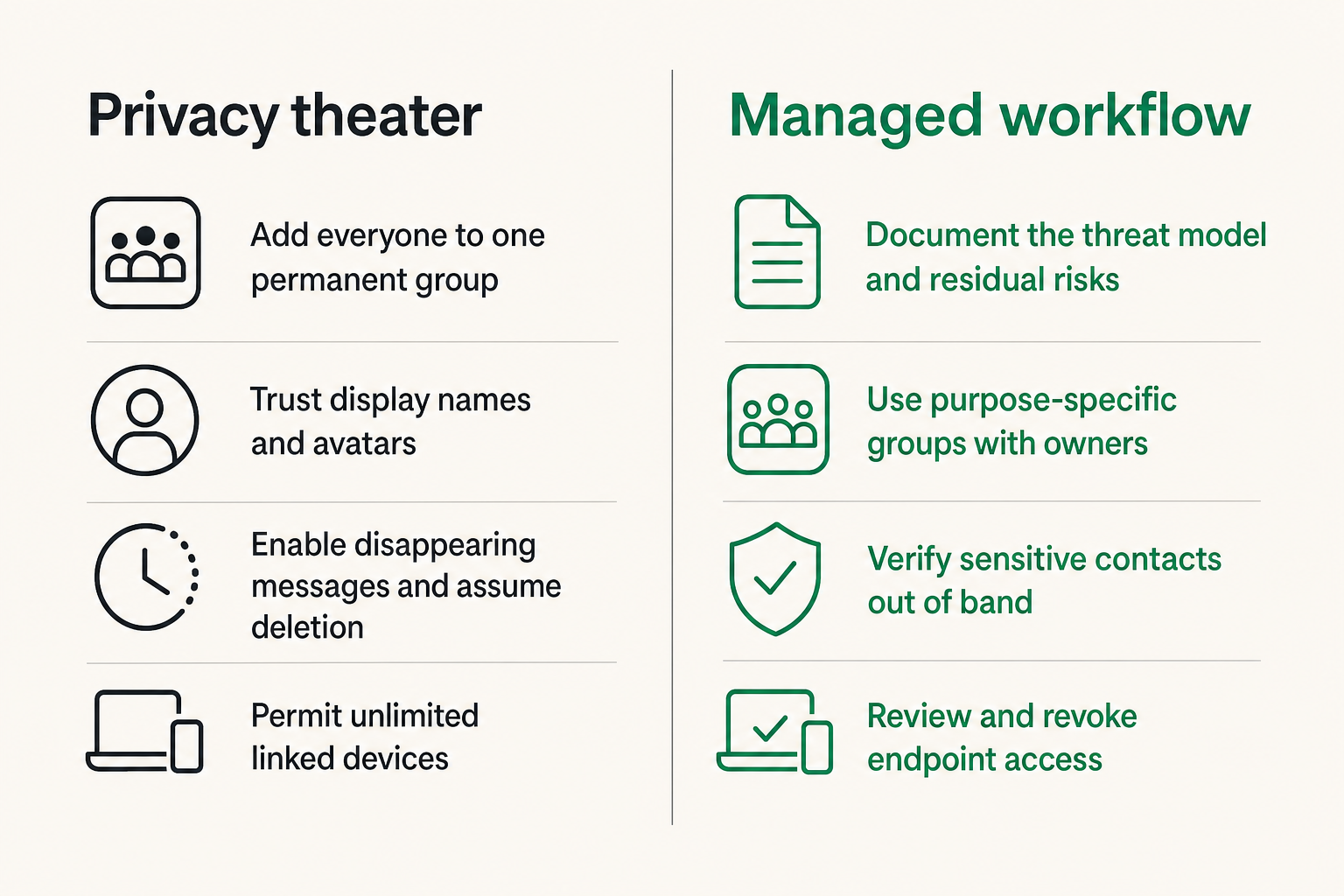
The difference between a resilient deployment and privacy theater is usually mundane operational discipline.
| Privacy theater | What works |
|---|---|
| “We use Signal, so the conversation is secure” | Document the threat model and residual risks |
| Add everyone to one permanent group | Use purpose-specific groups with owners |
| Trust display names and avatars | Verify sensitive contacts out of band |
| Enable disappearing messages and assume deletion | Treat timers as accumulation reduction only |
| Permit unlimited linked devices | Review and revoke endpoint access |
| Send every sensitive file through chat | Route durable or regulated data to appropriate systems |
| Improvise after a lost phone | Rehearse loss, recovery, and compromise procedures |
The mistake teams make is optimizing the visible control—the app icon—while neglecting invisible state such as linked devices, stale membership, exported files, and recovery secrets.
Recognize common failure modes
Common implementation failures include:
- No onboarding verification. Employees join a group using details forwarded through an untrusted channel.
- Weak offboarding. Former workers lose corporate accounts but remain in independent chat groups.
- Notification leakage. Sensitive text appears on lock screens, watches, cars, or desktop notification centers.
- Device mixing. Personal family devices and work endpoints share backups, photo libraries, or desktop sessions.
- Unclear record handling. Decisions disappear before being transferred to the official record.
- Recovery assumptions. A lost phone causes unexpected loss of history or access.
- Urgency bypass. An attacker impersonates leadership and uses time pressure to prevent verification.
- Overbroad trust. Membership in one project group becomes informal authorization for unrelated information.
A good procedure addresses these failures before debating advanced cryptography. None of them makes protocol improvements irrelevant. They simply occur at a different layer.
Avoid shadow archives
When users need search, continuity, or auditability that the approved workflow does not provide, they create shadow archives. They forward messages to email, take screenshots, copy text into personal notes, or keep files indefinitely.
This is a product and policy signal. Ask why the archive appeared. Perhaps the disappearing-message timer is too short, the official record system is cumbersome, or users do not know where decisions belong. Prohibition without a usable alternative pushes the behavior underground.
The answer is not necessarily longer chat retention. It may be a one-click template for recording a decision without copying the entire conversation. Preserve the business outcome while minimizing unnecessary conversational context.
A practical Signal rollout sequence
Implement the minimum viable policy
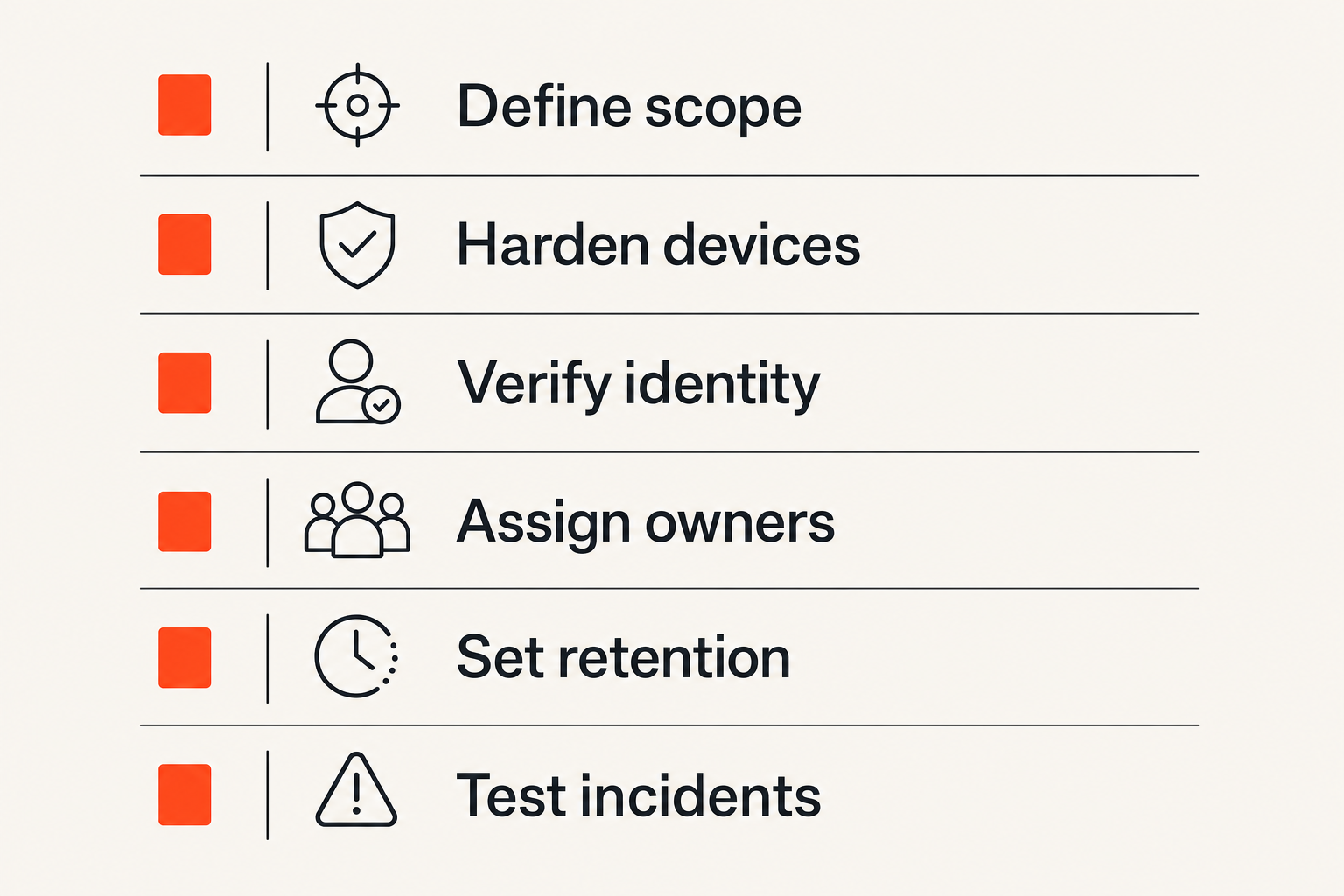
Rollout should move from threat model to tested behavior. A workable sequence is:
- Define scope. Name approved users, devices, conversation classes, and prohibited data.
- Set the device baseline. Require updates, strong locks, encrypted storage, and controlled notifications.
- Create identity procedures. Specify when safety-number or out-of-band verification is mandatory.
- Design groups. Assign owners, purpose, membership criteria, and review intervals.
- Choose retention behavior. Set disappearing-message guidance and identify systems of record.
- Document incidents. Cover loss, suspected compromise, unexpected key changes, and malicious contact.
- Pilot with a small group. Observe actual friction before organization-wide deployment.
- Train through scenarios. Practice verification, offboarding, file handling, and device replacement.
- Review periodically. Adjust policy when product behavior, platforms, or threats change.
Practical rule: A secure-messaging rollout is complete only when users can handle identity changes, device loss, offboarding, and record transfer without improvising.
Keep the first policy short. A two-page procedure people can apply is more useful than an exhaustive document nobody consults during an urgent conversation.
Test normal and abnormal events
The pilot should test more than successful message delivery. Use a small scenario table:
| Event | Expected action |
|---|---|
| New executive contact | Verify through established channel before sensitive discussion |
| Unexpected identity change | Pause high-impact requests and re-verify |
| Lost phone | Report through alternate route; assess sessions and group exposure |
| Departing contractor | Remove from groups and review shared files |
| New desktop link | Confirm device ownership and local security baseline |
| Formal decision in chat | Transfer decision to authorized record system |
Do not collect sensitive message content as evidence that the test passed. Record whether the procedure was followed, how long it took, and where users became confused.
Measure workflow health
Secure messaging does not need invasive employee surveillance to be managed. Use process-level measures rather than conversation inspection:
- Percentage of sensitive groups with a named owner
- Membership reviews completed on schedule
- Time to remove a departing user from relevant groups
- Percentage of high-risk participants completing verification
- Number of unreviewed linked-device exceptions
- Time to report a lost or compromised device
- Rate of successful recovery exercises
- Frequency of prohibited data-handling incidents
Metrics should reveal control gaps, not create a centralized map of private conversations. Collect the minimum needed to operate the policy. If measurement itself creates a sensitive relationship graph, redesign it.
Post-quantum security and long-lived secrets
Understand what post-quantum protection changes
The post-quantum concern is not that a general-purpose quantum computer is known to be reading Signal messages today. The concern is long-lived confidentiality: an adversary may capture encrypted traffic now and attempt decryption later if cryptographic capabilities change.
Signal has publicly introduced post-quantum protections into parts of its protocol evolution. Exact coverage, migration state, client requirements, and implementation details can change, so high-assurance users should verify current technical documentation rather than relying on old feature summaries.
Post-quantum mechanisms do not fix malware, screenshots, weak verification, exposed notifications, or malicious recipients. They address a cryptographic threat class. That distinction matters because “quantum-safe” can otherwise become the next version of “encrypted means secure.”
Evaluate the complete cryptographic lifecycle
For secrets that must remain confidential for many years, ask:
- Does post-quantum protection apply to initial key establishment, ongoing sessions, or both?
- What happens when one participant runs an outdated client?
- How are protocol transitions authenticated?
- Are backups and exported files protected to the same standard?
- Can downgrade or compatibility behavior weaken the intended protection?
- How quickly are vulnerable endpoints updated or revoked?
- Is the implementation documented and open to meaningful scrutiny?
QryptChat describes its focus on quantum-resistant encrypted messaging, which is relevant when long-term confidentiality is a design requirement rather than a marketing checkbox. Evaluate that claim alongside endpoint controls, identity, metadata, recovery, and software maintenance.
The useful way to think about cryptographic agility is operational: can the system replace algorithms and migrate users without silently abandoning old devices or exposing conversation state?
Where qrypt.chat fits
Choose architecture before branding
Signal is a strong option for many personal and team conversations, particularly when default end-to-end encryption, broad availability, and a mature user experience matter. It is not necessary to dismiss Signal to ask whether another architecture better fits a specific threat model.
Compare secure messengers on the complete workflow:
- Addressing and identity exposure
- Initial and ongoing key agreement
- Multi-device trust
- Metadata minimization
- Group administration
- Backup and recovery boundaries
- Post-quantum design
- Open implementation and reviewability
- Update and vulnerability response
- User experience under real pressure
The best tool is the one whose trust assumptions match the consequence of failure and whose controls users can operate consistently.
Use multiple channels deliberately
Some teams will use Signal for broad external reach and another encrypted platform for a narrower high-sensitivity community. That can work if channel boundaries are explicit. It fails when users copy entire conversations between tools, cannot remember which channel is authoritative, or assume contacts have been equally verified everywhere.
Define what each channel is for, how identities are introduced, where records belong, and how incidents cross channel boundaries. Avoid automatic bridges that decrypt and re-encrypt messages through an intermediary unless that trust change is intentional and documented.
In closing, signal encrypted messaging should be evaluated as an architecture and operating workflow, not just an application choice. Strong encryption establishes the protected core. Device security, verification, metadata decisions, group ownership, retention, and recovery determine whether that protection survives daily use.
Try qrypt.chat
You are writing for people who care about private communication, secure messaging, and practical digital security. Explore a quantum-resistant approach to encrypted communication at Try qrypt.chat.